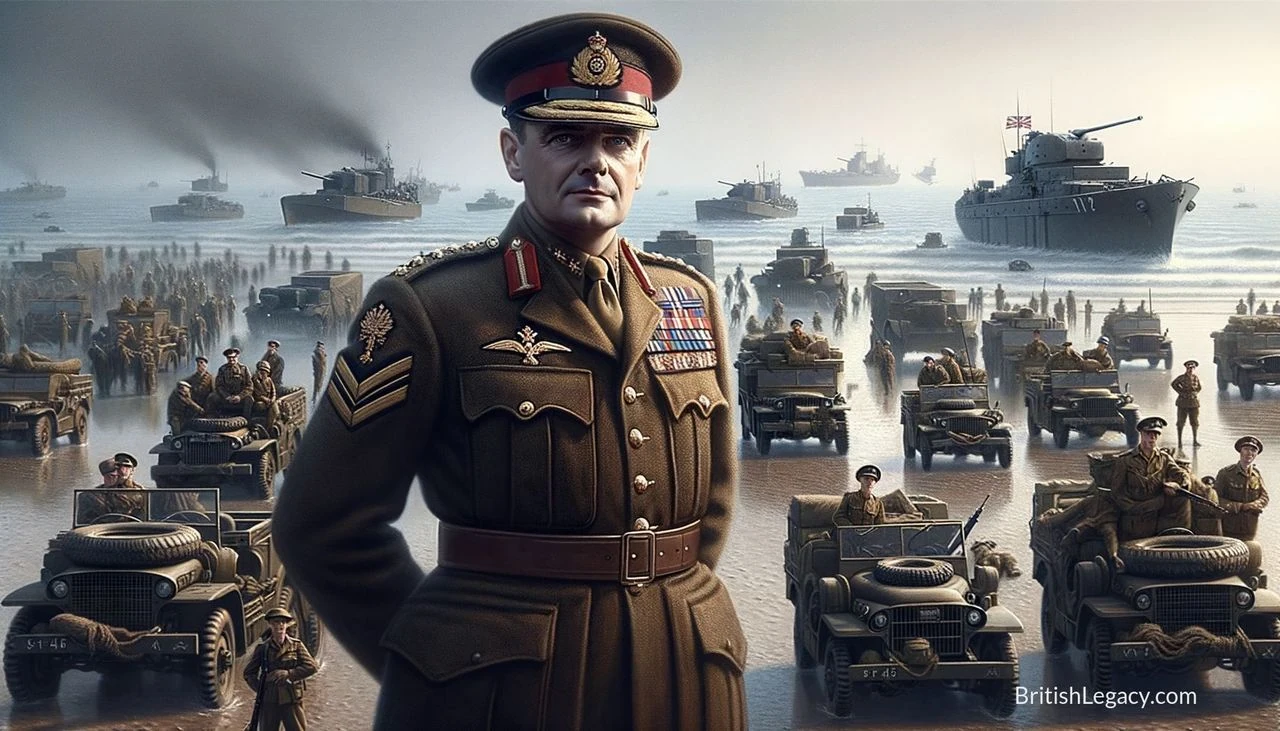
General Sir Miles Dempsey commanded the British Second Army in north-west Europe from the Normandy landings in June 1944 to the crossing of the Rhine in March 1945. He was a senior officer in a campaign fought by Allied forces, not a lone architect of victory. His achievement lay in directing a vast army through difficult operations while working closely with other British, Canadian and American commands. Modest and uncomfortable with publicity, he remained less familiar to the public than some of his contemporaries.
From Sandhurst to the Western Front
Miles Christopher Dempsey was born in New Brighton, Wallasey, Cheshire, on 15 December 1896. He attended Shrewsbury School, where he captained the first cricket eleven in 1914, and entered the Royal Military College, Sandhurst, that October. He graduated in February 1915 and was commissioned as a second lieutenant in the Royal Berkshire Regiment.
From June 1916, Dempsey served with the regiment on the Western Front. He saw action at Delville Wood and the Battle of Cambrai, and was adjutant and company commander. In March 1918, a German gas attack wounded him and led to his evacuation to England; he later returned to the battalion for the Hundred Days Offensive. He was mentioned in despatches and awarded the Military Cross.
After the war, his service took him to Iraq during the revolt of 1920, to Iran as part of the British presence during the Russian Civil War, and to India. He returned to Britain for a post at Sandhurst and later attended the Staff College at Camberley, graduating in 1931. He played cricket for Sussex and Berkshire, and sport remained part of his life alongside military study. Before the Second World War, he held staff appointments and commanded the 1st Battalion, Royal Berkshire Regiment.
Learning command in the Second World War
Dempsey took the 13th Infantry Brigade to France with the British Expeditionary Force in 1939. During the retreat in 1940, the brigade fought in the defence of the River Scarpe and at the Ypres–Comines Canal, then helped cover the withdrawal to Dunkirk. For his service in France, Dempsey received the Distinguished Service Order. He subsequently trained troops in Britain and commanded infantry and armoured formations, gaining experience in preparing units for combined operations.
In December 1942, he became commander of XIII Corps in the Eighth Army. He took part in the planning and execution of the Allied invasion of Sicily in July 1943, followed by the landing in mainland Italy. During planning for Sicily, he objected to the proposed dispersal of the landings, arguing that forces should be able to support one another if the enemy response proved strong. The plan was revised after senior commanders considered these concerns. In Italy, XIII Corps advanced north through difficult terrain, where the Germans’ destruction of bridges and routes slowed the advance.
These campaigns established Dempsey’s experience in coordinating forces and prepared him for a much larger command. In January 1944, he set up Second Army headquarters in London and worked with naval and air-force counterparts to plan the assault on Normandy. The Second Army landed at Gold, Juno and Sword beaches on 6 June. Dempsey went ashore that evening and established a mobile tactical headquarters in Normandy, allowing him and his staff to remain close to the campaign as it developed.
Normandy, Belgium and the Rhine
The battle for Caen became a costly struggle against determined German resistance. The fighting drew substantial German forces, including armoured units, to the eastern part of the Allied front while the American First Army prepared its breakout farther west. Dempsey’s Operation Goodwood, launched in July, made a costly advance but also applied pressure to German reserves. The operation did not achieve a breakthrough, and Dempsey’s tactics and the difficulties of coordinating infantry and armour formed part of the campaign’s complicated record. The subsequent American Operation Cobra began after a delay and broke through farther west.
After the breakout, the Second Army advanced across northern France and into Belgium. It liberated Brussels on 3 September 1944, and Allied troops entered Antwerp the following day. Dempsey questioned whether Montgomery’s plan for Operation Market Garden was likely to succeed and proposed an alternative crossing of the Maas and Rhine. He nevertheless took part in the operation, which began on 17 September. Unexpected German resistance prevented the Allies from securing their final objective at Arnhem, and the operation was terminated.
In March 1945, Dempsey’s army crossed the Rhine in Operation Plunder. He was the first British commander to cross the river during the operation. The Second Army then advanced into Germany. In May, its forces captured Bremen and Kiel; Dempsey also negotiated the surrender of the Hamburg garrison. A delegation of senior German officers came to his headquarters seeking to surrender to Montgomery, and Dempsey sent them on to the 21st Army Group commander. Dempsey received British and Allied honours for his service in north-west Europe.
Service after Europe and a quieter life
After the war in Europe ended, Dempsey took command of the Fourteenth Army in the Far East. He oversaw the repatriation of prisoners of war and dealt with the transition that followed Japan’s surrender. He later became Commander-in-Chief, Allied Land Forces, South East Asia, and in 1946 took command in the Middle East, where his responsibilities included the Greek Civil War and the Palestine Emergency. He retired from the Army in 1947, although he later held a shadow appointment as Commander-in-Chief, Home Forces, which he relinquished in 1956.
Dempsey’s post-war life included a substantial interest in horse racing. He bred and raced horses and chaired the Racecourse Betting Control Board from 1947 to 1951. In 1948, he married Viola O’Reilly, and they settled in Berkshire. He also held business and ceremonial appointments, including service as colonel of the Royal Berkshire Regiment. He declined to write memoirs and ordered that his diaries be burned, though some papers survived in archives.
In 1950, Dempsey lobbied for the Special Air Service to remain a permanent part of the Army; it achieved that status in 1950. He was advanced to Knight Grand Cross of the Order of the British Empire in the 1956 New Year Honours. He died at his home in Yattendon, Berkshire, on 5 June 1969, and was buried in the churchyard there. In Singapore, Dempsey Road and Dempsey Hill preserve his name at the former site of Tanglin Barracks.
Why General Sir Miles Dempsey deserves a place in British Legacy
Dempsey’s place in British history rests on a substantial record of command across two world wars and the difficult transitions that followed them. In 1944 and 1945, he led the Second Army through the Normandy campaign, the advance into Belgium, the failed attempt to reach Arnhem, and the Rhine crossing. These operations depended on the work of soldiers and commanders across Allied forces. Dempsey’s contribution was to direct a major British army within that coalition, adapting his command to a rapidly changing front rather than claiming success for himself alone.
His earlier service also helps explain the breadth of that achievement. From the Western Front in the First World War to Sicily and Italy, he gained experience in different forms of warfare and in coordinating large formations. His objections during the planning for Sicily and his doubts about Market Garden show that he was willing to question plans, even when the final decision lay with a superior commander. After the war, he took responsibility in the Far East and Middle East, and his lobbying helped secure the SAS’s permanent place in the Army. His later connections with the Royal Berkshire Regiment and Berkshire, alongside the Singapore place names that bear his name, mark the British military and local settings in which his career was rooted. Remembering Dempsey adds a useful perspective to the history of Allied victory: one of its leading British commanders was effective without seeking the spotlight.
Sources
Miles Dempsey — Wikipedia revision · Miles Dempsey — Wikipedia
Adapted in part from Miles Dempsey by Wikipedia contributors, under CC BY-SA 4.0. Text has been edited and combined with the existing article; this adapted text is shared under the same licence. Contributor history.