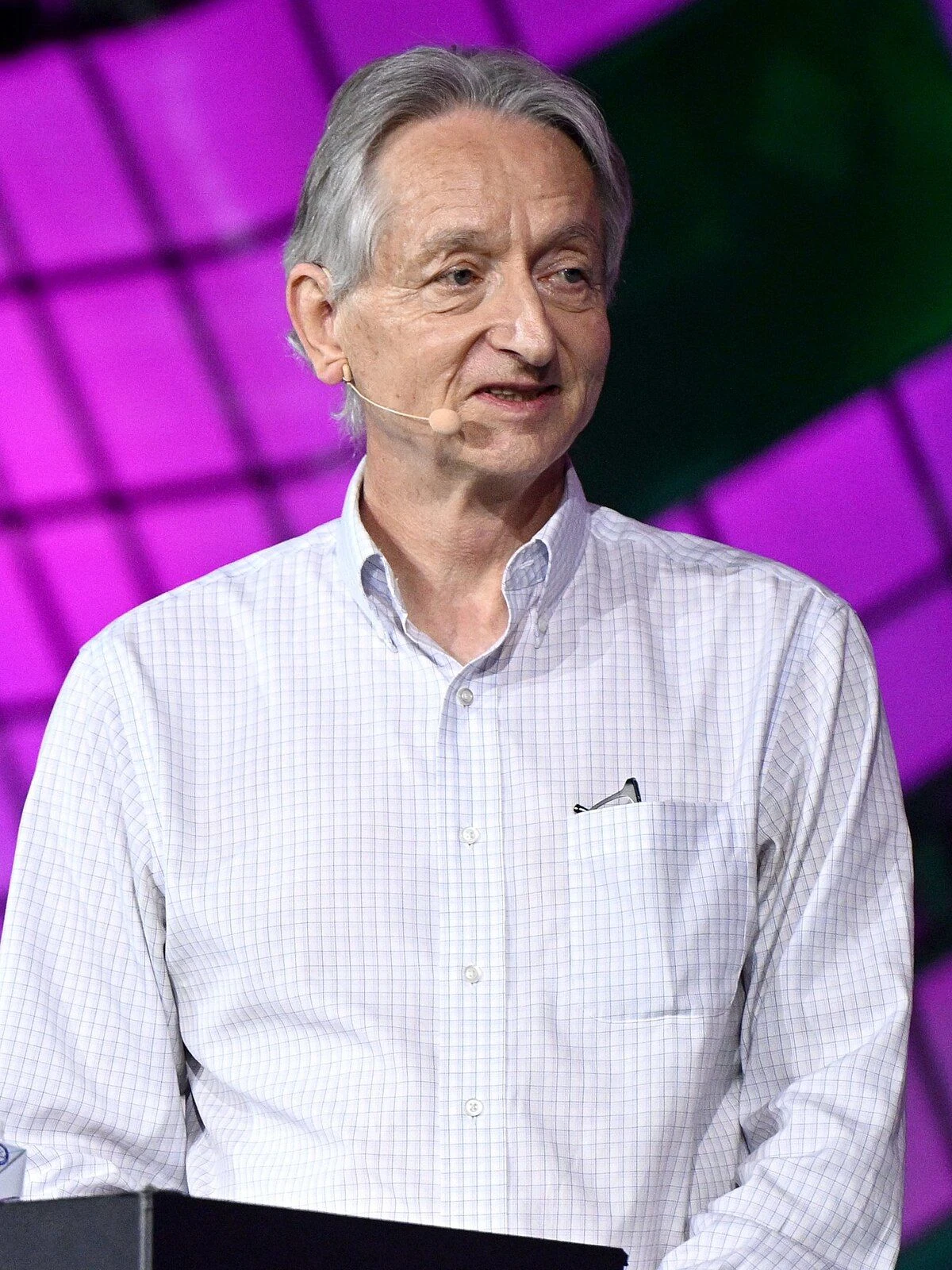
Geoffrey Hinton’s work helped move artificial neural networks from a contested research approach towards the foundations of modern machine learning. Born in London and educated at Cambridge and Edinburgh, he later built most of his career in North America. His story connects British scientific education with an international research community—and with a scientist who, after decades advancing artificial intelligence, began warning publicly about its risks.
From Wimbledon to Cambridge and Edinburgh
Geoffrey Everest Hinton was born in Wimbledon, London, on 6 December 1947. He attended Clifton College in Bristol before going to King’s College, Cambridge, in 1967. His undergraduate studies ranged across natural sciences, art history and philosophy before he graduated in experimental psychology in 1970. After spending a year apprenticed in carpentry, he returned to academic study.
From 1972 to 1975, Hinton studied at the University of Edinburgh. He received his PhD in artificial intelligence in 1978, for research supervised by Christopher Longuet-Higgins. The contrast between that work and his later influence is striking: Longuet-Higgins favoured symbolic artificial intelligence, while Hinton’s research became closely associated with neural networks, which learn patterns from data rather than relying solely on explicitly programmed rules.
After his doctorate, Hinton worked at the University of Sussex and the MRC Applied Psychology Unit. Difficulty securing funding in Britain contributed to his move to the United States, where he worked at the University of California, San Diego, and Carnegie Mellon University. His career would cross several countries, but British education and early research remained important parts of its formation.
Keeping neural networks in the conversation
In the 1980s, Hinton was part of the Parallel Distributed Processing group at Carnegie Mellon University. Its members pursued a connectionist approach to artificial intelligence: the idea that abilities such as recognising patterns, using language and handling concepts could emerge from networks of connected units learning from data. This approach competed with systems built around explicit rules, and its advocates continued to develop it during a period often called the AI winter.
Hinton’s work included research into distributed representations, in which information is carried across patterns of activity rather than assigned to one isolated symbol. In 1985, he co-invented the Boltzmann machine with David Ackley and Terry Sejnowski. He and his collaborators also developed work on topics including time-delay neural networks, mixtures of experts, Helmholtz machines and product of experts. These projects formed part of a wider effort to understand how networks could learn, represent information and process it.
Backpropagation became one of the best-known methods associated with this research. In a 1986 paper, Hinton, David Rumelhart and Ronald J. Williams helped popularise its use for training multi-layer neural networks. The method adjusts a network’s connections in response to error, helping it learn useful internal representations. It is important, though, not to mistake popularising an approach for inventing it: Hinton later credited Rumelhart with the basic idea, and earlier proposals for backpropagation and related methods predated their paper.
Hinton’s research extended beyond that contribution. He and colleagues proposed the wake-sleep algorithm in 1995, using alternating phases of recognition and generation to train a network. In 2008, he developed the visualisation method t-SNE with Laurens van der Maaten. Later projects included capsule neural networks, intended to represent relationships between parts and whole objects, and GLOM, a speculative architecture for image understanding. In 2022, he introduced the Forward-Forward algorithm, which uses two forward passes in place of the conventional forward-and-backward sequence of backpropagation.
AlexNet and the deep-learning shift
Hinton’s long-running work on neural networks gained a much wider profile through AlexNet. In 2012, his graduate students Alex Krizhevsky and Ilya Sutskever collaborated with him on the image-recognition system, which won the ImageNet challenge. Its result marked a breakthrough in computer vision and helped demonstrate the potential of deep neural networks for demanding recognition tasks.
The achievement belonged to a larger research effort, not to one person working alone. Hinton’s contribution sat alongside the work of students and collaborators, while the result helped draw greater attention to deep learning. Networks with multiple layers could learn complex patterns from data; AlexNet’s performance made that approach harder for researchers and technology companies to overlook.
Hinton taught a free online course on neural networks in 2012 and co-founded DNNresearch with Krizhevsky and Sutskever that year. Google acquired the company in 2013, and Hinton divided his time between the University of Toronto and Google Brain. He had been affiliated with the University of Toronto since 1987, apart from his period at University College London from 1998 to 2001. At UCL, he was founding director of the Gatsby Charitable Foundation Computational Neuroscience Unit.
He also helped build research communities. Hinton became a fellow of the Canadian Institute for Advanced Research in 1987 and later helped establish its Neural Computation and Adaptive Perception programme, subsequently known as Learning in Machines & Brains. He led the programme for ten years. Among its members were Yoshua Bengio and Yann LeCun, with whom he later shared the Turing Award.
Recognition and a change in emphasis
Hinton’s awards recognised both the influence and the reach of his work. He received the first Rumelhart Prize in 2001. In 2018, he shared the ACM A.M. Turing Award with Bengio and LeCun for conceptual and engineering breakthroughs that made deep neural networks a critical part of computing. In 2024, he and John Hopfield received the Nobel Prize in Physics for foundational discoveries and inventions enabling machine learning with artificial neural networks; the citation specifically noted Hinton’s development of the Boltzmann machine.
His honours also include election as a Fellow of the Royal Society in 1998 and as a Fellow of the Royal Society of Canada in 1996. He was made a Companion of the Order of Canada in 2018. These distinctions reflect a career rooted in research but shaped by institutions and collaborators in Britain, the United States and Canada.
In May 2023, Hinton announced that he was leaving Google so he could speak freely about the risks of artificial intelligence. He has raised concerns about malicious use, the effects of automation on employment and the possibility that increasingly capable systems could become difficult to control. After receiving the Nobel Prize, he called for urgent research into AI safety. His public position does not erase his research achievements; it adds a consequential question about how the technologies he helped advance should be governed.
Why Geoffrey Hinton deserves a place in British Legacy
Geoffrey Hinton’s British connection is specific and consequential. He was born in Wimbledon, educated at Clifton College, studied experimental psychology at Cambridge and completed his doctoral research at Edinburgh. Those early stages preceded a career that became international, but they form a clear part of the education and intellectual development behind his work. His story also shows how scientific achievement crosses borders: research begun in Britain continued in the United States and Canada, where universities and collaborative programmes gave neural-network research room to grow.
His place in British Legacy rests not on a claim that one person invented modern artificial intelligence, but on the documented contribution he made to a collective transformation. Hinton helped popularise backpropagation for multi-layer networks, co-invented the Boltzmann machine, and worked with students whose AlexNet system helped demonstrate the power of deep learning in image recognition. His teaching and research leadership also helped train and connect researchers. The consequences of this work are global, while the educational beginnings are British. His later warnings about AI’s risks add another dimension: scientific leadership includes considering the effects of powerful technologies, not only advancing them.
Sources
Geoffrey Hinton — Wikipedia, revision 1378627080
Adapted in part from Geoffrey Hinton by Wikipedia contributors, under CC BY-SA 4.0. Text has been edited and combined with the existing article; this adapted text is shared under the same licence. Contributor history.