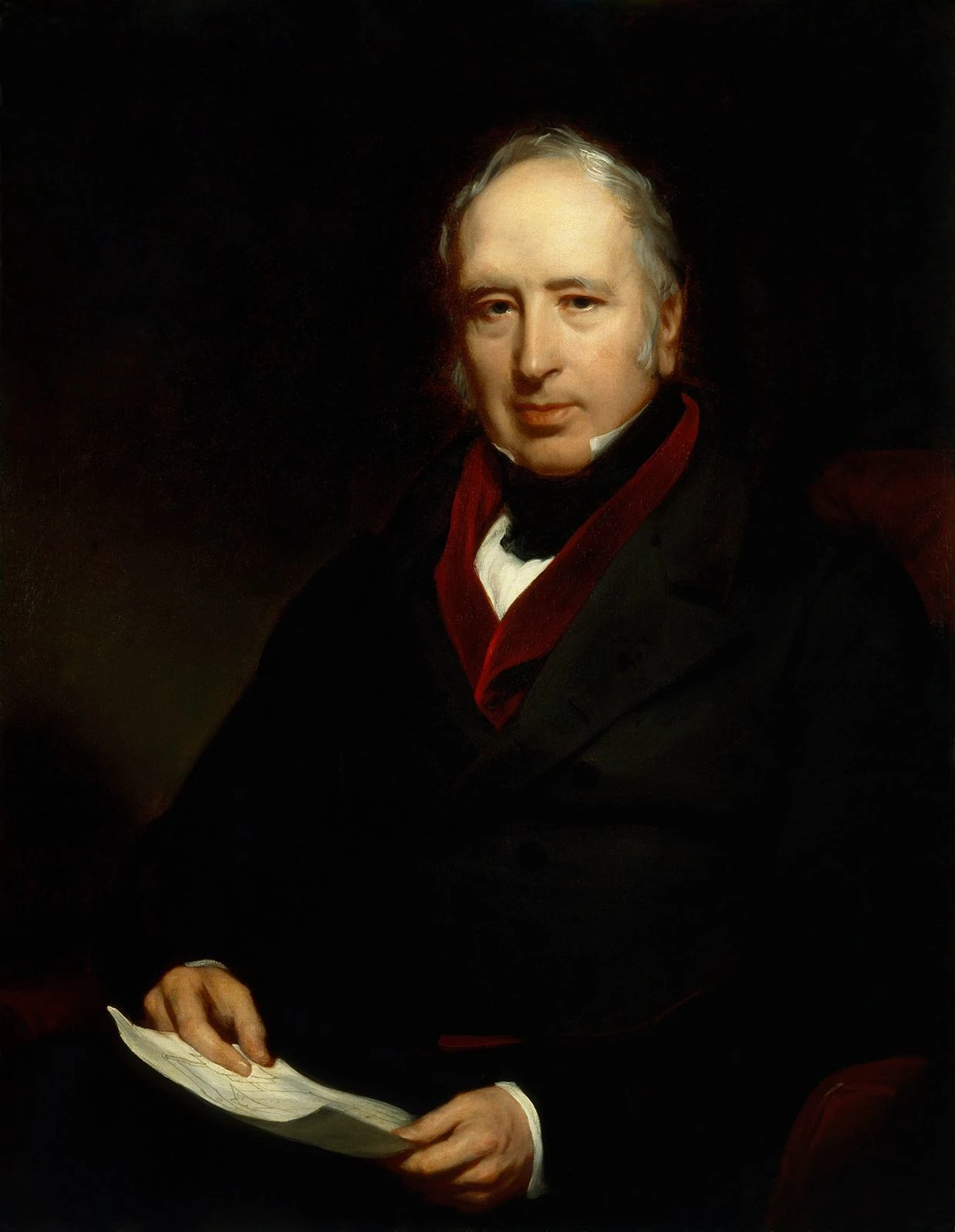
Before powered flight, George Cayley set out how a heavier-than-air machine might stay aloft and be controlled. He treated lift, propulsion and control as distinct functions, developed a cambered wing and built models and gliders to test his ideas. His work did not produce a powered aeroplane, but it gave later designers a practical framework for understanding flight.
A Yorkshire engineer with broad interests
Cayley was born in Scarborough on 27 December 1773 and died at Brompton, Yorkshire, on 15 December 1857. He was the sixth baronet and inherited estates including Brompton Hall and Wydale Hall. His interests extended well beyond aeronautics: across his life he worked on engineering problems involving transport, machinery, buildings and land.
His public life connected him to education and scientific organisations. Cayley represented the Whig party as Member of Parliament for Scarborough from 1832 to 1835. In 1838 he helped found the Royal Polytechnic Institution, now the University of Westminster, and served as its chairman for many years. He was also a founding member of the British Association for the Advancement of Science and a vice-president of the Yorkshire Philosophical Society.
In 1799, Cayley described the outline of a modern aeroplane: a fixed wing to provide lift, a separate means of propulsion and a system of control. He recognised that sustained flight depended on an engine light enough to provide the necessary thrust. This was a statement of the engineering problem, not a claim that he had already solved powered flight.
Testing the theory in models and gliders
A model flown in 1804 had a wing towards the front and an adjustable tail at the rear, including horizontal stabilisers and a vertical fin. A movable weight allowed its centre of gravity to be adjusted. These features made the model more than a sketch of a flying machine: they let Cayley investigate the relationship between shape, balance and control.
He studied the forces affecting an aircraft—weight, lift, drag and thrust—and developed an efficient cambered aerofoil. To investigate drag at different speeds and angles, he built a whirling-arm apparatus, developing earlier work on ballistics and air resistance. He also experimented with rotating wing sections and considered the elements of vertical flight. His work on lateral stability included the dihedral angle; on many models, he placed the centre of gravity below the wings to help maintain balance.
Cayley’s aviation writing included the three-part treatise On Aerial Navigation, published in 1809–10. Sketches found in his school notebooks in 2007 have been taken as evidence that he was developing ideas about flight at a young age. The precise conclusions to draw from those drawings are less certain than the experiments and arguments recorded in his later work.
His investigations culminated in a larger glider that crossed Brompton Dale in 1853. The identity of its adult pilot has not been established conclusively: accounts have variously named a coachman, footman or butler, while later suggestions include an employee and Cayley’s grandson. The achievement itself is more securely documented than the pilot’s name. Cayley designed and built a glider reliably reported to have carried a person aloft, a landmark in the history of human flight.
He had earlier designed and built a biplane in which an unknown ten-year-old boy flew, though the date and details are not established in the account. These experiments should be understood as steps in the development of gliding flight, not as powered aviation. Cayley predicted that sustained flight would require a lightweight engine capable of providing adequate thrust and lift.
Invention beyond aviation
Cayley applied his engineering attention to practical problems in many fields. His projects included self-righting lifeboats, railway-crossing signals, a form of caterpillar tractor he called the Universal Railway, prosthetic devices and proposals for small helicopters. He also designed tension-spoke wheels. By using tightly stretched spokes, he shifted the load from compression to tension; wire later replaced string in practical versions of the wheel.
His engine work requires distinctions between different designs. Cayley built a working hot-air engine in 1807 and developed a second in 1837. He also proposed an engine using gaseous vapours and designed a prototype internal-combustion engine fuelled by gunpowder. The 1837 design applied combustion products directly to a piston and has been described as a forerunner of the internal-combustion engine. These were separate lines of experimentation, not an engine that powered his gliders.
His other interests included electricity, theatre architecture, ballistics, optics and land reclamation. This range helps explain the character of his work: he approached flight as one difficult engineering challenge among many, using observation, experiment and design to make abstract principles more workable. He also believed that advances should be freely available.
Influence, institutions and remembrance
Cayley’s framework for flight influenced the development of aeronautical engineering. The Wright brothers acknowledged his importance. His distinction between lift, propulsion and control, together with his work on cambered wings, became part of the foundation on which later aircraft design developed. He is often called the father of aviation, a shorthand for this foundational contribution rather than a claim that he built a powered aeroplane.
His institutional work extended that legacy beyond his experiments. The Royal Polytechnic Institution connected him with an organisation devoted to technical and scientific learning; the institution later became the University of Westminster. His roles in the British Association for the Advancement of Science and the Yorkshire Philosophical Society also placed him within networks of scientific activity in Britain.
Cayley is commemorated at institutions and aviation sites in Britain. The University of Westminster recognises his contribution to its founding, while the Royal Air Force Museum London and the Yorkshire Air Museum present material about his achievements. A North Yorkshire free-flight club founded in 1975 bears his name. In 1974, he was inducted into the International Air & Space Hall of Fame.
Replicas have returned his glider to flight. Derek Piggott flew a replica at the original site in 1973. A later replica, built by a BAE Systems team, marked the 150th anniversary of the 1853 flight and was flown at Brompton Dale. These reconstructions make the design more than a historical diagram: they allow later pilots and audiences to encounter the practical questions Cayley was trying to answer.
Why George Cayley deserves a place in British Legacy
George Cayley deserves a place in British Legacy because he changed how flight could be understood. He separated an aircraft’s functions into lift, propulsion and control, identified the forces involved, and tested ideas through models and gliders. His 1804 model and the human-carrying glider of 1853 belong to a sustained programme of investigation rather than an isolated flash of invention. By recognising that a successful powered aircraft would need a sufficiently light engine, he also identified a central obstacle that his own gliders could not overcome.
His contribution was not confined to aviation. Cayley pursued engineering projects in transport, machinery and public safety, from tension-spoke wheels to self-righting lifeboats and railway-crossing signals. His work on engines, prosthetics and other practical problems shows the breadth of his technical interests, while his belief that advances should be freely available gives that work a wider public dimension. He also helped establish the Royal Polytechnic Institution, linking invention to education and public engagement with science.
The British connection is concrete: Cayley was born in Scarborough, worked in Yorkshire, represented Scarborough in Parliament and helped found a British institution for technical learning. His experiments gave later aviators a foundation; his designs addressed problems well beyond flight; and his institutional work helped create places where technical knowledge could be shared. Remembering him means recognising both the principles he established and the practical, public-minded range of his engineering.
Sources
George Cayley — Wikipedia, revision 1376728900 · George Cayley — Wikipedia
Adapted in part from George Cayley by Wikipedia contributors, under CC BY-SA 4.0. Text has been edited and combined with the existing article; this adapted text is shared under the same licence. Contributor history.