
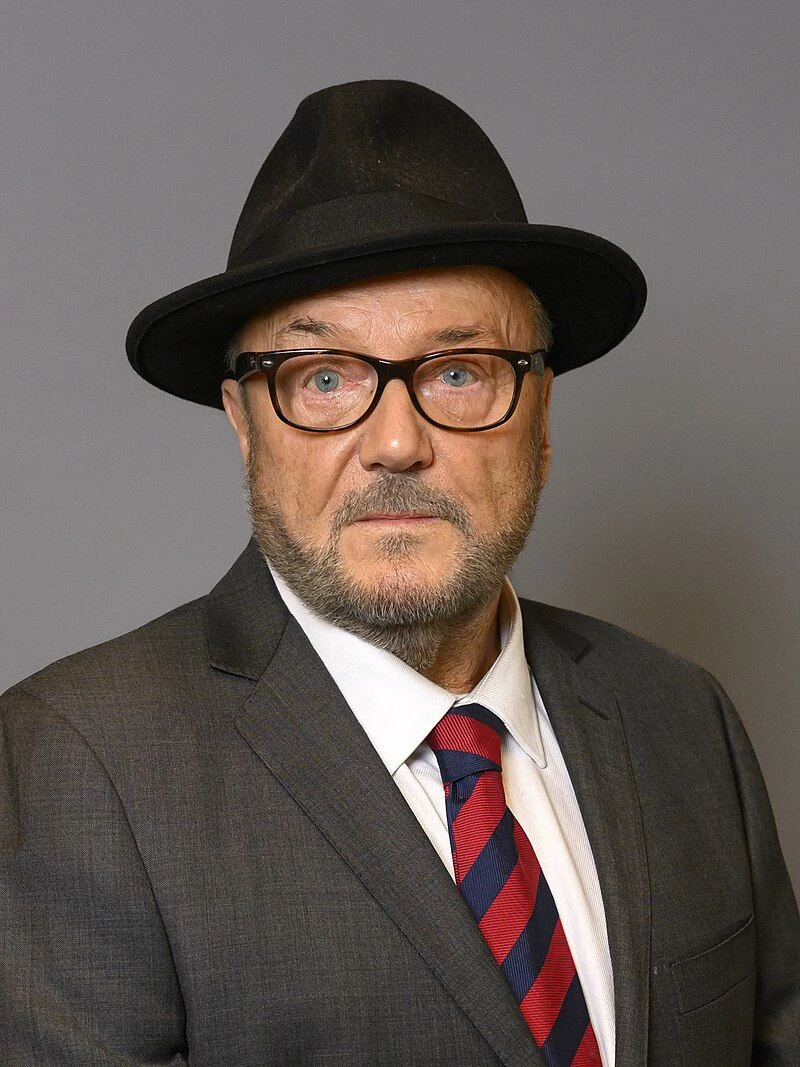
George Galloway has repeatedly turned political dissent into an electoral and public platform. First elected to Parliament for Labour in Glasgow in 1987, he later returned as a Respect MP in east London and Bradford, and briefly represented Rochdale for the Workers Party of Britain in 2024. His career has ranged from anti-war campaigning and international aid convoys to broadcasting and legal disputes. It has also drawn sustained criticism, particularly over his political alliances and remarks on international affairs. The result is a public life that cannot be reduced to either the causes he has championed or the controversies they have generated.
Dundee, Labour and the route to Parliament
Galloway was born in Dundee on 16 August 1954 and attended Harris Academy. He joined the Labour Party Young Socialists at 13, having claimed to be 15, and became involved in Dundee party organisation while still a teenager. His early political work developed through local roles: he became secretary-organiser of Dundee Labour in 1977 and, in 1981, the youngest chair of the Scottish Labour Party to that point.
Between 1983 and 1987, he was general secretary of War on Want, the British charity campaigning against poverty worldwide. The role took him abroad, including to Eritrea during the 1985 famine; his eyewitness accounts appeared in The Sunday Times and The Spectator. That experience preceded his entry to Parliament and helped establish the international focus that would remain prominent in his politics.
At the 1987 general election, Galloway won Glasgow Hillhead for Labour, defeating Roy Jenkins. After the seat was abolished, he was elected for Glasgow Kelvin in 1997 and again in 2001. His relationship with the party was not straightforward: he frequently broke with the Labour whip, and his opposition to the 2003 invasion of Iraq brought him into direct conflict with the leadership. In October that year, Labour expelled him after a disciplinary hearing found him guilty of four charges relating to his statements and conduct, including inciting Arabs to fight British troops and British troops to disobey orders.
Iraq, dissent and the Respect years
Galloway opposed the 1991 Gulf War and criticised the sanctions imposed on Iraq afterwards. His campaigning included the Mariam Appeal, founded in 1998 to challenge sanctions and draw attention to their effects on ordinary Iraqis. The campaign became controversial in its own right. A Charity Commission inquiry found that the appeal undertook charitable work and should have registered, but did not substantiate allegations that funds had been misused. A later commission report raised concerns about donations linked to the United Nations Oil-for-Food Programme and the trustees’ failure to make sufficient enquiries. A 2007 parliamentary standards report found strong circumstantial evidence that the Iraqi government had supported the appeal’s campaigning; it did not find that Galloway had personally and directly received money unlawfully.
Claims about Galloway’s personal involvement in oil deals were disputed. He denied receiving payments, and in 2004 won a libel action against The Daily Telegraph over articles alleging that he had received money from the programme. The judge found the articles seriously defamatory and awarded damages. In 2005, Galloway appeared before a United States Senate committee investigating the programme and rejected its allegations. The distinction between contested allegations, official findings about the appeal, and the outcome of the libel case matters: they were not all the same claim, nor did they produce the same conclusions.
Following his expulsion from Labour, Galloway helped form Respect, a left-wing coalition with an anti-war platform. In 2005 he defeated Labour’s Oona King in Bethnal Green and Bow, winning a seat in east London. His campaign was sharply contested. The Iraq War was a central issue, and the campaign also drew criticism and disputes over its conduct. His victory made him a prominent parliamentary opponent of the invasion, but it did not settle arguments about the wider politics of the campaign.
Galloway’s opposition to the war took him beyond Westminster. In 2005, he testified before the US Senate committee, where he forcefully challenged its accusations and criticised the committee’s handling of the inquiry. His appearance became a high-profile episode in a career shaped by confrontational public argument. He also helped organise the Viva Palestina convoy to Gaza in 2009. The convoy carried vehicles and humanitarian supplies across several countries; it reached Gaza in March. The campaign later faced scrutiny over its finances and ceased to be recognised as a charity in 2013.
Returns to Parliament and a changing party platform
After losing Bethnal Green and Bow in 2010, Galloway returned to Parliament at the 2012 Bradford West by-election. The result was an unexpected victory for Respect and a major upset for Labour. He led Respect from 2013 until the party was dissolved in 2016. In 2015, he lost Bradford West to Labour’s Naz Shah. His later electoral bids included unsuccessful contests as an independent candidate and a run in the 2021 Batley and Spen by-election, where he came third.
In December 2019, Galloway founded the Workers Party of Britain and became its leader. He won the Rochdale by-election in February 2024, campaigning amid national attention on the war in Gaza. His victory returned him to the Commons, but only briefly: at the general election that July, Labour’s Paul Waugh won the seat. Galloway had been Rochdale’s MP for 92 days.
Foreign affairs have remained at the centre of his public profile, but his positions and political partnerships have shifted over time. He has criticised Western military intervention in the Middle East and supported Palestinian causes, including through Viva Palestina. His remarks and conduct on these issues have also provoked criticism. In 2013, he walked out of an Oxford debate after learning that his opponent was Israeli, saying he did not recognise Israel and would not debate with Israelis. The following year, he declared Bradford an “Israel-free zone”; the remarks were investigated by police and he was not prosecuted. He has also faced criticism for comments on the Israeli–Palestinian conflict and for his statements on other international disputes.
His public work has not been confined to elections. Galloway has presented radio and television programmes and written about politics. He presented programmes for the Iranian broadcaster Press TV and the Russian state-backed channel RT; his RT work ended in 2022. In 2019, talkRADIO dismissed him after a tweet about Israeli flags at a football match, saying it did not tolerate antisemitic views. Galloway disputed the characterisation of his views. These episodes form part of the record of a broadcaster whose media work, as well as his political interventions, has repeatedly attracted argument.
Public argument, legal cases and accountability
Galloway’s career has also been shaped by disputes over what he has said and what has been said about him. His successful libel action against The Daily Telegraph concerned allegations that he had profited from Iraq’s Oil-for-Food Programme; the newspaper did not seek to prove the allegations true, and the court found its reporting seriously defamatory. He also accepted damages and a public apology from The Christian Science Monitor after it reported that he had received money from the Iraqi government.
Those legal outcomes do not erase separate findings about the Mariam Appeal. The parliamentary standards process concluded that there was strong circumstantial evidence that the Iraqi government had supported the appeal’s campaign, while noting that it had found no direct evidence of Galloway personally and unlawfully receiving money. The Charity Commission, meanwhile, criticised the appeal’s governance and the trustees’ handling of donations. Keeping these findings distinct is essential to describing the dispute accurately.
His record has included other contentious interventions. In 2012, comments he made about allegations against WikiLeaks founder Julian Assange were criticised by campaigners and by Respect leader Salma Yaqoob, who later resigned from the party. Galloway also lost a libel action in 2016 after making defamatory accusations about former assistant Aisha Ali-Khan; his counsel apologised on his behalf. These episodes sit alongside his electoral successes and campaigning, showing how public attention has often followed both the causes he pursued and the manner in which he pursued them.
Why George Galloway deserves a place in British Legacy
George Galloway belongs in a record of British political life because his career offers a sustained example of dissent moving between party organisation, Parliament, campaigning and broadcasting. His election for Labour in Glasgow, subsequent break with the party over Iraq, and victories for Respect and the Workers Party show how a politician can build support outside the dominant party structure and return to Westminster under different political labels. His opposition to the Iraq invasion was not confined to speeches: he helped organise campaigns and challenged the claims made against him in public and in court. The Mariam Appeal and Viva Palestina also connect his political work to practical, if disputed and sometimes criticised, campaigning around Iraq and Gaza.
That legacy should not be presented as uncomplicated. Galloway’s public statements have drawn serious criticism, and official inquiries into the Mariam Appeal raised questions about governance and the source of donations. His legal victories over particular publications do not settle every controversy about his politics, just as criticism of his positions does not cancel the documented outcomes of those cases. For British Legacy, the value of his story is in showing the contested character of democratic politics: how a politician can challenge government policy, attract voters beyond established parties, command media attention and face scrutiny over both methods and claims. His career is a specific part of Britain’s political history, not a universal emblem of dissent or a simple tale of triumph.
Sources
George Galloway — revision 1379575553 · George Galloway
Adapted in part from George Galloway by Wikipedia contributors, under CC BY-SA 4.0. Text has been edited and combined with the existing article; this adapted text is shared under the same licence. Contributor history.
.jpg)