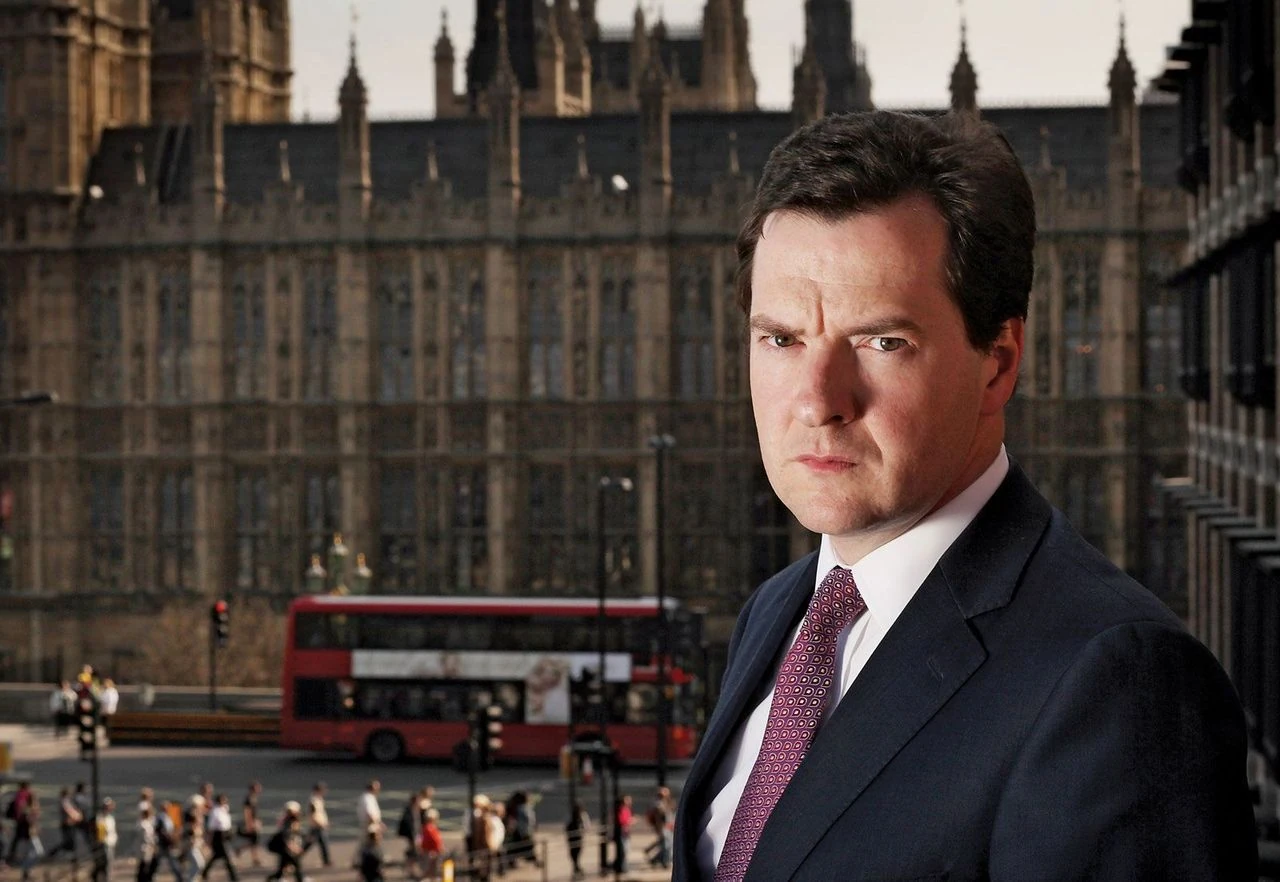
George Osborne became Chancellor of the Exchequer in May 2010, as Britain was dealing with the consequences of the financial crisis and a large deficit in government finances. For the next six years, he made reducing that deficit the defining aim of his economic programme. His budgets, spending plans and welfare reforms brought arguments about fiscal restraint and its social costs to the centre of British politics.
Osborne’s career did not begin in the Treasury. Before becoming an MP, he worked in Conservative politics and government; after leaving Parliament, he moved through newspaper editing, finance and public institutions. But his chancellorship remains the clearest measure of his political influence—and the subject of a lasting dispute over what his policies achieved and whom they affected.
From Oxford to Westminster
Born in Paddington, London, on 23 May 1971, Osborne was given the name Gideon Oliver Osborne. At 13, he decided to use George as an additional first name. He attended Norland Place School, Colet Court and St Paul’s School, then studied Modern History at Magdalen College, Oxford, graduating with an upper second-class degree in 1993. He also spent a semester at Davidson College in North Carolina.
After university, Osborne did freelance work for The Daily Telegraph before joining the Conservative Research Department in 1994. He became head of its political section and later worked as a special adviser to Douglas Hogg, then Minister of Agriculture, Fisheries and Food. He also served in the political office at 10 Downing Street during John Major’s premiership and worked on the Conservatives’ unsuccessful 1997 general-election campaign.
From 1997 to 2001, Osborne worked for Conservative leader William Hague as a speechwriter and political secretary. He was elected MP for Tatton in June 2001, succeeding the independent MP Martin Bell. At the time, he was the youngest Conservative member of the House of Commons. He held the seat until he left Parliament in 2017.
Conservative leader Michael Howard appointed Osborne Shadow Chief Secretary to the Treasury in 2004 and Shadow Chancellor the following year. Osborne kept the latter role after managing David Cameron’s successful leadership campaign in 2005. The transition from party strategist to Treasury spokesman placed him at the centre of the Conservatives’ economic offer before they entered government.
At the Treasury: deficit reduction and its costs
Osborne became Chancellor on 11 May 2010 in the Conservative–Liberal Democrat coalition government. He inherited a large deficit following the 2008 financial crisis. His approach prioritised reducing public borrowing through spending restraint and reforms to public services and welfare. The scale and distribution of those measures made “austerity” the label most closely attached to his tenure.
His early decisions included setting a cap on the total benefits a family could receive and ending universal child benefit for higher-rate taxpayers. In 2011, he announced Project Merlin, under which banks aimed to lend about £190 billion to businesses, curb bonuses and disclose some pay information for their highest earners. He also presented supply-side reforms and infrastructure investment as ways to support growth.
In 2012, Osborne reduced the 50 per cent additional rate of income tax to 45 per cent. The change was contested: Osborne argued that the lower rate was more competitive, while questions remained about its revenue effects and the timing of tax receipts. His 2013 Budget was delivered after the Office for Budget Responsibility halved its growth forecast for the year, from 1.2 per cent to 0.6 per cent. In 2016, he introduced a sugar tax and raised the income-tax personal allowance to £11,500.
Osborne’s record cannot be reduced to a simple account of fiscal success or failure. His government’s spending choices formed part of a wider, contested economic programme, and claims that austerity straightforwardly restored the public finances are not borne out by the figures discussed in assessments of his tenure. By July 2016, the UK still had a budget deficit. Critics argued that cuts to benefits and services increased hardship and inequality; assessments cited in the Wikipedia account also connect the programme to weaker growth and lasting social costs. These are serious criticisms, not a settled verdict on every consequence of policy.
His chancellorship also included the Northern Powerhouse initiative, intended to encourage economic development outside London through better transport links and investment in science and technology in northern cities. After the Conservatives won a majority in 2015, Osborne remained Chancellor and became First Secretary of State. Following the 2016 referendum vote to leave the European Union and David Cameron’s resignation, Theresa May dismissed him from the Treasury.
Leaving Parliament and taking on new roles
Osborne returned to the backbenches, then announced in 2017 that he would leave Parliament at that year’s general election. In the meantime, he had been appointed editor of the Evening Standard; he took up the role in May 2017. He moved to editor-in-chief in June 2020 and left the newspaper in March 2021.
His post-parliamentary work also included financial and advisory roles. He joined the investment firm BlackRock as a part-time adviser in 2017, and in 2018 became a partner and chairman at the growth-stage investment firm 9Yards Capital. He left BlackRock in 2021 and became an investment banker at Robey Warshaw.
Osborne took on a prominent cultural role when he became chairman of the British Museum in October 2021, having joined its board of trustees the month before. He has also chaired the Northern Powerhouse Partnership, established to bring business leaders and politicians together around regional devolution. Since 2023, he has co-hosted the politics and economics podcast Political Currency with Ed Balls.
Why George Osborne deserves a place in British Legacy
George Osborne deserves a place in British Legacy because, as Chancellor from 2010 to 2016, he helped shape the choices and arguments that defined a consequential period in British public life. His focus on deficit reduction informed government decisions about spending, taxation and welfare. His budgets also made those decisions visible to voters, Parliament and public services, where disagreements about economic priorities became debates about the state’s responsibilities and the distribution of hardship. To describe his legacy clearly is not to endorse his programme: the social costs and economic results remain contested, and the criticisms are an essential part of the record.
His wider career connects economic policy with other British institutions. The Northern Powerhouse initiative made regional development part of his political programme; his later chairmanship of the British Museum placed him at the head of one of the country’s major cultural institutions. His work in journalism and finance extended his public life beyond elected office, while his podcasting has kept him involved in political discussion. Together, these roles show why Osborne’s legacy reaches beyond the Treasury: he has been a participant in arguments about the economy, the regions, public institutions and political choices. Remembering him in British Legacy means preserving both the decisions he made and the continuing debate over their consequences.
Sources
Adapted in part from George Osborne by Wikipedia contributors, under CC BY-SA 4.0. Text has been edited and combined with the existing article; this adapted text is shared under the same licence. Contributor history.