Gilbert & George have spent more than five decades making art together, and appearing in it together. Their partnership began at Saint Martin’s School of Art in London in 1967. It grew into a practice that unsettles the boundary between artwork and everyday life: the two artists perform as “living sculptures”, while their large, vividly coloured photographic pictures take on subjects including religion, race, sex, money and death. Their insistence that art should reach beyond specialist audiences is summed up in their slogan, “Art for All”.
Two artists become a partnership
Gilbert Prousch was born in 1943 in San Martin de Tor, in South Tyrol, Italy. Ladin was his native language. Before moving to England, he studied at art schools in Val Gardena and Hallein and at the Kunstakademie in Munich. George Passmore, born in Plymouth in 1942, studied art at Dartington College of Arts and Oxford School of Art. The two met on 25 September 1967 while studying sculpture at Saint Martin’s. They later described the encounter as love at first sight; a more practical explanation they gave was that George could understand Gilbert’s English.
They developed a shared identity rather than presenting themselves as two separate artists working side by side. Their formal suits became a recognisable uniform, and they have described their work in different media as sculpture. The idea of “living sculpture” connects the performances, the pictures and their public appearance: they resist separating artistic activity from ordinary life. They have lived on Fournier Street in Spitalfields since 1968, and London’s East End has remained a setting and recurring source for their work.
“Art for All” expresses their stated opposition to an art addressed only to insiders. The ambition is not simply to make work easy to look at. Their pictures and performances can be deliberately confronting, and their claim on a broad audience includes the right to unsettle it. This tension between accessibility and provocation has been central to their public identity.
Making a sculpture of themselves
One early photographic self-portrait, made in 1969, shows the pair in the suits that would become their signature. Its deliberately abrasive title, George the Cunt and Gilbert the Shit, was intended to head off criticism. That same year they performed The Singing Sculpture at the National Jazz and Blues Festival; it was staged again at the Nigel Greenwood Gallery in 1970.
For the performance, Gilbert and George stood on a table with their heads and hands covered in coloured metallic powders. They moved and sang along to a recording of Flanagan and Allen’s “Underneath the Arches”, sometimes performing for a day at a time. The ordinary suits and the song’s familiar music sat alongside the strange stillness and repetition of the action. Rather than depicting a sculpture, they presented themselves as one, testing how a gallery audience might distinguish a performance from an object or an artist from an artwork.
They had also used their own bodies as a statement outside a formal performance. In August 1969, after not being selected to exhibit at the London staging of When Attitudes Become Form, they entered its private view and appeared among the guests as living sculptures. Their approach soon extended beyond performance: from 1970 to 1974 they made drawings, which they called “Charcoal on Paper Sculptures”, and paintings. Across these forms, the shared identity of the artists remained part of the work.
The pictures: colour, East End and confrontation
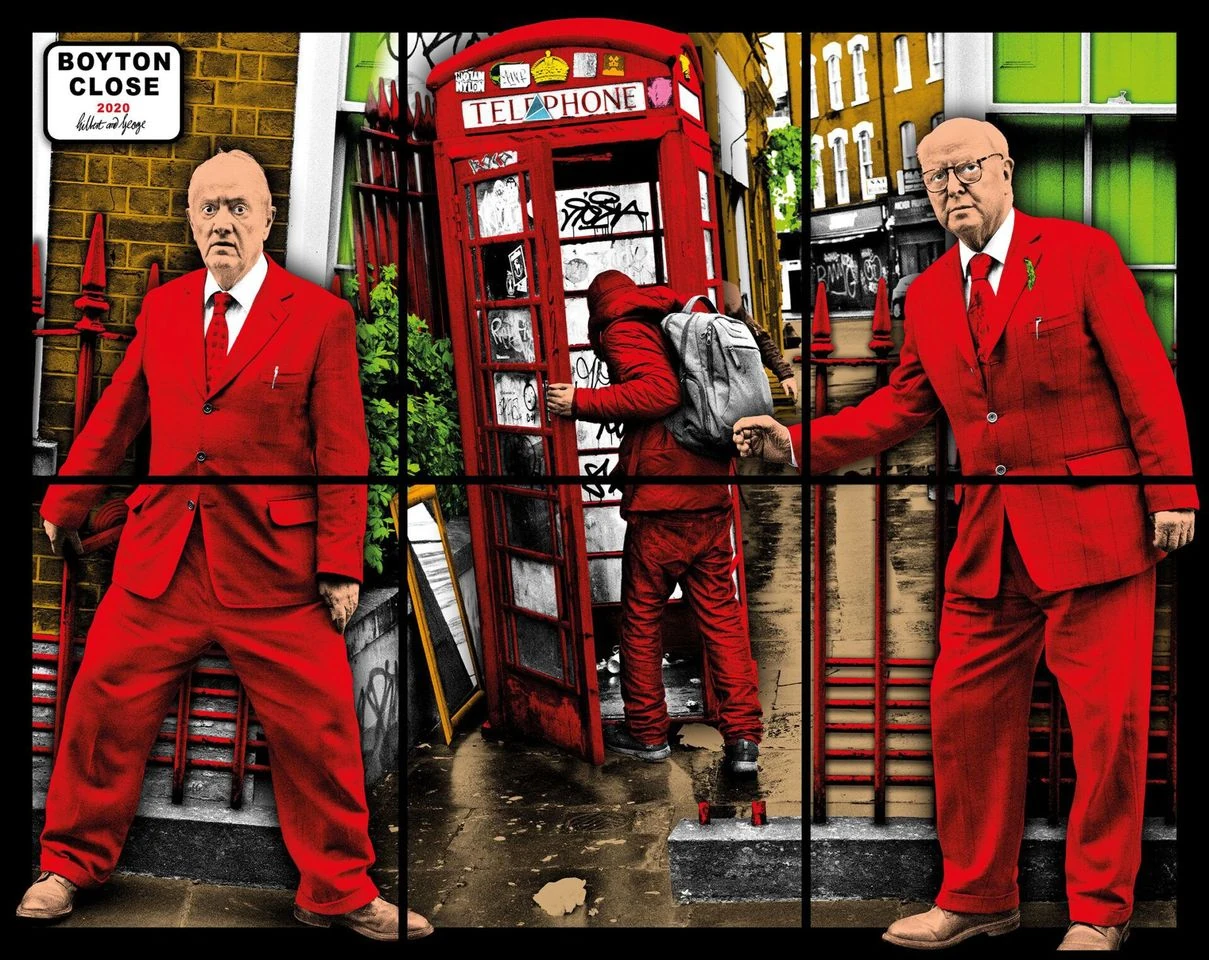
Gilbert and George are widely known for The Pictures, large-scale photographic works that developed from early black-and-white images. Red and yellow were added by hand to some early works; later pictures used bolder colours, sometimes backlit and crossed by black grids. The artists themselves often appear within the compositions. They have described the pictures as a kind of “visual love letter” to the viewer, a phrase that sits provocatively alongside their use of stark imagery and challenging titles.
Their subject matter reaches into areas they have identified as death, hope, life, fear, sex, money, race and religion. The East End supplies recurring signs and settings, but the concerns are not confined to local description. In the Jack Freak Pictures, for example, Union Jack imagery is distorted and interwoven with visual references to the neighbourhood, including flags, maps, street signs, graffiti and details such as brickwork and foliage. First shown at White Cube galleries in 2009, the exhibition travelled to venues in Europe.
Their work has also provoked criticism. In 1986 a series depicting East End “rough types”, including skinheads, drew objections; a picture of an Asian man carried the title “Paki”. Other works have attracted attention for depictions of nudity, sexual acts and bodily fluids. The Naked Shit Pictures of 1994 and Sonofagod Pictures of 2005 make the confrontational aspect of their practice explicit. Their art does not avoid the possibility that a viewer will find its imagery offensive, nor does provocation alone explain what the pictures mean.
Public recognition and a home for the work
The pair won the Turner Prize in 1986. In 2005 they represented the United Kingdom at the 51st Venice Biennale. A major retrospective at Tate Modern in 2007 was described as the largest retrospective there to that point for any of its artists; that year they also received a South Bank Award and the Lorenzo il Magnifico Award. Their recognition has been accompanied by exhibitions in Britain and internationally, and honorary degrees from several institutions.
They brought their work to television audiences too. The 1997 London Weekend Television documentary series The Fundamental Gilbert and George won the BAFTA for best documentary series. In 2007, the BBC programme Imagine featured them; a picture, “Planed”, was made available as a free download for 48 hours, allowing viewers to print and assemble it themselves. The gesture offered a practical interpretation of “Art for All”: an artwork could reach people outside a gallery, though in a form that depended on their own participation.
In April 2023, the Gilbert & George Centre opened on Heneage Street in London. With three gallery spaces, it gives their work a dedicated exhibition venue in the city where the partnership began. Its opening extends their commitment to presenting the work to the public and makes the East End, so often present in their pictures, the setting for a permanent institution devoted to their art.
Why Gilbert & George deserve a place in British Legacy
Gilbert & George deserve a place in British Legacy for the way their partnership has changed what an artistic practice can look like. They made collaboration inseparable from their identity: two artists in matching suits, appearing together in performance and often inside their own pictures. From The Singing Sculpture to the large photographic works, they have repeatedly challenged the division between artist, artwork and audience. Their Turner Prize win and their representation of the United Kingdom at the Venice Biennale mark their standing within British contemporary art, while their sustained international exhibition history shows that the work has travelled well beyond its London origins.
Their British connection is also specific and rooted in place. Gilbert came to England from South Tyrol; George was born in Plymouth; they met at an art school in London and have made the East End a continuing focus of their work. Their 2023 centre in Heneage Street gives that connection a public home. Just as important is the ambition behind “Art for All”. The artists have sought audiences beyond the specialist art world, from television viewers to people able to assemble a downloadable picture at home. Their imagery can be difficult and contentious, but it invites a wider public into a sustained argument about social life. That combination of experiment, public reach and a distinctive London history makes their contribution to British cultural life substantial.
Sources
Gilbert & George — Wikipedia revision 1374836368
Adapted in part from Gilbert & George by Wikipedia contributors, under CC BY-SA 4.0. Text has been edited and combined with the existing article; this adapted text is shared under the same licence. Contributor history.