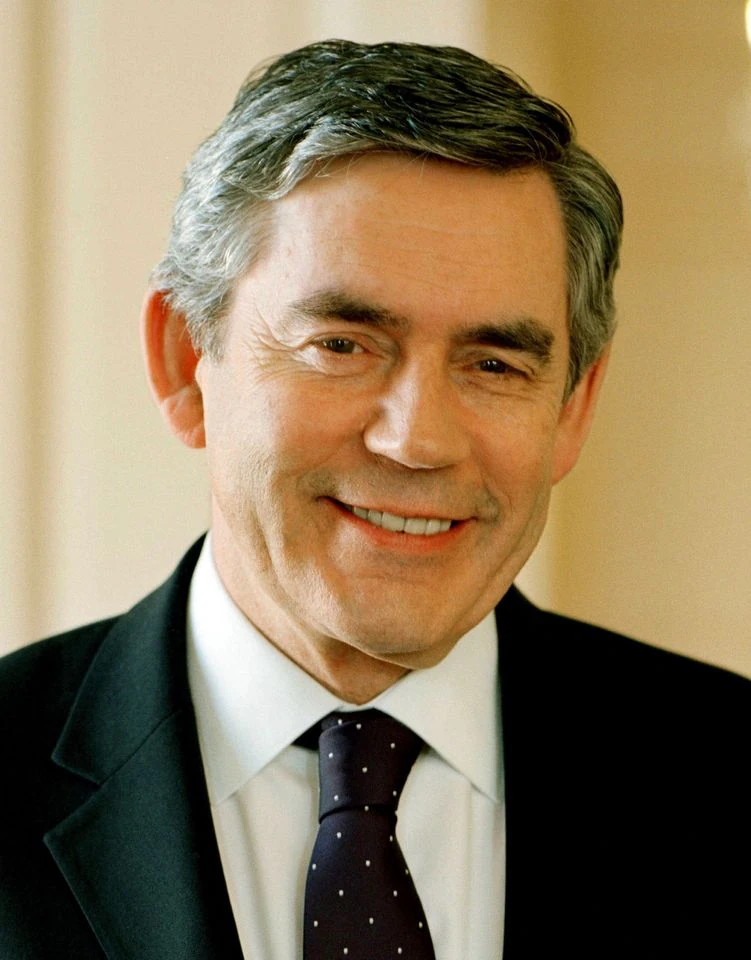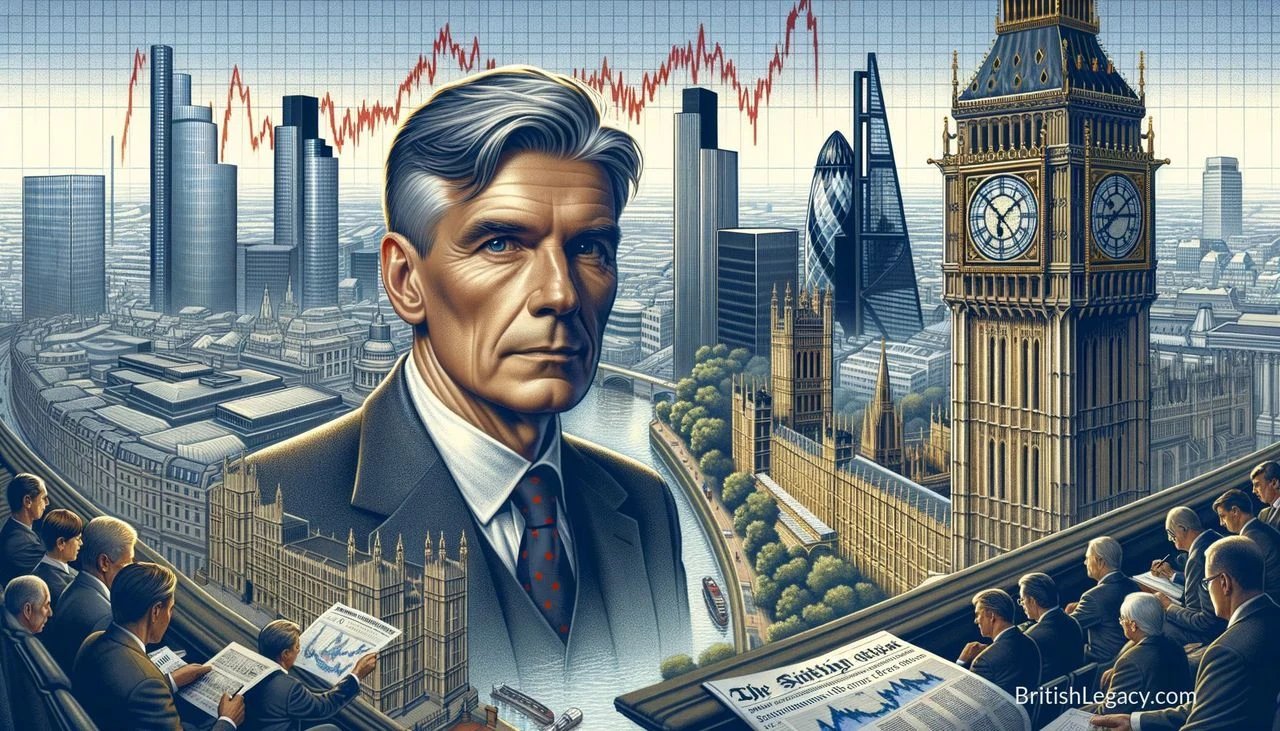
Gordon Brown’s political career took him from representing a Scottish constituency at Westminster to the Treasury, Downing Street and international work on education and finance. As Chancellor from 1997 to 2007, he changed how interest rates were set and oversaw tax and spending reforms. As Prime Minister, from 2007 to 2010, he faced the global financial crisis, when his government used public money to support banks and protect the financial system. His record includes both substantial policy changes and difficult political setbacks.
A Scottish education and a route into politics
James Gordon Brown was born in Giffnock, Renfrewshire, on 20 February 1951. His father, John, was a Church of Scotland minister. The family moved to Kirkcaldy when Brown was three, and he grew up there with his two brothers. He attended Kirkcaldy West Primary School and Kirkcaldy High School before entering the University of Edinburgh at 16 to study history.
Brown graduated with first-class honours in 1972 and completed a doctorate in 1982. While a student, he was elected rector of the university, serving from 1972 to 1975, and edited The Red Paper on Scotland. Before entering Parliament, he lectured in politics at Glasgow College of Technology, tutored for the Open University and worked as a journalist and current-affairs editor at Scottish Television. He stood unsuccessfully in Edinburgh South in 1979.
In 1983, Brown was elected Labour MP for Dunfermline East. He took on opposition roles in trade and industry before becoming Shadow Chancellor in 1992. He also took part in the Scottish Constitutional Convention, signing the Claim of Right for Scotland in 1989. Labour’s victory in the 1997 general election brought him to the Treasury.
Ten years at the Treasury
Brown served as Chancellor of the Exchequer from May 1997 until June 2007, making him the longest-serving Chancellor in modern history. One of his first major decisions was to give the Bank of England operational independence over monetary policy, including interest-rate setting through its Monetary Policy Committee. He also changed the inflation measure used by the government and transferred banking supervision to the Financial Services Authority. The division of responsibilities created by these arrangements later attracted criticism, including arguments that it contributed to the severity of Britain’s experience of the 2008 crisis.
His budgets combined changes to taxation with increased public spending. Brown reduced the basic rate of income tax from 23 per cent to 20 per cent, lowered corporation tax and introduced a 10 per cent income-tax band in 1999. He introduced the Windfall Tax on privatised utilities in 1997, directing its estimated £5 billion proceeds towards the New Deal for Young People. His government also expanded tax credits, including the Working Families Tax Credit and Child Tax Credit, and increased spending on health and education.
The record was contested. Brown removed the 10 per cent starting rate in his 2007 budget, a change that increased tax for five million people; the Institute for Fiscal Studies identified people earning between £5,000 and £18,000 as the biggest losers. Between 1999 and 2002, the government sold 60 per cent of the UK’s gold reserves. The sale was intended to diversify the reserves, but it was widely criticised after the gold price rose. Brown also set five tests for possible UK membership of the euro; the Treasury concluded in 2003 that they had not been met.
Downing Street during a financial crisis
Brown succeeded Tony Blair as Labour leader and Prime Minister in June 2007. His premiership began with proposals to change the relationship between government, Parliament and citizens, and he appointed Jacqui Smith as the first woman to serve as Home Secretary. He did not call a general election in 2007, despite speculation that he might. Labour’s standing then fell, and the party suffered serious losses in local and by-elections.
The financial crisis became the defining test of his government. Brown’s administration introduced a rescue package of about £500 billion, took majority shareholdings in Northern Rock and Royal Bank of Scotland, and put public money into other banks. It also cut VAT temporarily by 2.5 percentage points and introduced a car-scrappage scheme as part of efforts to support demand during the recession. These measures helped shape Britain’s response, while increasing public exposure to the cost of stabilising the financial system.
Brown also worked for a co-ordinated international response to the crisis. His government hosted the London G20 summit in 2009, where leaders agreed measures intended to support the world economy and strengthen financial regulation. Describing his role as if he had convened the G20 itself would overstate it: the relevant event was the summit hosted during his premiership, within an existing international forum.
Other legislation included the Climate Change Act 2008 and the Equality Act 2010. The government’s term ended after Labour lost 91 seats in the 2010 general election, producing a hung Parliament. Brown resigned as Labour leader and Prime Minister after a Conservative–Liberal Democrat coalition agreement was reached.
After office: Scotland and international service
Brown remained an MP for Kirkcaldy and Cowdenbeath until 2015. During the 2014 Scottish independence referendum campaign, he argued for Scotland to remain in the United Kingdom. After leaving Parliament, he continued to publish on politics and global affairs, including My Life, Our Times and Seven Ways to Change the World.
His later work has included a sustained focus on education and international development. In 2012, he became the United Nations Special Envoy for Global Education. He chaired the International Commission on Financing Global Education Opportunity from 2016 until its work concluded in 2023, and became honorary president of the International Finance Facility for Education. In 2021, the World Health Organization appointed him Ambassador for Global Health Financing. In 2024, he was appointed to the Order of the Companions of Honour for public and charitable services in the UK and abroad.
Why Gordon Brown deserves a place in British Legacy
Brown’s place in British political history rests first on the scale and duration of his work at the Treasury. During a decade as Chancellor, he altered the framework for monetary policy by granting operational independence to the Bank of England, and he oversaw major changes to taxation, tax credits and public spending. Those policies affected how the UK managed interest rates and supported households, while decisions such as removing the 10 per cent tax band and selling gold reserves remain part of the debate about his record. A meaningful account of his legacy needs both the reforms and the disputes surrounding them.
His premiership brought a different kind of responsibility: responding to a crisis that crossed national borders. Bank rescue measures and the London G20 summit placed Britain within efforts to stabilise finance and co-ordinate international action. Brown’s subsequent work on global education and health financing extends that outward-facing role beyond government, connecting his public service to international institutions. His Scottish roots and long representation of constituencies in Fife are also central to his political story. Taken together, his career links domestic economic policy, the pressures of governing during recession and continuing work on global challenges—an evidenced British legacy that is both influential and contested.
Sources
Gordon Brown — Wikipedia revision 1379536968
Adapted in part from Gordon Brown by Wikipedia contributors, under CC BY-SA 4.0. Text has been edited and combined with the existing article; this adapted text is shared under the same licence. Contributor history.