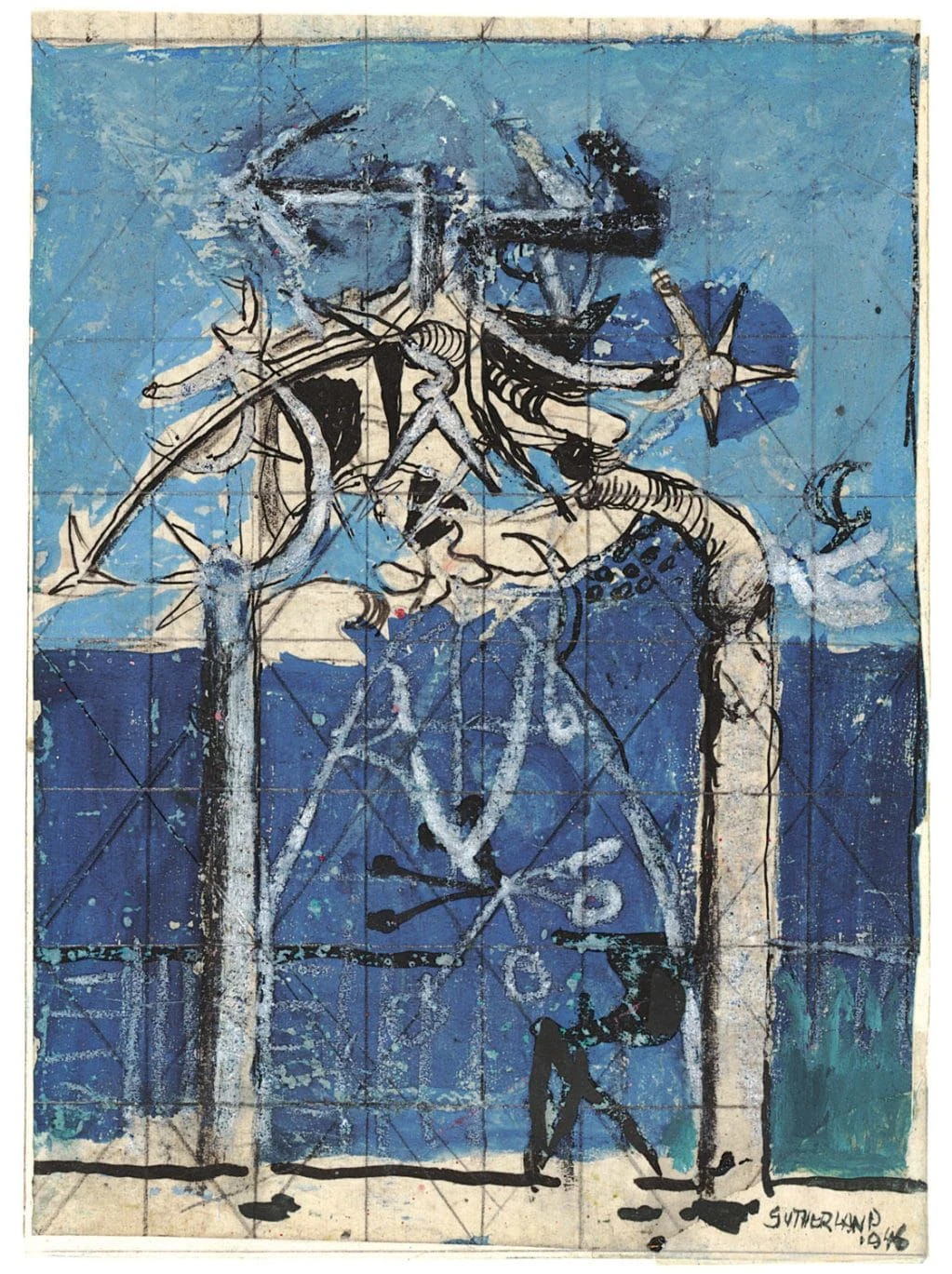
Graham Sutherland made landscapes that seem to grow and shift before the eye: rocks, plants and coastal forms become strange, almost animate structures. He carried that way of seeing from his early prints into the paintings of Pembrokeshire that established his reputation, and later into images of bomb damage and portraits of public figures. His career joined experiment in modern art to subjects drawn from the British landscape and the country’s wartime experience.
From engraving to the Pembrokeshire coast
Graham Vivian Sutherland was born in Streatham, London, on 24 August 1903, the eldest of three children of George Humphrey Vivian Sutherland, a barrister who later became a civil servant, and Elsie Foster. Both parents were amateur painters and musicians. After Homefield Preparatory School in Sutton, he attended Epsom College until 1919. He then began an engineering apprenticeship at the Midland Railway locomotive works in Derby. After a year, he persuaded his father that he wanted to study art instead.
Sutherland failed to gain a place at the Slade School of Art and entered Goldsmiths’ School of Art in 1921. There he specialised in engraving and etching, graduating in 1926. His prints of pastoral subjects drew on the work of Samuel Palmer, in part through the influence of the older etcher F. L. Griggs. While still a student, he exhibited drawings and engravings in London; commercial printmaking became his main source of income in the late 1920s. He also taught engraving at Chelsea School of Art from 1926, later teaching composition and book illustration there.
When the print market contracted during the Great Depression, Sutherland turned increasingly to painting. His first visit to Pembrokeshire, in 1934, proved decisive. The Welsh coast supplied forms he could abstract without losing their connection to the land: rocks, vegetation and other natural shapes acquired an unsettling, sometimes surreal character. He returned each year until the Second World War. His work was shown at the International Surrealist Exhibition in London in 1936, and his first solo exhibition of paintings followed at the Rosenberg and Helft Gallery in 1938. These oil paintings of the Pembrokeshire landscape helped establish him as a leading British modern artist.
Painting was only one strand of his practice during the 1930s. Sutherland also worked in glass, fabric and poster design. In December 1926 he converted to Catholicism; the following year he married Kathleen Barry, a fellow Goldsmiths student. The couple lived in several places in Kent before buying a property at Trottiscliffe in 1945.
Recording the home front
During the Second World War, Sutherland worked as a full-time, salaried artist for the War Artists’ Advisory Committee. His commission took him from bomb-damaged Wales to London’s Blitz-scarred City and East End. Rather than present destruction as a sequence of identifiable reports, he made a body of work under the recurring title Devastation. The paintings recorded ruined buildings and industrial damage while withholding precise locations and excluding human remains. Fallen lift shafts and rows of bombed houses recur in the scenes.
He went on to paint industrial Britain: blast furnaces in Wales, tin mines in Cornwall, a limestone quarry in Derbyshire and coal mines around Swansea. In 1944 he spent four months at Woolwich Arsenal making a series of five paintings. Later that year, the committee sent him to record damage in France, including railway yards at Trappes and flying-bomb sites at Saint-Leu-d’Esserent. His commission resulted in about 150 paintings. These works extended his modernist approach beyond the coast, making the damaged and working landscapes of wartime Britain central to his art.
Religious imagery, portraits and Coventry
After the war, Sutherland developed a figurative and religious strand of work. Commissioned by Walter Hussey, vicar of St Matthew’s Church in Northampton and a patron of modern religious art, he painted The Crucifixion (1946). Its pale Christ, with broken limbs, marked his first major religious painting and his first large figure study. Later works combined religious symbols with forms from nature, especially thorns. In the related Origins of the Land series, rocks and fossils became increasingly abstract arrangements.
From 1949 he also painted portraits of prominent figures. Some sitters were unsettled by the results: Lord Beaverbrook called his portrait both an “outrage” and a “masterpiece”, while Somerset Maugham came to admire an image he had initially disliked. Sutherland’s portrait of Winston Churchill, painted in 1954, caused a more lasting controversy. Churchill disliked the realistic depiction and initially resisted its presentation. He eventually accepted it disparagingly as “a remarkable example of modern art”. The painting was later destroyed on the orders of Lady Spencer-Churchill; studies for it survive. Sutherland’s other portraits, including those of Konrad Adenauer and the Queen Mother, helped make him an unofficial state portraitist.
His standing also brought major public commissions. In 1951 he made a large work for the Festival of Britain, and in 1954 he was commissioned to design the central tapestry for the new Coventry Cathedral. Christ in Glory in the Tetramorph took three years to complete and was installed in 1962. To realise the design, Sutherland visited its French weavers, Pinton Frères of Felletin, nine times. From 1948 to 1954 he served as a Tate trustee. He received the Order of Merit in 1960.
Return to Pembrokeshire and later recognition
Sutherland’s work after the war also drew on the French Riviera. He spent part of each year there from 1947 and, in 1955, bought a villa at Menton designed by Eileen Gray. He spent summers in Venice as well, encouraged by portrait patrons in Italy. Living abroad contributed to a decline in his standing in Britain. A return to Pembrokeshire in 1967, his first visit in more than twenty years, renewed his connection with the landscape. He worked there regularly for the rest of his life, drawing on places including the estuaries at Sandy Haven and Picton. Late print series included The Bees (1976–77) and Apollinaire (1978–79).
Retrospectives during and after his lifetime included exhibitions at the Institute of Contemporary Arts in 1951, Tate in 1982, the Musée Picasso in Antibes in 1998 and Dulwich Picture Gallery in 2005. Sutherland died at Trottiscliffe, Kent, on 17 February 1980, aged 76, and was buried in the churchyard there. His honours included an honorary Doctor of Letters from Oxford in 1962, the Shakespeare Prize in Hamburg in 1974 and, in 1973, France’s Commandeur des Arts et Lettres.
Why Graham Sutherland deserves a place in British Legacy
Sutherland’s place in British art rests on more than a recognisable style. His Pembrokeshire paintings showed how a specific landscape could be made strange without losing its physical presence. During the war, he turned that attention to bomb damage, mines, factories and other sites of industrial work. The resulting paintings are a sustained record of Britain under attack and at work, made by an artist whose visual language resisted straightforward illustration. His career therefore connects modernist experiment with the landscapes and events that shaped the country in the mid-twentieth century.
His influence also reached beyond easel painting. Christ in Glory in the Tetramorph, installed in Coventry Cathedral in 1962, brought his imagery into a major post-war public building, while his work in printmaking, glass, fabric and design demonstrates the breadth of his practice. His controversial portrait of Churchill remains a revealing example of the friction between an artist’s interpretation and a public figure’s preferred image. Sutherland’s return to Pembrokeshire in 1967, after years spent working abroad, renewed a lasting relationship with a Welsh landscape. Remembering him in British Legacy means recognising an artist who made British places, public life and wartime experience subjects for ambitious modern art.
Sources
Graham Sutherland — Wikipedia, revision 1364694848 · Graham Sutherland — Wikipedia
Adapted in part from Graham Sutherland by Wikipedia contributors, under CC BY-SA 4.0. Text has been edited and combined with the existing article; this adapted text is shared under the same licence. Contributor history.