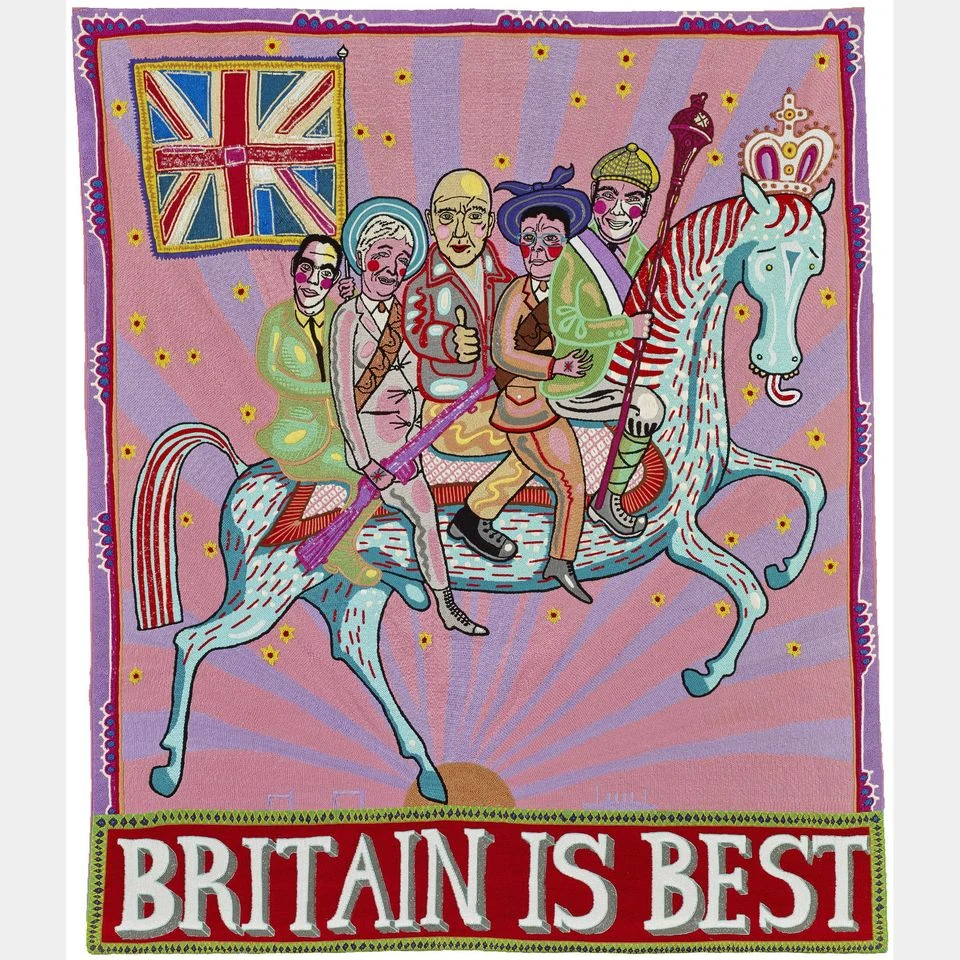
Grayson Perry’s work often draws viewers in with vivid colour, familiar objects and an inviting surface, then unsettles what they think they are seeing. His ceramic vessels borrow the shapes of classical pottery but carry scenes and subjects that complicate their decorative appeal. In tapestries, he has turned observations of contemporary Britain into narratives about class and taste. Across both, the artist has made craft, humour and storytelling vehicles for close scrutiny of society.
Learning to make, and to perform
Born in Chelmsford on 24 March 1960, Perry grew up in a working-class family. He has described an anxious childhood and a fantasy world built around his teddy bear, Alan Measles; both personal history and that childhood companion later found their way into his art. After a short period at King Edward VI Grammar School in Chelmsford, encouragement from an art teacher helped direct him towards studying art.
He completed an art foundation course at Braintree College of Further Education from 1978 to 1979, then studied fine art at Portsmouth College of Art and Design, graduating in 1982. He had an early interest in film, and exhibited his first piece of pottery at the Institute of Contemporary Arts’ New Contemporaries show in London in 1980. After graduating, he joined the Neo Naturists, a performance group whose events used body paint and nudity. Those beginnings place Perry’s later work across several forms: his practice has included pottery, drawing, printmaking, textiles, film and performance.
Perry has also appeared in public as Claire, his female alter ego, and has spoken about dressing in women’s clothes from an early age. Claire is not simply a separate public persona: Perry has included images of her in his art, where dress and character can contribute to a wider exploration of identity. His practice brings autobiography into contact with social observation, without limiting either to a single medium.
Pottery with an argument
Perry’s decorated vessels draw on ceramic traditions including Greek pottery and folk art. He makes them by coiling, then builds up their surfaces through techniques including glazing, incision, embossing and photographic transfers. Some carry small relief forms attached to the surface. Their classical outlines can seem familiar, while the images and themes they bear challenge the idea that pottery is merely useful or decorative.
That tension is central to the work: an approachable form can carry difficult or provocative material. Perry has used decorative surfaces to address subjects including family, sexuality, war and social life. Images of Claire and Alan Measles recur, as do reflections on his childhood. In works such as Using My Family (1998), the teddy bear represents affection; The Guardians, from the same period, depicts his mother and stepfather. Rather than separating personal experience from wider questions, Perry lets them sit together on the vessel.
His 2002 exhibition Guerrilla Tactics at the Stedelijk Museum Amsterdam formed part of the work for which he received the Turner Prize in 2003. He was the first ceramic artist to win it. The award recognised a practice that used a medium often placed below painting and sculpture in conventional art hierarchies to address substantial ideas. The distinction matters: Perry’s achievement was not simply to make ceramics prominent, but to demonstrate how their material, history and decorative possibilities could contribute to meaning.
Reading class in tapestries and places
In 2012, Perry’s television series All in the Best Possible Taste examined ideas of taste across working-class, middle-class and upper-class life in Britain. The project developed into The Vanity of Small Differences, a sequence of six tapestries telling the story of Tim Rakewell and tracing social mobility. Perry took inspiration from William Hogarth’s A Rake’s Progress. The tapestries draw on people, objects and incidents encountered during filming, joining individual detail to a broader account of how class shapes aesthetic taste.
His exploration of story through textiles continued with The Walthamstow Tapestry (2009), which surrounds large figures moving through the stages of life with hundreds of brand names. For A House for Essex, created with the architecture practice FAT and completed in 2015, Perry developed an artwork-filled building around the fictional life of Julie Cope. The project included large tapestries, woodcuts and ceramic work. Its imagined biography allowed him to use a specific Essex setting to consider memory, place and the everyday details through which a life is represented.
These projects show Perry’s interest in more than the finished object. He has used research, television, narrative and collaboration to shape work that can be encountered in a home, an exhibition or a broadcast. His media work includes Who Are You? (2014), a series about identity in which he made portraits for the National Portrait Gallery, and Grayson Perry: All Man (2016), which explored masculinity. In Grayson’s Art Club, begun during the COVID-19 pandemic, he and his wife, Philippa, encouraged viewers to make and share work from home.
Art beyond the gallery
Perry’s broadcasting has made art and its questions part of a wider public conversation. In 2005, he presented Channel 4’s Why Men Wear Frocks, examining masculinity and cross-dressing through his own experience. The programme received a Royal Television Society award for best network production. His 2013 BBC Reith Lectures, titled Playing to the Gallery, considered contemporary art and its relationship with audiences; he later expanded them into a book.
He has also written and illustrated books, including the graphic novel Cycle of Violence and The Descent of Man, which discusses modern masculinity. In 2011, his exhibition The Tomb of the Unknown Craftsman at the British Museum brought his own work into conversation with objects selected from the museum’s collection. His work is held by British collections including Tate, the Victoria and Albert Museum, the Arts Council Collection, the British Council Collection and the Crafts Council.
His public recognition has included election as a Royal Academician in 2011, appointment as a CBE in 2013 for services to contemporary art, and a knighthood in 2023 for services to the arts. In 2021, he received the Erasmus Prize, whose stated rationale recognised his visual language and his engagement with beauty, craftsmanship and social and cultural issues. The honours sit alongside, rather than replace, the work itself: Perry’s public reputation has been built through a combination of making, explaining and testing what art can address.
Why Grayson Perry deserves a place in British Legacy
Grayson Perry belongs in British Legacy because his work offers a sustained, distinctive account of contemporary Britain through objects people can read and recognise. The six tapestries of The Vanity of Small Differences turn class and taste into a connected visual story, drawing on the details of everyday life and on Hogarth’s earlier use of narrative images to examine society. A House for Essex similarly makes place and an invented life part of an ambitious artwork. These projects are specific to their subjects and settings, yet their materials and stories invite viewers to think about how class, memory and identity shape experience.
His contribution also rests on the seriousness he has brought to ceramics and textiles. The Turner Prize recognised a ceramic artist for work that challenged assumptions about what pottery could do; Perry’s vessels use their surfaces, techniques and traditional forms to carry autobiography and social comment. His broadcasting and writing extend that work beyond galleries, explaining contemporary art while giving audiences ways to question it. Through programmes such as All in the Best Possible Taste and Grayson’s Art Club, he has connected artistic practice with public participation and discussion. That combination of craft, critical attention and accessible communication makes Perry a significant figure in British visual culture.
Sources
Grayson Perry — Wikipedia revision 1378388689
Adapted in part from Grayson Perry by Wikipedia contributors, under CC BY-SA 4.0. Text has been edited and combined with the existing article; this adapted text is shared under the same licence. Contributor history.