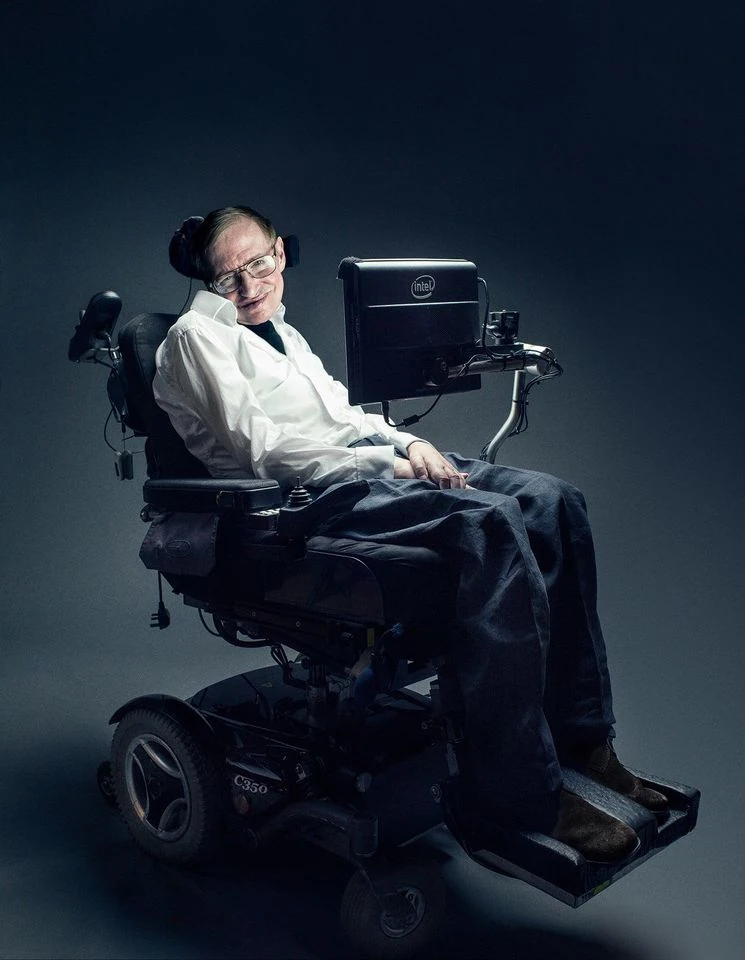
Stephen Hawking made black holes central to some of the most far-reaching questions in theoretical physics. His prediction that they emit radiation connected gravity with quantum theory; his book A Brief History of Time then carried questions about the universe from specialist debate to bestseller lists. For most of his career, he worked at the University of Cambridge, where he became one of Britain’s most recognisable scientists.
From Oxford to Cambridge
Stephen William Hawking was born in Oxford on 8 January 1942. He began studying physics at University College, Oxford, in 1959 and gained a first-class BA degree. In October 1962 he moved to Cambridge for postgraduate work in cosmology. He was diagnosed with a slow-progressing form of motor neurone disease in 1963, aged 21. The diagnosis brought a period of depression, but the illness progressed more slowly than doctors had initially expected, and he returned to his research.
Hawking’s early work centred on the origins and structure of the universe. Drawing on Roger Penrose’s work on singularities in black holes, he applied related ideas to cosmology. His doctoral thesis, Properties of Expanding Universes, was approved in 1966. That year he shared the Adams Prize with Penrose for an essay on singularities and space-time. Their collaboration helped establish the importance of singularities in theories of gravitational collapse and the universe’s beginning.
In 1970, Hawking and Penrose published a proof that, if the universe obeyed general relativity and fitted the physical cosmological models then under consideration, it must have begun as a singularity. Hawking also worked with other physicists on the properties of black holes. A result associated with this period, the area theorem, held that the total surface area of black-hole event horizons cannot decrease as black holes interact and merge.
What black holes can reveal
Hawking’s best-known scientific prediction followed work on the relationship between gravity and quantum mechanics. In 1974 he proposed that black holes emit radiation, now known as Hawking radiation. The idea challenged the picture of a black hole as a body from which nothing could escape. It was initially controversial; by the late 1970s, further research had helped establish it as a major theoretical breakthrough. The radiation is a prediction, and the search for it from astrophysical black holes continues.
Hawking went on to investigate what happens to information when a black hole evaporates. His arguments prompted a long-running debate about how general relativity and quantum mechanics fit together. In 2004 he conceded a scientific wager with physicist John Preskill over the information paradox and presented a solution of his own. In 2014 he called the alleged loss of information his “biggest blunder”. These changes of position are part of the scientific story: Hawking’s work opened questions that he and other physicists continued to examine.
In 1979, Hawking became Lucasian Professor of Mathematics at Cambridge, a post he held until retiring in 2009. He later served as director of research at the university’s Department of Applied Mathematics and Theoretical Physics. His academic work ranged beyond black holes to cosmology, including the no-boundary proposal developed with James Hartle. He continued to publish research into his final years; his last paper, written with Thomas Hertog, appeared posthumously in 2018.
A voice for cosmology beyond the university
Hawking’s public reach grew sharply after the publication of A Brief History of Time in 1988. He had begun writing the book to explain the universe to a general readership. His editor encouraged him to present complex ideas in non-technical language, and the book became an international bestseller. It remained on the Sunday Times bestseller list for 237 weeks and had sold an estimated nine million copies by 2009. The success made Hawking a public figure, bringing both new readers to cosmology and the demands of a life in the public eye.
He continued to write for readers outside academia, publishing The Universe in a Nutshell in 2001 and, with Leonard Mlodinow, A Briefer History of Time in 2005. With his daughter Lucy, he also co-wrote a series of children’s books beginning with George’s Secret Key to the Universe in 2007. The books used fiction to introduce young readers to ideas in theoretical physics.
Television and film gave Hawking another route to a broad audience. He appeared as himself in Star Trek: The Next Generation and The Simpsons, among other programmes. His computer-generated speech became part of his public identity after he lost the ability to speak. He first communicated using a computer program and a switch, later operating his system with movements of his cheek. Although other voices became available, he retained the synthesised voice he had long used.
Working with disability
Hawking’s motor neurone disease gradually paralysed him over several decades. He used a wheelchair and, after a tracheotomy in 1985, required round-the-clock nursing care. A computer system enabled him to select words and phrases for his speech synthesiser; as his ability to use his hands declined, he controlled it with a cheek muscle. His work depended on adaptations, technology and assistance, as well as his own scientific judgement.
He did not want to be defined solely by his illness. He described himself first as a scientist, then as a popular science writer, and as a person with the same desires and ambitions as others. At the same time, he took part in disability outreach and fundraising, and in 2012 narrated part of the opening ceremony of the London Paralympic Games. His life made his research visible to audiences who might not otherwise have encountered theoretical physics, while his communication methods showed how technology could support participation in intellectual and public life.
Honours and final years
Hawking was elected a Fellow of the Royal Society in 1974. He became a Commander of the Order of the British Empire in 1982 and a Companion of Honour in 1989. His many scientific awards included the Copley Medal, awarded by the Royal Society in 2006. In 2009 he received the United States Presidential Medal of Freedom. A BBC poll placed him 25th in its list of the 100 Greatest Britons in 2002.
Hawking died at his home in Cambridge on 14 March 2018, aged 76. After his cremation, his ashes were interred in Westminster Abbey between the graves of Isaac Newton and Charles Darwin. His memorial stone bears an equation describing the temperature of radiation from black holes. In 2021, an agreement ensured that thousands of pages of his papers would remain in Cambridge, while objects including his wheelchairs and speech synthesisers would be housed at the Science Museum in London.
Why Stephen Hawking deserves a place in British Legacy
Hawking’s place in British Legacy rests first on the substance of his scientific work. His research with Penrose strengthened the case for singularities in cosmology, while his prediction of Hawking radiation gave physicists a new way to think about black holes. The information paradox that followed remains a major problem in theoretical physics. These were not simply striking ideas with his name attached: they reshaped debate about gravity, quantum mechanics and the history of the universe. His long Cambridge career connected those questions to one of Britain’s leading centres of research and helped train a generation of doctoral students.
His public contribution was different but equally specific. A Brief History of Time showed that a book about cosmology could reach millions of readers, while later books for adults and children continued that effort to make difficult ideas approachable. Hawking’s appearances on television brought scientific subjects into popular culture; his use of speech technology also made visible the practical role of communication systems in supporting his work. These achievements do not reduce his story to one of personal inspiration. They show a scientist producing influential research, communicating beyond academic boundaries and continuing to work with changing physical abilities. That combination gives his British legacy both intellectual weight and a lasting public reach.
Sources
Stephen Hawking — revision 1379655897
Adapted in part from Stephen Hawking by Wikipedia contributors, under CC BY-SA 4.0. Text has been edited and combined with the existing article; this adapted text is shared under the same licence. Contributor history.