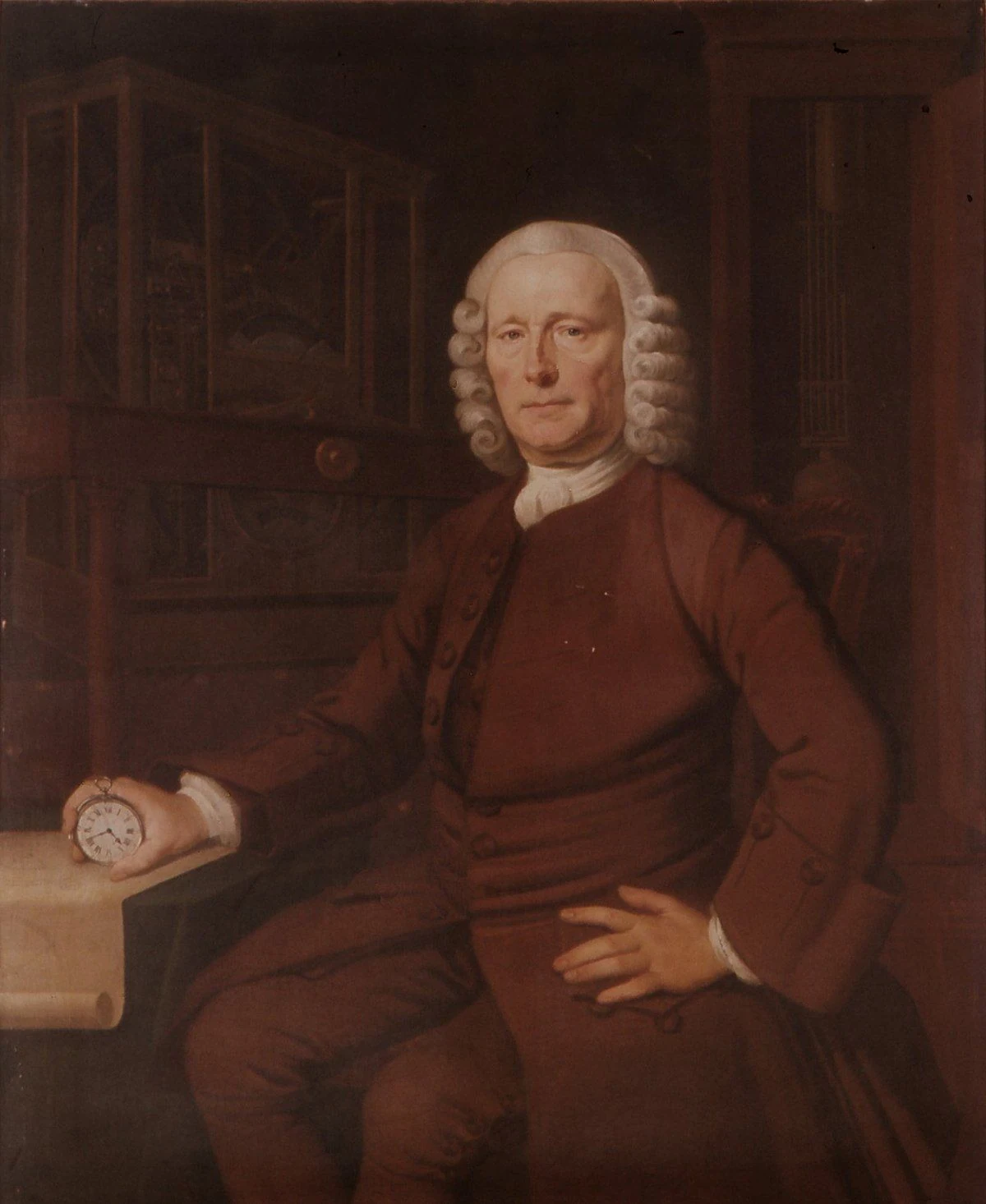
John Harrison set out to solve a problem that had defeated generations of navigators: how to establish a ship’s east–west position far from land. His answer was not a new chart or a celestial calculation, but a clock capable of keeping reliable time through a sea voyage. Over decades, he developed a succession of machines, culminating in a compact sea watch that demonstrated how a timekeeper could help determine longitude. The work brought him into conflict with the institutions judging his claim, but it also advanced the craft of precision timekeeping.
A carpenter’s approach to time
Harrison was born on 3 April 1693 at Foulby, near Wakefield, in the West Riding of Yorkshire. His family later moved to Barrow upon Humber in Lincolnshire, where he followed his father’s trade as a carpenter and built and repaired clocks in his spare time. In 1713, aged 20, he made his first longcase clock, with a mechanism constructed entirely from wood. Three of his early wooden clocks survive: the first is in the Science Museum in London, the second is also there, and the third is at Nostell Priory in Yorkshire.
His work was not limited to conventional clockmaking. Harrison developed mechanisms intended to improve timekeeping and reduce the effects of changing conditions. A gridiron pendulum used alternating brass and iron rods to compensate for temperature changes. His grasshopper escapement released a clock’s driving force with very little friction and needed no lubrication. These designs grew from practical workshop experience: he was trying to make clocks work more consistently, not merely to produce intricate objects.
Harrison’s first longcase clock should not be confused with his first surviving sea-going timekeeper. He began designing a marine clock in 1730 and sought help in London. The Astronomer Royal, Edmond Halley, introduced him to the clockmaker George Graham, who lent him money to build a model. Graham’s support helped Harrison develop a design based on his experience with wooden pendulum clocks, but intended to operate aboard a moving vessel.
From the sea clocks to the sea watch
Harrison’s first sea clock, later known as H1, took five years to build. In 1736 he sailed with it to Lisbon on HMS Centurion. The clock lost time on the outward voyage, but performed well on the return aboard HMS Orford. Its results impressed the Board of Longitude enough for it to award Harrison £500 towards further development, although the voyage was not the transatlantic trial specified for the main prize.
He went on to build H2 and then H3. The second design was abandoned after Harrison identified a flaw: the movement of a ship as it turned could affect the oscillation of its balances. H3 occupied him for 17 years, but did not reach the accuracy he wanted. The experiments nevertheless produced lasting mechanical innovations, including the gridiron pendulum and the caged roller bearing. Harrison’s work was iterative; each machine exposed difficulties that shaped the next.
After years developing large sea clocks, Harrison recognised that a watch might be a more practical marine timekeeper. His H4, completed in 1759, resembled an oversized pocket watch. It was tested aboard HMS Deptford on a voyage from Portsmouth to Kingston, Jamaica, in 1761, with Harrison’s son William accompanying it. The ship reached its destination after 81 days and five hours. Once its initial error and accumulated loss were accounted for, the watch was found to be five seconds slow against the known longitude of Kingston.
A further trial took place on the voyage to Bridgetown, Barbados. On that occasion H4 kept time to within 39 seconds, corresponding to a longitude error of less than ten miles. These results did not end the dispute with the Board. Its members questioned whether the watch’s performance proved a dependable method and whether a timekeeper that had taken six years to construct met the requirement for a practical solution. Harrison was also required to hand over the watch for further examination and testing.
Recognition after a prolonged dispute
The Longitude Act of 1714 had offered rewards of up to £20,000 for a successful method of finding longitude at sea. Harrison did not receive that full prize. The Board’s scepticism and the terms of its trials made recognition contentious, while the lunar-distance method offered a competing approach. On the Barbados trial, Nevil Maskelyne tested lunar distances as well as Harrison’s watch; the watch produced a more accurate result, though the comparison did not settle the Board’s objections.
Harrison began work on a second sea watch, H5, while H4 remained under scrutiny. Frustrated by the process, he sought the support of King George III. The King tested H5 through daily observations at the palace in 1772 and found it accurate to within one third of a second per day. He urged Harrison to petition Parliament. In 1773, when Harrison was 80, Parliament awarded him £8,750 for his achievements. He had received earlier payments for his work, but never the official Longitude prize in full.
Harrison died in London on 24 March 1776, aged 82. He was buried at St John’s Church, Hampstead, with his second wife, Elizabeth, and later their son William. The Worshipful Company of Clockmakers restored his tomb in 1879. A memorial tablet in Westminster Abbey was unveiled in 2006, recognising his contribution alongside fellow clockmakers George Graham and Thomas Tompion.
Why John Harrison deserves a place in British Legacy
Harrison’s place in British history rests on a specific achievement: he demonstrated that a carefully made timekeeper could help a navigator establish longitude at sea. His solution addressed a practical danger. When a ship’s east–west position was uncertain, errors in navigation could contribute to shipwreck and loss of life. H4’s successful trials showed the potential of carrying reference time across an ocean, even though Harrison’s dealings with the Board of Longitude were prolonged and he did not receive its full prize. His story therefore belongs not only to the history of invention, but also to the history of how institutions assess difficult technical work.
His legacy also lies in the methods and mechanisms developed along the way. The gridiron pendulum and grasshopper escapement reflect the breadth of his approach to precision: he tackled friction, temperature and the behaviour of moving parts, rather than treating the marine chronometer as a single isolated breakthrough. His clocks and sea timekeepers survive in British collections, including the Science Museum, Nostell Priory and the Royal Observatory at Greenwich. They make his achievement tangible: visitors can encounter the instruments through which a Yorkshire carpenter helped make long-distance navigation more reliable. Harrison’s contribution connects British craftsmanship and engineering with a lasting improvement in maritime practice.
Sources
John Harrison — Wikipedia, revision 1379697337
Adapted in part from John Harrison by Wikipedia contributors, under CC BY-SA 4.0. Text has been edited and combined with the existing article; this adapted text is shared under the same licence. Contributor history.