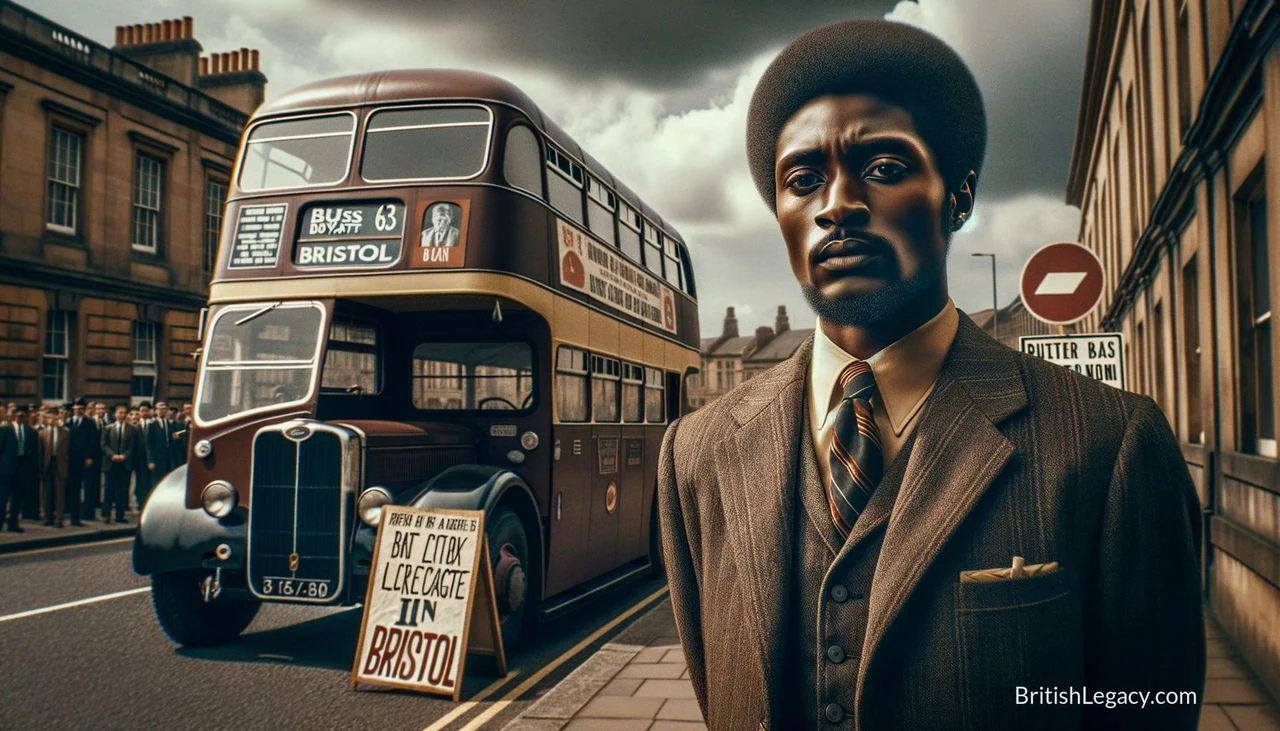
Paul Stephenson belongs in the story of modern Britain because he helped make racial discrimination in public employment impossible to ignore. Born in 1937, he became one of the central figures in the 1963 Bristol Bus Boycott, a campaign that challenged the refusal of the Bristol Omnibus Company to employ Black or Asian bus crews. What might have been dismissed as a local hiring dispute became something much larger: a public test of whether Britain would tolerate an open colour bar in everyday working life.
That is why Stephenson matters far beyond Bristol. The boycott was a practical campaign with a clear aim, but it was also a moral confrontation. It asked whether a city could rely on public transport while accepting that some of its own people were excluded from serving the public because of their race. Stephenson's leadership, and the discipline of those who stood with him, helped turn that question into a national issue. The campaign has been compared in significance with the Montgomery Bus Boycott in the United States, not because the two places were identical, but because each exposed the way ordinary transport could become a battleground for civil rights.
A boycott that exposed a British injustice
In the early 1960s, the Bristol Omnibus Company, backed by the Bristol branch of the labour union, refused to employ Black or Asian bus crews. The policy was plain, deliberate discrimination. It shut people out of work not because of ability or conduct, but because of race. That mattered in immediate practical terms, because jobs were being denied. It mattered just as much symbolically, because the exclusion said that Black and Asian people could use a public service but were not acceptable as the people running it.
Stephenson's importance lies partly in the clarity with which he and his fellow campaigners recognised that this was not an isolated slight. It was a system. The boycott was therefore not framed as a complaint about one unfortunate incident, but as a challenge to an entrenched practice. That distinction is crucial. A one-off grievance can be minimised; a policy has to be defended or abandoned. By forcing Bristol to confront the issue in those terms, Stephenson helped move the argument from private prejudice to public principle.
This was also unmistakably a British struggle. The setting was not a distant abstraction but a city bus company, a local union branch and the ordinary routines of work and travel. The conflict showed that civil-rights history in Britain was not imported from elsewhere as a slogan. It grew from specific conditions in British towns and cities, and from campaigners who insisted that equality had to apply here as well.
Building a campaign in Bristol
Stephenson did not act alone, and the article's account makes that collective character part of the achievement. Alongside Roy Hackett, Owen Henry, Audley Evans and Prince Brown, he helped launch the Bristol Bus Boycott in April 1963. Those names matter because the victory was not the work of a single heroic voice detached from the community. It was organised, shared and sustained by people prepared to challenge a powerful local arrangement together.
The campaign's strength lay in the simplicity of its demand. The boycott sought to pressure the Bristol Omnibus Company into hiring Black and Asian workers. There was nothing vague about that goal. It was measurable and concrete. Either the colour bar would remain, or it would end. That clarity made the campaign intelligible to the public and difficult for its opponents to disguise behind procedural excuses.
The movement quickly gathered support in Bristol and beyond. That widening support is an important part of Stephenson's legacy. A successful boycott is never only about moral conviction; it also depends on persuasion, endurance and the ability to turn private sympathy into visible pressure. Stephenson and his colleagues managed to do that. Over four months, they kept attention fixed on an injustice that many institutions might have preferred to outlast in silence.
Four months that forced change
The boycott lasted for four months and drew the attention of the media and the wider British public. That duration tells its own story. It was long enough to prove seriousness, long enough to sustain scrutiny, and long enough to make continued resistance costly in reputational terms. Public pressure became part of the mechanism of change. The issue could no longer be treated as a matter for closed conversations between company managers and union officials.
Eventually, the campaign succeeded. On 28 August 1963, the company announced the end of its colour bar. The importance of that moment lies not only in the statement itself, but in what it made possible in practice. The policy changed, and Raghbir Singh was employed as Bristol's first non-white bus conductor. A barrier that had been defended as normal was broken in the open.
This is where Stephenson's leadership becomes especially significant. Many campaigns expose an injustice; fewer compel an institution to reverse itself. The boycott achieved a result that could be seen and tested in real life. It altered who could hold a public-facing job in Bristol. It also demonstrated that organised local action, if clear in purpose and sustained in pressure, could force established bodies to retreat from racial discrimination.
The victory carried another lesson that still matters. Systems of exclusion often present themselves as ordinary custom, too embedded to challenge. Stephenson and his fellow campaigners proved otherwise. They showed that what had been normalised could still be named, resisted and changed.
Beyond one protest
It would be enough to remember Paul Stephenson for the Bristol Bus Boycott alone, but the supplied account makes clear that his public service did not end there. He continued his activism in other campaigns and educational roles, extending the work beyond the immediate battle with the bus company. That continuation matters. It suggests a life shaped not by a single dramatic episode, but by a sustained commitment to justice.
In 1974, he became the first Black youth worker in Bristol. Even in the brief form in which the fact survives here, it is revealing. Youth work is patient, practical work. It deals with confidence, opportunity, guidance and belonging. To become the first Black person to hold such a role in the city meant carrying symbolic weight as well as professional responsibility. It also points to a wider truth about Stephenson's legacy: he was not interested only in winning arguments against discrimination, but in helping build fairer civic life afterwards.
The same spirit runs through the account of his ideals. Equality, justice and community solidarity were not separate themes in his work; they belonged together. The point was not merely to condemn bad rules, but to help create a society in which people of different backgrounds were treated with dignity. That is a harder and more durable ambition than protest alone.
Influence, recognition and lasting meaning
The success of the Bristol Bus Boycott is presented as having far-reaching implications. It helped push the question of race and equality higher in British public life and is linked here to the creation of the Race Relations Act 1965, the first British legislation aimed at tackling racial discrimination. Whether one looks at the boycott as a catalyst, a warning or a precedent, its significance is clear: it showed that racial exclusion in Britain was not an abstract social problem but a matter requiring public action.
Stephenson's methods also mattered. The article links his outlook with wider civil-rights leadership, including inspiration drawn from Martin Luther King Jr., while stressing that he adapted those principles to British conditions. That adaptation is one of the most interesting features of his achievement. He was not simply repeating another country's movement. He was applying the language of equality and collective action to the institutions, habits and pressures of Britain as they actually were.
Recognition came formally in 2009, when he was appointed OBE. Honours do not create a legacy, but they can signal that a country has begun to acknowledge whom it once made fight to be heard. In Stephenson's case, the honour sits most meaningfully beside the earlier achievement: he helped expose a wrong in British life, helped defeat it in one of its visible forms, and remained engaged in work that benefited ethnic minority communities afterwards.
Why Paul Stephenson deserves a place in British Legacy
Paul Stephenson deserves a place in British Legacy because he helps us see British history more clearly. His story shows that the struggle for civil rights was not only something to admire from afar in books, speeches and foreign newsreels. It happened in Bristol, in disputes over jobs, public services and dignity. Stephenson stood at the centre of a campaign that took a local colour bar and made it a national embarrassment. In doing so, he helped prove that British fairness means very little unless it reaches the workplace, the street and the institutions people use every day.
He also deserves to be remembered because the achievement was concrete. The boycott was not a gesture without consequence. It ended a discriminatory hiring policy and opened the way for Black and Asian workers to take their place on Bristol's buses. Its success then fed into a wider shift in how Britain confronted race relations. That is a serious civic contribution: not only protesting against injustice, but helping to move the country towards law, policy and public standards that treated exclusion as unacceptable.
There is something enduringly instructive in Stephenson's example. He worked through solidarity, persistence and a demand so clear that no institution could honestly misunderstand it. Later, in youth work and community roles, the same commitment appears in another form: not just resistance to unfairness, but investment in people and belonging. Future generations can look at his life and understand that British democracy has often been improved by those willing to challenge it to live up to its own promises. That is exactly the kind of inheritance British Legacy exists to honour.