Joseph Mallord William Turner made landscape and seascape carry more than scenery. Across six decades, he painted turbulent seas, shifting skies and the changes brought by steam and railways, continually testing how colour and atmosphere could shape what a viewer saw. The painter who began as a young architectural draughtsman became a Royal Academician, a prolific traveller and one of Britain’s defining artists of the Romantic period.
A precocious start at the Royal Academy
Turner was born in London on 23 April 1775. His father, William, ran a barbershop and wig shop and encouraged his son’s early drawings, displaying them in the shop window. Turner entered the Royal Academy Schools in 1789, aged 14. He was already working: architectural and topographical watercolours brought him commissions from architects, and he studied London views with the draughtsman Thomas Malton. He also painted theatre scenery, an early experience that may help explain his later interest in dramatic light and colour.
His progress at the Academy was rapid. A watercolour was accepted for its annual exhibition in 1790; in 1796, he exhibited Fishermen at Sea, a moonlit seascape that helped establish his reputation as a marine painter. He became a Royal Academician in 1802, aged 27. Before then, he had built a market for his work through commissions, exhibitions and watercolours that gave customers views of places across Britain. In 1804 he opened his own gallery in London, giving him more control over how his paintings were shown and sold.
Turner’s standing did not shield him from hostility. His working-class origins and accent could set him apart in the Academy’s aristocratic circles, while his increasingly experimental paintings drew sharp criticism. Yet he remained attached to the institution. Elected its Professor of Perspective in 1807, he gave his first public lecture in 1811. He was not a polished lecturer, but he taught in the Academy Schools and worked to improve their teaching.
Learning from journeys, changing what landscape could do
Travel was central to Turner’s practice. From 1791, he made regular sketching journeys, first around Britain and later across Europe. His sketchbooks gathered observations of buildings, rivers, mountains, clouds and changing weather; he could return to them years later when developing watercolours, prints and oils. The Thames remained a recurring subject, close to his London life. Tours through England and Scotland also supplied views for books and print projects, including Picturesque Views on the Southern Coast of England and The Rivers of England.
In 1802, during a brief interval of peace in Europe, Turner travelled to Paris and the Swiss Alps. A longer journey through Italy in 1819 took him to cities including Venice and Rome. Further European trips followed. These encounters with landscapes and Old Master paintings fed an art that could borrow from established traditions without being confined by them. Turner worked in markedly different styles, sometimes presenting a carefully composed classical scene alongside a painting in which forms seem to dissolve into weather and light.
Watercolour was not a sideline. Turner developed it into a medium capable of great expressive range, while his oils also drew on techniques associated with watercolour. His changing approach to colour and atmosphere could be difficult for contemporary audiences. Some critics mocked the apparent looseness of later paintings; others recognised an attempt to show how nature is experienced through shifting light, mist and movement. His work helped raise the status of landscape, a genre long ranked below history painting in academic hierarchies.
That ambition is visible in the range of his subjects. In Snow Storm: Hannibal and his Army Crossing the Alps (1812), the invading army is diminished by a vast, threatening storm. The Shipwreck (1805) places people at the mercy of the sea. Turner’s landscapes and marine scenes could include ordinary working people and the risks of their lives, rather than treating nature as a decorative backdrop. In Slavers Throwing Overboard the Dead and Dying – Typhoon Coming On (1840), the storm-tossed sea frames a subject of human violence and suffering.
Ships, steam and the modern landscape
Turner’s interest in the sea endured from Fishermen at Sea to late marine paintings. He studied Dutch seascapes, but made the movement of water and the force of wind central to his own. Naval history, too, became a way to consider the human cost of conflict. His paintings of the Battle of Trafalgar departed from straightforward celebration: in his later version, the foreground includes blood and bodies in the water. The subject allowed him to show victory and loss together.
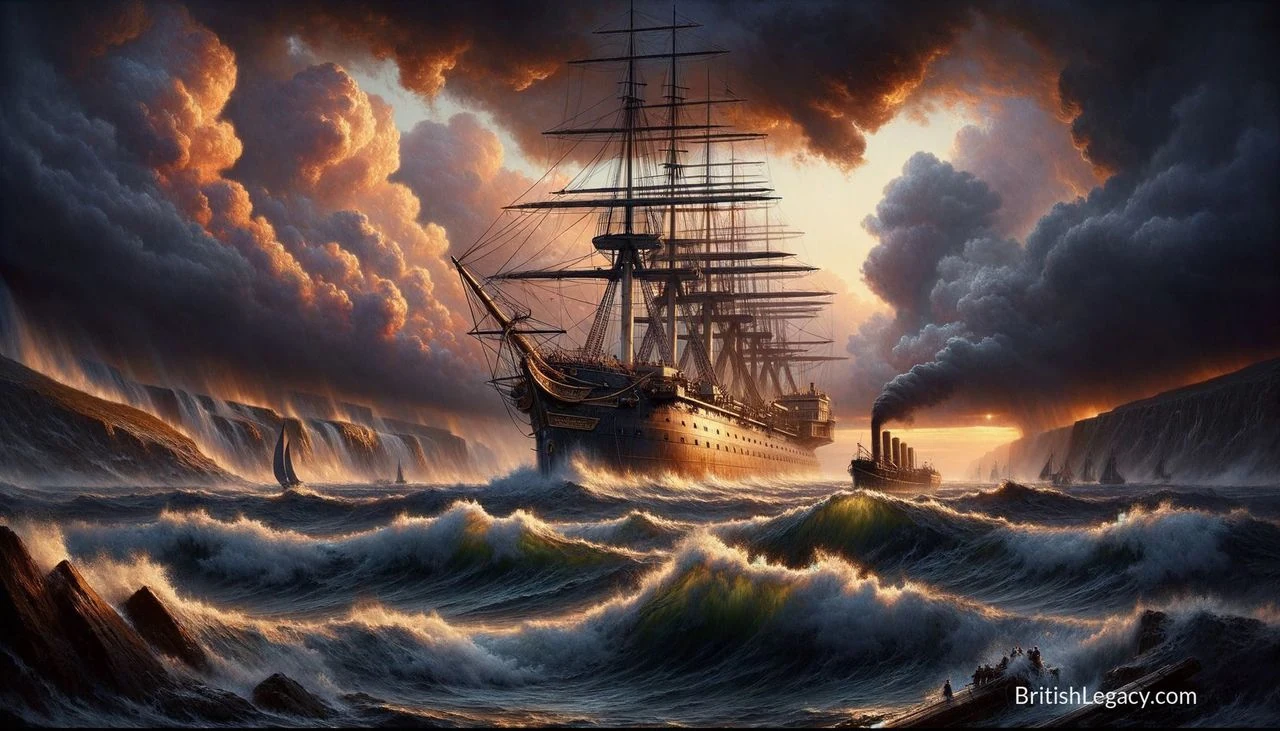
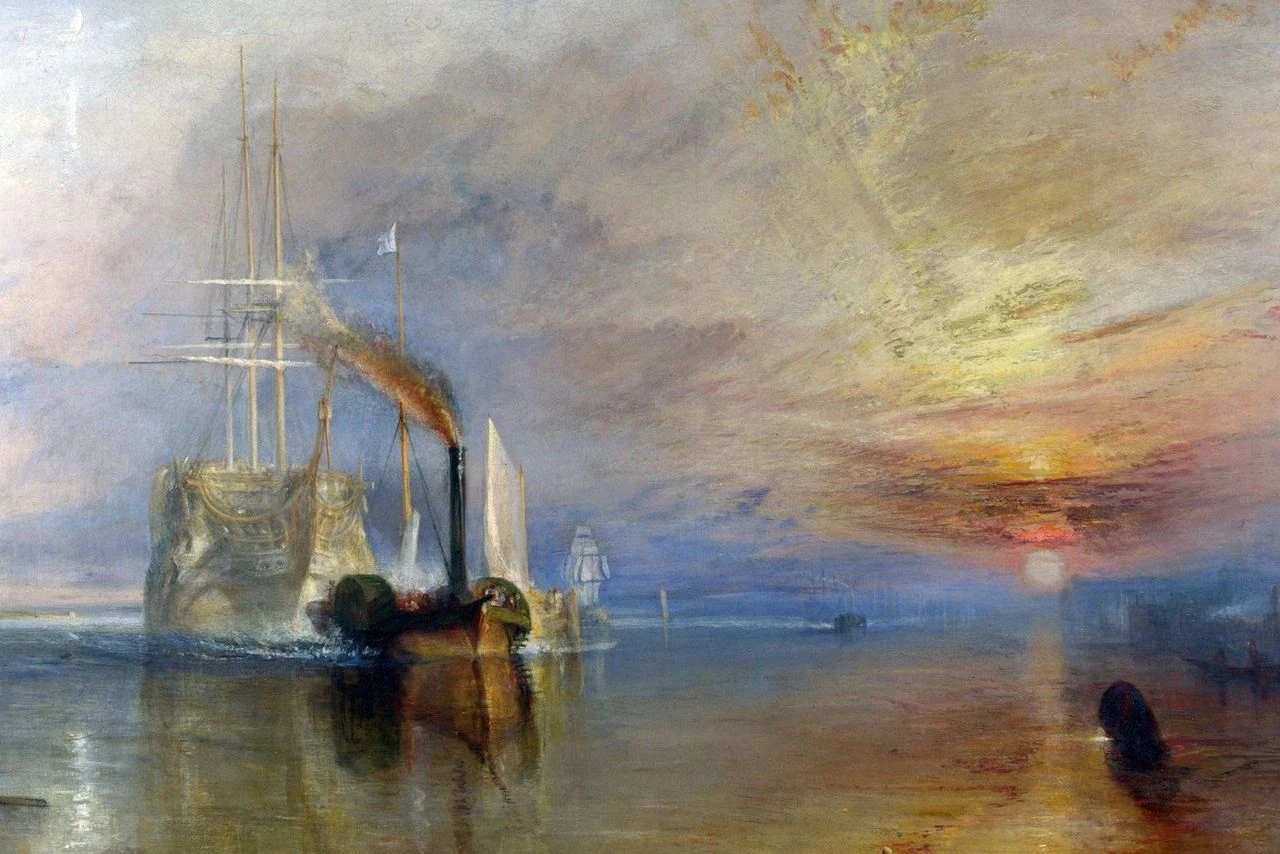
The Fighting Temeraire brings that sense of historical change into a quieter image. The former warship, a veteran of Trafalgar, is towed towards the place where it will be broken up. A small steam tug draws the great sailing vessel across a glowing evening sky: the old ship’s final journey becomes a meeting between Britain’s naval past and a newer industrial age. The painting’s date is commonly given as 1839, the year it was exhibited; the National Gallery title includes 1838. Turner’s image makes the transition itself, not simply the vessel’s history, part of its subject.
He also painted the new machinery of his own time. In Keelmen Heaving in Coals by Moonlight (1835), labour and industry occupy a night-time scene on the Tyne. Rain, Steam and Speed – The Great Western Railway (1844) shows a locomotive rushing over a bridge through rain and haze. The train is not rendered as a precise engineering study: its speed and the conditions around it are the point. Turner treated the railway as a subject for painting, bringing industrial change into a landscape tradition that might otherwise have looked only to rural scenery and the past.
His work was not always well received. Some late paintings were dismissed as incoherent, even as Turner continued to experiment with colour and increasingly simplified forms. Later viewers and artists found a different significance in those choices. Monet and Pissarro saw Turner’s paintings during a visit to London in 1870; his handling of light and atmosphere is associated with their early Impressionist work. That influence sits alongside his own sustained engagement with the conventions of the Academy, rather than replacing it.
Legacy in paintings and public life
Turner died in London on 19 December 1851, aged 76, and was buried at St Paul’s Cathedral. He left a substantial body of work: about 550 oil paintings and more than 2,000 watercolours, as well as drawings and sketchbooks. His bequest to the nation included around 100 finished and 200 unfinished oil paintings, together with a large collection of works on paper. He wanted a gallery to be built for the paintings. After disputes over his will and the intended site, the Clore Gallery at Tate Britain opened in 1987 to house the bequest.
His continuing public presence takes several forms. Turner’s works are held by institutions including the National Gallery and Tate Britain. The Turner Prize, established in 1984, is awarded to a British visual artist. A memorial plaque marks the site of his birthplace in Maiden Lane, Covent Garden. His art also entered popular culture through Mike Leigh’s 2014 film Mr. Turner, which focused on the painter’s later years.
Why J. M. W. Turner deserves a place in British Legacy
Turner belongs in British Legacy because his career connects artistic change to the places and transformations of Britain. The Thames, the English coast, the Tyne and the railway were not merely settings: they became subjects through which he examined how people lived alongside water, weather, work and new technology. In The Fighting Temeraire, an ageing warship and a steam tug share the same frame; in Rain, Steam and Speed, the railway becomes an experience of motion and atmosphere. These paintings make national history visible without reducing it to celebration. They hold change, memory and human cost together.
His legacy also lies in the possibilities he opened for painting. Turner pursued landscape across watercolour, oil and print, travelled to collect observations, and continued to experiment even when audiences resisted the results. His treatment of light and atmosphere influenced Monet and Pissarro, while his bequest placed a major body of work in public hands and ultimately led to the Clore Gallery at Tate Britain. The Turner Prize gives his name a continuing place in British visual culture, though its significance rests not on a simple claim that every later artist follows him. It is the combination of an expansive body of work, a lasting challenge to the limits of landscape painting and a documented public legacy that makes his place here compelling.
Sources
J. M. W. Turner — Wikipedia revision 1379822235
Adapted in part from J. M. W. Turner by Wikipedia contributors, under CC BY-SA 4.0. Text has been edited and combined with the existing article; this adapted text is shared under the same licence. Contributor history.