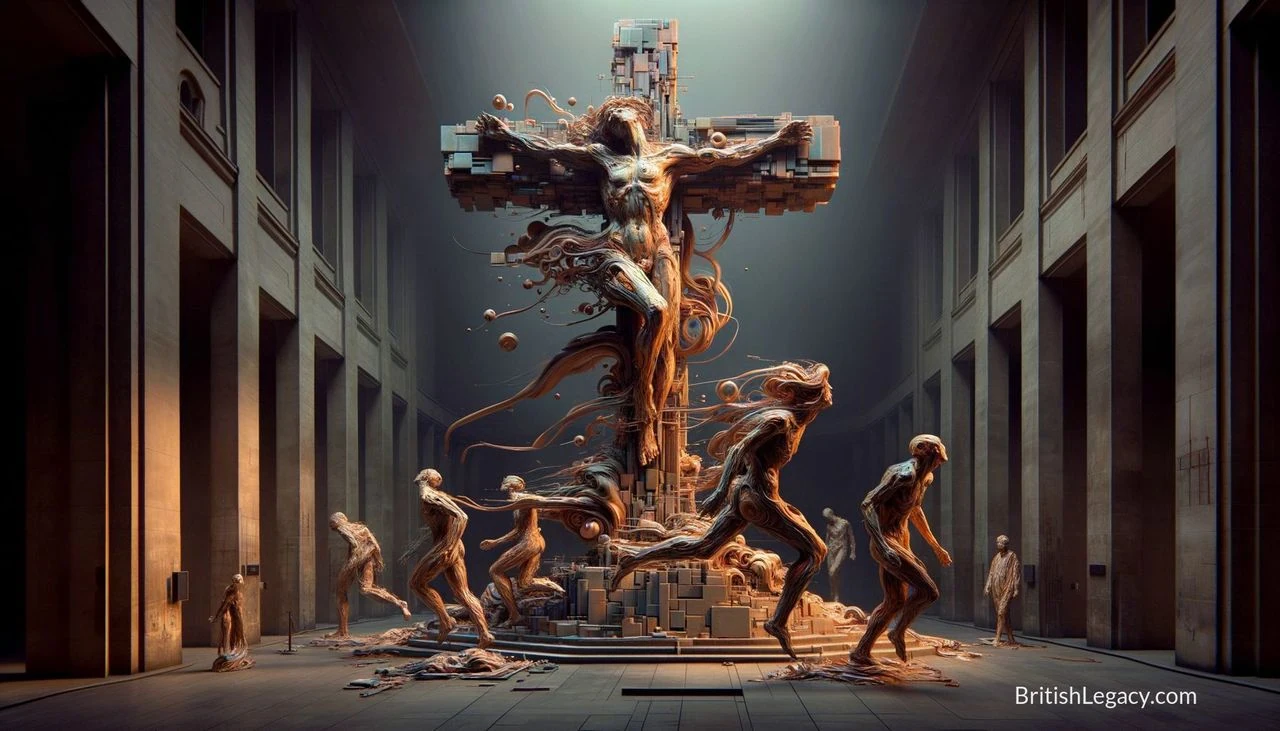
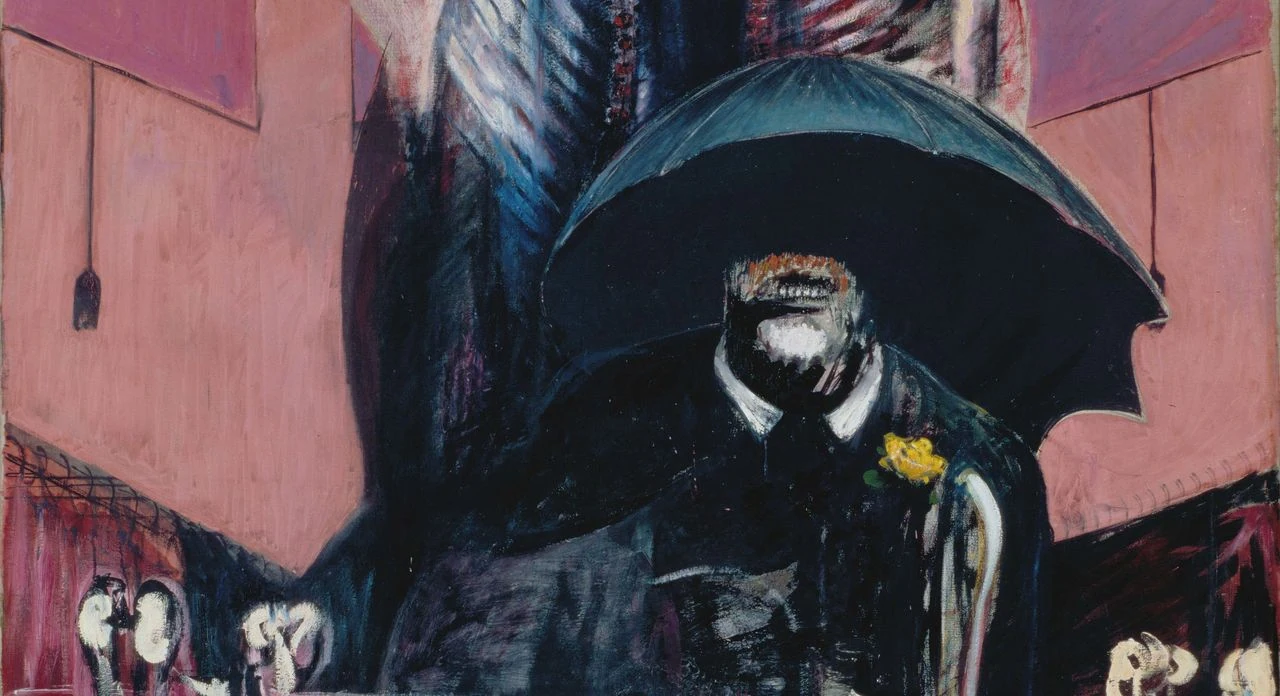
Francis Bacon built a career around the human figure, but rarely presented it as settled or whole. Faces appear distorted, bodies compressed or caught in motion, and figures often sit alone within spare, cage-like spaces. His 1944 triptych Three Studies for Figures at the Base of a Crucifixion brought this unsettling language to public attention. It also announced the concerns that would persist through a long career: the body, suffering, isolation and the unstable boundary between portrait and abstraction.
A Dublin childhood and a delayed start
Bacon was born in Dublin on 28 October 1909, when Ireland was part of the United Kingdom of Great Britain and Ireland. His father, Anthony Edward Mortimer Bacon, was born in Australia to English and Australian parents; his mother, Christina Winifred Firth, came from a family associated with Sheffield steel and coal. The family moved between Ireland and England, and Bacon’s formal education was interrupted by illness, including asthma. He attended Dean Close in Cheltenham from 1924 to 1926, but did not follow a conventional route into art.
After leaving the family home, he spent time in London, Berlin and Paris. In Paris he visited galleries and encountered works that remained important to his visual imagination. He returned to London in 1928 or 1929 and worked as an interior decorator and furniture designer. Painting came seriously only later, after years of drifting between jobs and places. His early works included Crucifixion (1933), which attracted public attention, but the response disappointed him. He became disillusioned with painting and abandoned it for several years.
By the late 1930s Bacon had resumed work, though much of his early output was later destroyed or suppressed. During the Second World War he volunteered for civil defence, serving in the Air Raid Precautions rescue service until asthma made him unfit to continue. In 1943 he took a studio at 7 Cromwell Place in South Kensington. The room became a working base as his painting developed towards the stark, individual style for which he became known.
The breakthrough of the Three Studies
Three Studies for Figures at the Base of a Crucifixion (1944) is generally regarded as Bacon’s first mature work. Its three biomorphic figures, set against an emphatic orange ground, draw on his earlier interest in the Crucifixion and on forms associated with Picasso. The triptych was exhibited in 1945 and established Bacon as a leading figure in post-war British painting. He later regarded the paintings that preceded it as irrelevant, a judgement that underlines how sharply he separated his mature practice from his uncertain beginnings.
The Crucifixion remained a recurring structure in Bacon’s work: not simply a religious subject, but a way to arrange bodies, spectatorship and bodily harm. He returned to the theme at different points in his career. The same period also brought the beginnings of other motifs. The open mouth, which would recur in his paintings, drew on several visual sources, including medical illustrations and the image of the screaming nurse in Sergei Eisenstein’s film Battleship Potemkin. Bacon transformed such references rather than illustrating them directly.
In the late 1940s and 1950s he developed his series of heads and popes. His pope paintings drew on Diego Velázquez’s portrait of Pope Innocent X, but Bacon’s isolated figures seem less like formal likenesses than studies in confinement and exposure. In Study after Velázquez’s Portrait of Pope Innocent X (1953), the open mouth and vertical lines around the figure intensify the sense of a voice caught inside the picture. The motif is often described as a scream, though Bacon’s open mouths can also suggest other expressions.
Portraits, friends and changing motifs
Bacon frequently worked in series, returning to a subject or image across several canvases and often using diptych or triptych formats. His output ranged from the biomorphic forms of the 1930s and the heads and popes of the following decades to animal subjects, portraits and self-portraits. From the mid-1960s, he concentrated mainly on portraits of friends and companions. The figures are often abstracted, while their surroundings are reduced to simple, enclosing structures.
George Dyer became one of the most important presences in this work. Bacon met him in 1963, and Dyer appeared in numerous portraits. Their relationship was difficult; it was not a simple story of a sitter and painter. Dyer died by suicide in Paris in October 1971, shortly before the opening of Bacon’s retrospective at the Grand Palais. Bacon continued with the exhibition, then made a group of portraits and three so-called Black Triptychs that dealt with the period surrounding Dyer’s death. In later paintings, loss and the passage of time became increasingly prominent.
Bacon’s life was also closely bound to Soho, where he spent time with artists and other friends. The Colony Room, a private drinking club in Dean Street, was among his regular haunts. His social world and his studio practice were distinct, but portraits of people close to him became a major part of his art. He did not merely record their likenesses: repetition, distortion and changes of pose allowed him to return to the same person from different angles and at different moments.
Recognition, death and the studio in Dublin
Bacon’s reputation grew after the 1945 exhibition of the Three Studies. He represented Britain internationally and became one of the best-known painters of his generation. The scale of his achievement is visible in the range of subjects he sustained over decades, as well as in the continuing attention paid to his work. His paintings have also commanded exceptional prices at auction, though market value is only one measure of their standing.
Bacon died in Madrid on 28 April 1992, aged 82. After his death, the contents of his studio at 7 Reece Mews in South Kensington were donated to the Hugh Lane Gallery in Dublin. The studio was documented and reconstructed there, preserving the arrangement of the room and making its dense collection of materials available for study. The archive includes photographs, books, correspondence, artist’s materials and damaged canvases. It offers a record of the working environment behind paintings that can otherwise seem to have emerged from an intensely private imagination.
Why Francis Bacon deserves a place in British Legacy
Bacon belongs in a story of British art because his career helped define the possibilities of post-war painting in Britain. The 1944 Three Studies for Figures at the Base of a Crucifixion marked a decisive break in his own practice and established a powerful new presence in the country’s art world. He made the human figure a site of instability rather than ideal form, and used series, triptychs and repeated motifs to examine how a face or body could change under pressure. His paintings do not offer easy consolation, but they gave later audiences and artists a demanding way to think about physical vulnerability and isolation.
His British connection sits alongside, not in place of, his Irish birth and the international reach of his work. Bacon spent important working years in London, where his studio and social life became part of the city’s post-war cultural landscape. His paintings travelled widely, while the reconstruction of his Reece Mews studio at the Hugh Lane Gallery in Dublin preserves a substantial record of how he worked. Together, the pictures and the studio show both the force of a singular artistic vision and the practical process of making it: accumulating images, returning to subjects and testing variations over time. That combination of a defining British career, an internationally influential body of work and a preserved working archive gives Bacon a lasting place in British Legacy.
Sources
Francis Bacon (artist), revision 1374145571 · Francis Bacon (artist)
Adapted in part from Francis Bacon (artist) by Wikipedia contributors, under CC BY-SA 4.0. Text has been edited and combined with the existing article; this adapted text is shared under the same licence. Contributor history.