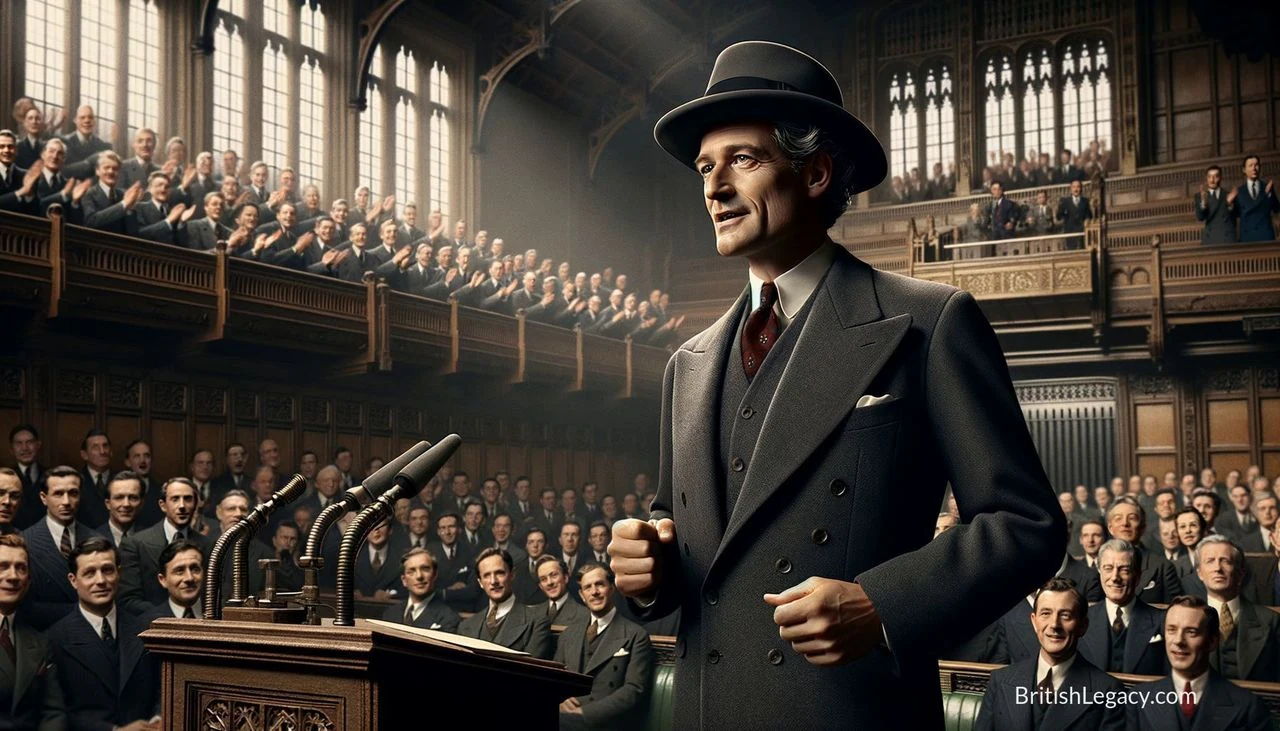
Winston Churchill’s place in British history rests most securely on his leadership during the Second World War, but the familiar image of the defiant wartime prime minister captures only part of a long and contentious career. He was a soldier and war correspondent, a minister in Liberal and Conservative governments, a prolific writer and a politician whose record included social reform as well as decisions that remain controversial. His speeches gave public expression to the resolve to continue fighting in 1940; his political life before and after the war shows a figure shaped by ambition, changing party loyalties and a powerful attachment to the British Empire.
A soldier who turned experience into a career in print
Churchill was born at Blenheim Palace in Oxfordshire on 30 November 1874. His father, Lord Randolph Churchill, was a Conservative politician; his mother, Jennie Jerome, was American. Educated at Harrow and the Royal Military College, Sandhurst, he became an officer in the 4th Queen’s Own Hussars in 1895. He sought opportunities to see military action and to write about it. In Cuba, India and Sudan he served as a soldier and correspondent; his dispatches and books helped make his name before he entered Parliament.
During the Second Boer War, Churchill reported for the Morning Post. Captured after his train was derailed, he escaped from a prisoner-of-war camp in Pretoria, an episode that attracted public attention. He later returned to South Africa with the South African Light Horse. Elected Conservative MP for Oldham in 1900, aged 25, he published accounts of his experiences and undertook lecture tours. Journalism and authorship were not side occupations: writing remained a source of income and a central part of his public career.
Party changes and social reform
Churchill crossed from the Conservatives to the Liberals in 1904, having opposed protectionist tariffs. In the Liberal governments of the early twentieth century he held several senior offices. As president of the Board of Trade, he worked with David Lloyd George on social reforms, including measures on working hours, minimum wages and assistance for unemployed people. As home secretary, he pursued changes to prison administration. His record was not uniformly progressive: his handling of industrial unrest, including the Tonypandy riots, drew lasting criticism from parts of the labour movement.
As First Lord of the Admiralty from 1911, he concentrated on naval preparation. During the First World War, the failure of the Dardanelles and Gallipoli campaigns brought intense criticism, and he left the Admiralty in 1915. He then served on the Western Front before returning to government. In David Lloyd George’s wartime administration he became minister of munitions and later held the war and air portfolios. His political trajectory continued to shift: after losing his seat in 1922 and spending time outside Parliament, he returned as a Conservative and served as chancellor of the exchequer from 1924 to 1929. His decision to restore the pound to the gold standard in 1925 was controversial and is associated in the historical account with deflation and unemployment.
Warning about Germany, then leading a country at war
Out of government during much of the 1930s, Churchill warned against German rearmament and opposed the policy of appeasement. When Britain declared war on Germany in September 1939, Neville Chamberlain appointed him First Lord of the Admiralty. On 10 May 1940, after the German invasion of Belgium, Luxembourg and the Netherlands, Churchill became prime minister and formed a coalition government that included Labour leaders Clement Attlee and Arthur Greenwood.
His first speech as prime minister promised “blood, toil, tears and sweat”; in June, as France fell and the evacuation from Dunkirk ended, he told the Commons that Britain would “fight on the beaches”. His words made the government’s refusal to seek a settlement clear at a moment when the course of the war remained perilous. He also directed and participated in the work of a coalition administration, overseeing Britain’s contribution to the Allied war effort and maintaining close relations with United States president Franklin D. Roosevelt. The United States provided vital supplies through Lend-Lease. Churchill and Roosevelt’s 1941 Atlantic Charter set out shared aims for the post-war world, while the invasion of the Soviet Union that year brought the Soviet Union into the alliance against Germany.
His premiership involved strategy, diplomacy and the management of a state at war, not speeches alone. Churchill took part in Allied conferences with Roosevelt and Joseph Stalin as plans for the defeat of Germany and the post-war settlement developed. The Allies accepted Germany’s surrender in May 1945. Churchill broadcast the news of victory in Europe and appeared with the Royal Family at Buckingham Palace. Yet the end of the war did not secure his political future. Labour won the July 1945 general election, and Churchill resigned as prime minister.
After 1945: opposition, a second premiership and writing
As Leader of the Opposition, Churchill used a 1946 speech in the United States to describe the division of Europe by Soviet influence as an “iron curtain”. He also advocated European co-operation, while insisting that Britain should not join a federal grouping. The Conservatives returned to office in 1951, and Churchill became prime minister for a second time. His government’s domestic priority included a substantial housebuilding programme, which reached its target of 300,000 homes a year. Foreign affairs, including relations with the United States and the changing position of the British Empire, occupied much of his attention. He resigned in 1955 and remained an MP until 1964.
Churchill’s public life was accompanied by sustained work as a writer. He published histories, biographies, memoirs and journalism, including the six-volume The Second World War and the four-volume A History of the English-Speaking Peoples. In 1953 he received the Nobel Prize in Literature. He was also an amateur painter. He died in London on 24 January 1965, aged 90, and was given a state funeral. His grave is at St Martin’s Church, Bladon, in Oxfordshire.
Power, empire and the arguments around his record
Churchill’s career cannot be reduced to his wartime premiership. He was a lifelong advocate of the British Empire, and his opposition to self-government in the colonies forms part of the record through which his reputation is judged. The account of his second premiership describes his attachment to the Empire and his concern for Britain’s position as a world power, even as decolonisation advanced. His attitudes and actions have also drawn criticism in discussions of race.
Wartime decisions require scrutiny alongside his public leadership. During the Bengal famine of 1943, millions died amid shortages, administrative failures and natural disasters. Churchill’s government was criticised for its response and for refusing requests for greater grain imports; the impact of British policy on the death toll remains contested. He also initiated an area-bombing campaign, and later expressed concern about the destruction of Dresden. Remembering these matters does not erase the significance of his leadership in 1940; it gives a fuller account of the powers he exercised and the consequences of decisions made under his government.
Why Winston Churchill deserves a place in British Legacy
Churchill deserves a place in British Legacy because his leadership in 1940 became a defining episode in the country’s experience of the Second World War. At a moment when France had fallen and Britain faced the prospect of invasion, he led a coalition government committed to continuing the fight. His speeches gave memorable form to that decision, while his work with allies helped sustain the effort through to victory in Europe. That record is specific and consequential: it connects political judgement, public communication and the conduct of a national government under extreme pressure.
His wider career also makes his place in the national story worth examining rather than simply celebrating. Churchill’s work on social legislation, his shifting party allegiance, his writing and his second premiership all show a politician whose influence extended well beyond the wartime years. So do the harder parts of his legacy: his defence of empire, criticism of his racial views and the continuing debate over government policy during the Bengal famine. A British legacy that acknowledges both achievement and consequence is more useful than a portrait of unqualified heroism. Churchill’s life offers a way to consider how leadership is exercised, how public memory is formed and why the record of even the most celebrated figures must remain open to scrutiny.
Sources
Winston Churchill — Wikipedia revision 1378790280 · Winston Churchill — Wikipedia
Adapted in part from Winston Churchill by Wikipedia contributors, under CC BY-SA 4.0. Text has been edited and combined with the existing article; this adapted text is shared under the same licence. Contributor history.