
David Hockney moved between painting, printmaking, photography, stage design and digital drawing without treating any one medium as a limit. The vivid swimming pools that became among his best-known images grew from a move to Los Angeles; later, he returned to the landscapes of Yorkshire, making large works outdoors and turning to the iPad. Across a career rooted in Bradford and British art education but lived partly in the United States and France, he kept testing how pictures might represent people, places and the act of looking.
Bradford beginnings and an unconventional art-school education
Hockney was born in Bradford, West Yorkshire, on 9 July 1937, the fourth of five children. He attended Wellington Primary School and Bradford Grammar School before studying at Bradford School of Art from 1953 to 1958. In 1959 he entered the Royal College of Art in London, where he encountered artists including R. B. Kitaj, Frank Bowling and Neil Stokoe. His work appeared alongside Peter Blake’s in the New Contemporaries exhibition, associated with the arrival of British Pop art.
At the RCA, Hockney challenged the terms on which students were assessed. In 1962, after being told he could not graduate without completing a life-drawing assignment, he painted Life Painting for a Diploma in protest. He had refused to write an examination essay, arguing that his work should be judged through his art. The college changed its regulations and awarded him a diploma. The episode foreshadowed a career in which he would question conventions not only in subject and style, but in the tools artists might use.
His early work did not fit neatly into one category: alongside the association with Pop art, it included expressionist elements. We Two Boys Together Clinging (1961), named after a poem by Walt Whitman, addressed gay love. Hockney came out as gay while still a student, before the decriminalisation of homosexual acts between men over 21 in England and Wales in 1967. His paintings made intimate relationships part of his subject matter at a time when that openness carried particular weight.
California, swimming pools and the painted figure
Hockney moved to Los Angeles in 1964. The region’s light and way of life prompted a series of swimming-pool paintings, made with acrylic paint and strong colour. A Bigger Splash (1967) is among the works associated with this period: a still, sunlit setting is interrupted by the splash of someone entering the water, though the swimmer is absent from view. The image’s apparent simplicity rests on careful contrasts between the hard-edged architecture, the flat surface of the pool and the brief disturbance of the water.
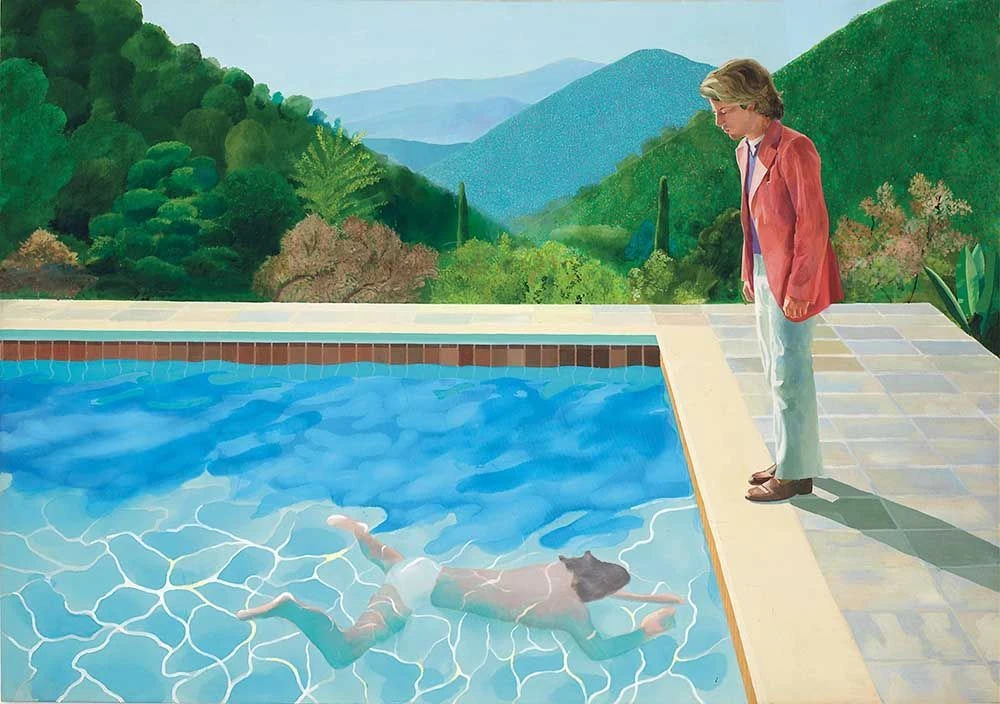
Portraiture remained equally important. From 1968, Hockney made life-size or slightly smaller paintings of friends, relatives and colleagues, often returning to the same sitters. His subjects included fashion designer Celia Birtwell and her husband Ossie Clark, art dealer Nicholas Wilder and dancer Wayne Sleep. He also repeatedly painted himself, producing more than 300 self-portraits. Portrait of an Artist (Pool with Two Figures) (1972) brings the pool motif together with the human presence that is sometimes absent from those earlier scenes: one figure stands at the water’s edge, looking towards a swimmer below the surface.
Hockney’s interest in theatre widened his practice beyond the canvas. His first stage designs included Ubu Roi at London’s Royal Court Theatre in 1966, followed by productions at Glyndebourne and the Metropolitan Opera. He later designed for the Royal Opera House, including Richard Strauss’s Die Frau ohne Schatten in 1992. Sets and costumes demanded that he think about colour, space and composition at a scale experienced by performers and audiences together.
Prints, photographs and changing ways of seeing
Hockney worked in lithography and etching as well as painting. His printmaking included the 1960s series A Rake’s Progress and Illustrations for Fourteen Poems from C. P. Cavafy, and, later, the suite The Blue Guitar, made with printer Aldo Crommelynck. Its imagery drew on a chain of artistic influence: Hockney’s etchings were inspired by Wallace Stevens, whose poem was itself inspired by Pablo Picasso.
In the early 1980s, Hockney began making photographic collages he called “joiners”. He assembled multiple photographs of one subject, taken from different viewpoints or at different moments, into a single image. Rather than accepting the camera’s fixed perspective, the resulting works asked how a viewer moves through a space. Pearblossom Highway #2 is a landscape example; My Mother, Bolton Abbey (1982) uses the approach for a portrait. Dissatisfaction with photography’s limits eventually helped draw him back to painting.
His experiments with technology continued. In 1985 he used the Quantel Paintbox, drawing directly on a screen for the BBC series Painting with Light. From 2009, he made hundreds of portraits, still lifes and landscapes with the Brushes application on an iPhone and iPad. The devices let him draw quickly and share images with friends, but they did not displace older methods: across his career he continued to work in print, watercolour, oil paint, photography and other media.
Yorkshire landscapes and major exhibitions
From the 1990s, Hockney returned increasingly often to Yorkshire. He began painting the countryside outdoors, using memory, observation and different media to explore familiar places anew. His large landscape Bigger Trees Near Warter, made on 50 canvases, was shown at the Royal Academy’s Summer Exhibition in 2007. He donated it to Tate in 2008. The work’s scale made the landscape itself an expansive subject, while its construction from separate canvases kept the process of making visible.
The Royal Academy’s 2012 exhibition A Bigger Picture brought together more than 150 works, including landscapes and drawings made on an iPad. It attracted more than 600,000 visitors in under three months before travelling to museums in Bilbao and Cologne. In 2017, Tate Britain mounted a retrospective spanning six decades and several media; it became the gallery’s most visited exhibition to that point. Hockney’s capacity to change tools without abandoning the pleasures of drawing was part of the story the exhibition presented.
He continued to develop new work later in life, including iPad images of Normandy’s changing seasons, made in 2020. His pictures are held in collections around the world, and the David Hockney Foundation, created in 2008, works to advance understanding and appreciation of visual art and culture through exhibitions, preservation and publication of his work.
Honours, public life and death
Hockney received the John Moores Painting Prize in 1967 and was made a Member of the Order of the Companions of Honour in 1997. In 2012 he was appointed to the Order of Merit. He was also a Royal Academician. These distinctions accompanied a career whose reach was measured not just in honours but in the breadth of work shown in major exhibitions, including retrospectives at Tate Britain, the Metropolitan Museum of Art and the Centre Pompidou.
He died at his home in London on 11 June 2026, aged 88. His life connected Bradford, London, Los Angeles, Yorkshire and Normandy, but his British contribution was never confined to birthplace or residence. It lay in the continuing influence of an artist who made the possibilities of painting, drawing and looking part of the subject itself.
Why David Hockney deserves a place in British Legacy
Hockney’s place in British Legacy rests on an identifiable body of work and a sustained willingness to make art through different means. Trained in Bradford and at the Royal College of Art, he emerged in the context of British Pop art, but never stayed within a single movement or medium. His paintings of California swimming pools, portraits of friends and family, prints, photographic collages, theatre designs and Yorkshire landscapes show how one artist could build a recognisable practice without repeating one formula. His experiments with screen-based drawing extended that enquiry into digital tools, while the landscapes returned attention to places in England he knew closely.
The public life of the work matters too. Major exhibitions at the Royal Academy and Tate Britain brought painting, drawing, print, photography and digital images into view together, allowing audiences to follow changes in both subject and technique. His donation of Bigger Trees Near Warter to Tate placed a substantial work depicting the Yorkshire landscape in a national collection. Through the David Hockney Foundation’s stated work of exhibition, preservation and publication, the effort to make his art available for study and appreciation also continues beyond individual shows. These are specific contributions to British visual culture: a long record of artistic experiment, the representation of British places and people, and works and collections that remain accessible to audiences.
Sources
David Hockney — Wikipedia revision 1376796197 · David Hockney — Wikipedia
Adapted in part from David Hockney by Wikipedia contributors, under CC BY-SA 4.0. Text has been edited and combined with the existing article; this adapted text is shared under the same licence. Contributor history.
.jpg)