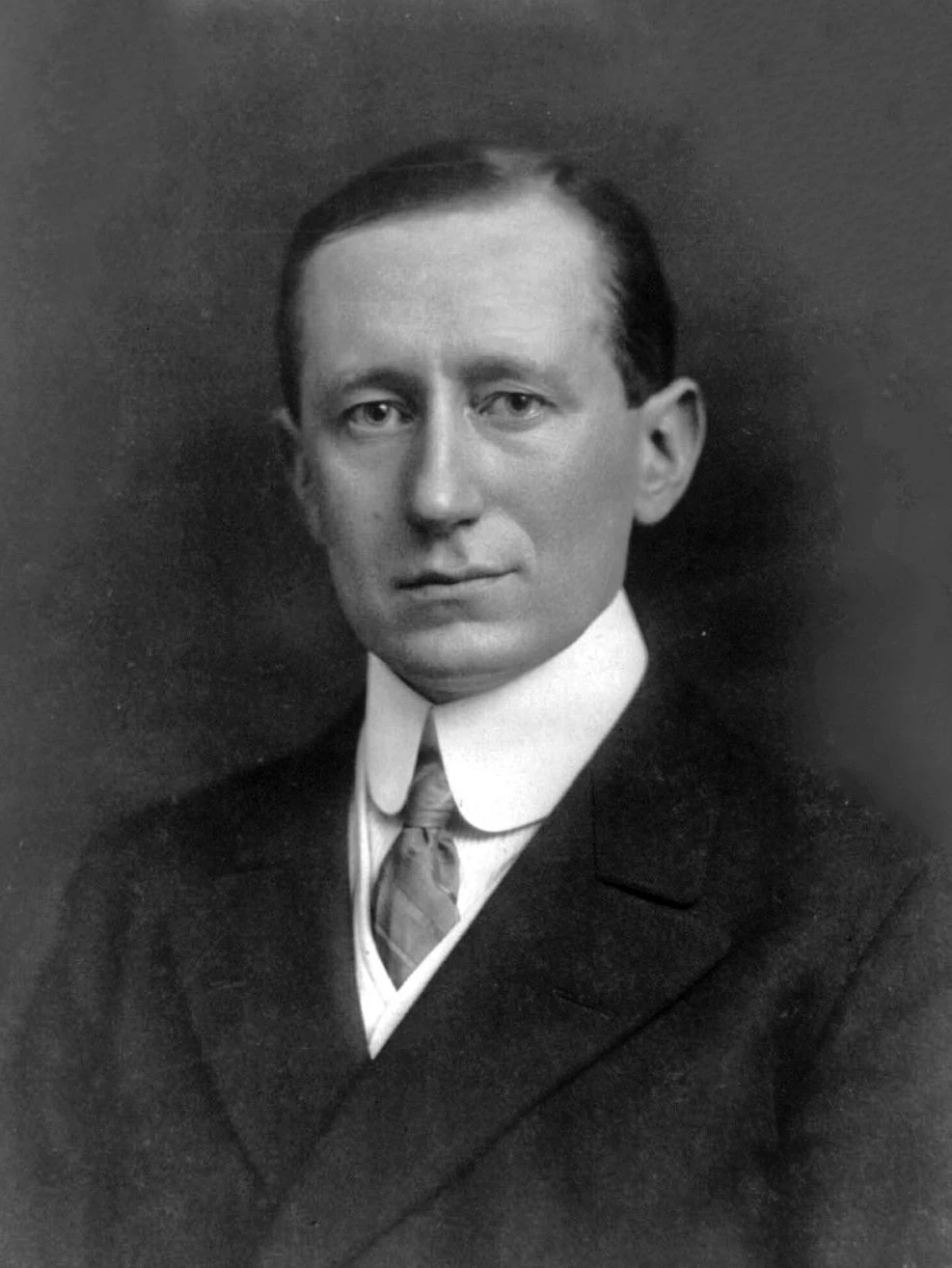
Guglielmo Marconi’s radio work crossed a crucial threshold in Britain: it turned wireless signalling from an experiment into a practical system for sending messages. After arriving in London in 1896, he secured support from the General Post Office’s chief electrical engineer, William Preece, patented his system and demonstrated it over increasing distances. His achievements helped establish a British company and a new means of communication between ships and shore. Marconi was Italian, not British, but Britain was central to the development and early commercial use of his wireless telegraphy.
Experiments become a working system
Born in Bologna on 25 April 1874, Marconi grew up in a family that could provide private tutors. He became interested in science and electricity, and in the early 1890s began exploring how telegraph messages might be sent without connecting wires. Radio waves were already being studied by physicists, but their potential as a practical communication method was not yet established.
Marconi began experimenting at his family home, Villa Griffone, with equipment he largely built himself. His early apparatus used a transmitter to produce radio waves, a receiver with a coherer to detect them and a telegraph key to send the dots and dashes of Morse code. In 1895, he improved the range by raising the antenna and grounding the transmitter and receiver. Tests on his family’s estate reached beyond a hill, a breakthrough that persuaded him the system might be developed for commercial and military use.
He travelled to Britain in 1896, aged 21, accompanied by his mother. The move brought him into contact with Preece, the General Post Office’s chief electrical engineer, who supported demonstrations of the new technology. Marconi applied for British Patent No. 12,039 on 2 June 1896. Its title, “Improvements in Transmitting Electrical impulses and Signals, and in Apparatus therefor”, described a communication system based on radio waves.
Marconi demonstrated the equipment in London and on Salisbury Plain. In May 1897, a message reading “Are you ready” travelled across open sea from Flat Holm Island to Lavernock Point, near Cardiff. The transmitter was then moved to Brean Down, extending the range to about ten miles. These tests made the Bristol Channel a working proving ground, not simply a dramatic backdrop to the story of wireless.
From British demonstrations to the Atlantic
Marconi’s system attracted interest beyond the Post Office. In 1897 he founded the Wireless Telegraph & Signal Company in the United Kingdom, later known as the Marconi Company. Further demonstrations followed: in March 1899, he sent a wireless signal across the English Channel from Wimereux in France to South Foreland Lighthouse in England.
Wireless also began to show its value in everyday and emergency settings. In 1898, Marconi’s system was used to report the Kingstown Regatta, an early instance of wireless coverage of a sporting event. That December, the British lightship service authorised a wireless link between South Foreland Lighthouse and the East Goodwin lightship. When a merchant vessel ran aground on the Goodwin Sands in March 1899, the lightship sent a distress signal that reached the lighthouse radio operator, who summoned the Ramsgate lifeboat.
Marconi’s best-known early experiment took place on 12 December 1901. From Poldhu in Cornwall, his transmitter sent the Morse code letter S, which he reported hearing at Signal Hill in St John’s, Newfoundland, across a distance of about 2,200 miles. The reception was celebrated as the first across the Atlantic, but its evidential basis has since been questioned: no automatic record was made, and Marconi and his assistant listened for the expected signal through a telephone receiver.
More systematic tests followed in 1902, aboard the SS Philadelphia. Marconi recorded readable messages from Poldhu at distances of up to 1,551 miles, and test letters at up to 2,099 miles. These measurements gave recorded evidence of long-distance reception, although they did not settle every question about the earlier Newfoundland experiment. In December 1902, official transatlantic wireless messages were exchanged between Poldhu and the Marconi station at Table Head, near Glace Bay in Nova Scotia.
Wireless at sea and the growth of broadcasting
Communication with ships gave wireless a practical purpose beyond distance records. In 1904, Marconi’s company began sending nightly news summaries to subscribing ships. In 1907, a regular commercial transatlantic radiotelegraph service opened between Glace Bay and Clifden, Ireland, although reliable communication across the ocean remained technically difficult for several years.
Wireless distress calls helped bring the technology to wider public attention. After the collision between RMS Republic and SS Florida in 1909, the Republic’s Marconi equipment was used to send calls for help, contributing to the rescue of more than 1,500 people. The sinking of RMS Titanic in 1912 brought further attention to marine wireless. Its operators, Jack Phillips and Harold Bride, worked for the Marconi International Marine Communication Company, rather than the ship’s owner. Marconi gave evidence to the British Wreck Commissioner’s inquiry about wireless telegraphy and emergency procedures at sea.
Britain was also an early setting for radio broadcasting. The Marconi Company’s New Street Works in Chelmsford hosted Dame Nellie Melba in a public entertainment broadcast on 15 June 1920. In 1922, the company operated stations at 2MT in Writtle and 2LO in London; both helped pave the way for the formation of the British Broadcasting Company.
International recognition and political life
In 1909, Marconi shared the Nobel Prize in Physics with Ferdinand Braun, in recognition of their contributions to the development of wireless telegraphy. His British career was part of an international life: he served in Italian military and naval technical roles during the First World War, and was appointed to the Senate of the Kingdom of Italy in 1914. He received an Honorary Knight Grand Cross of the Royal Victorian Order in Britain that year.
Marconi’s public life also included his affiliation with Fascism. He joined Italy’s National Fascist Party in 1923 and later held senior positions under the regime, including president of the National Research Council and president of the Royal Academy of Italy. He publicly identified himself with Fascism. That political record belongs in an account of his career alongside his engineering achievements; technological importance does not erase political choices.
Marconi died in Rome on 20 July 1937, aged 63. At the time of his death he was president of the Royal Academy of Italy. Radio transmitters around the world observed two minutes of silence in his honour, and the British Post Office asked broadcasting ships to join them.
Why Guglielmo Marconi deserves a place in British Legacy
Marconi deserves a place in British Legacy because the decisive development of his wireless system was closely connected to Britain. Here, with support from William Preece and the General Post Office, he patented his system and demonstrated that it could carry messages across open water. The company he founded in the United Kingdom helped turn wireless telegraphy into a commercial service. His work linked British shores and ships, and the distress signal sent from the East Goodwin lightship showed the human value that the technology could have when a vessel was in danger.
His British story also runs from the experimental links across the Bristol and English Channels to transatlantic services, shipboard news and early broadcasting in Chelmsford and London. These were not all the work of one inventor: they depended on engineers, operators, companies and the development of the technology over time. Marconi’s importance lies in helping make wireless communication practical and in building organisations that put it to use. Remembering him here is not a claim that he was British, nor that he single-handedly created modern communications. It recognises how an Italian-born inventor’s work took root in Britain and contributed to changes in maritime safety, news distribution and broadcasting.
Sources
Guglielmo Marconi — Wikipedia revision 1379540110
Adapted in part from Guglielmo Marconi by Wikipedia contributors, under CC BY-SA 4.0. Text has been edited and combined with the existing article; this adapted text is shared under the same licence. Contributor history.