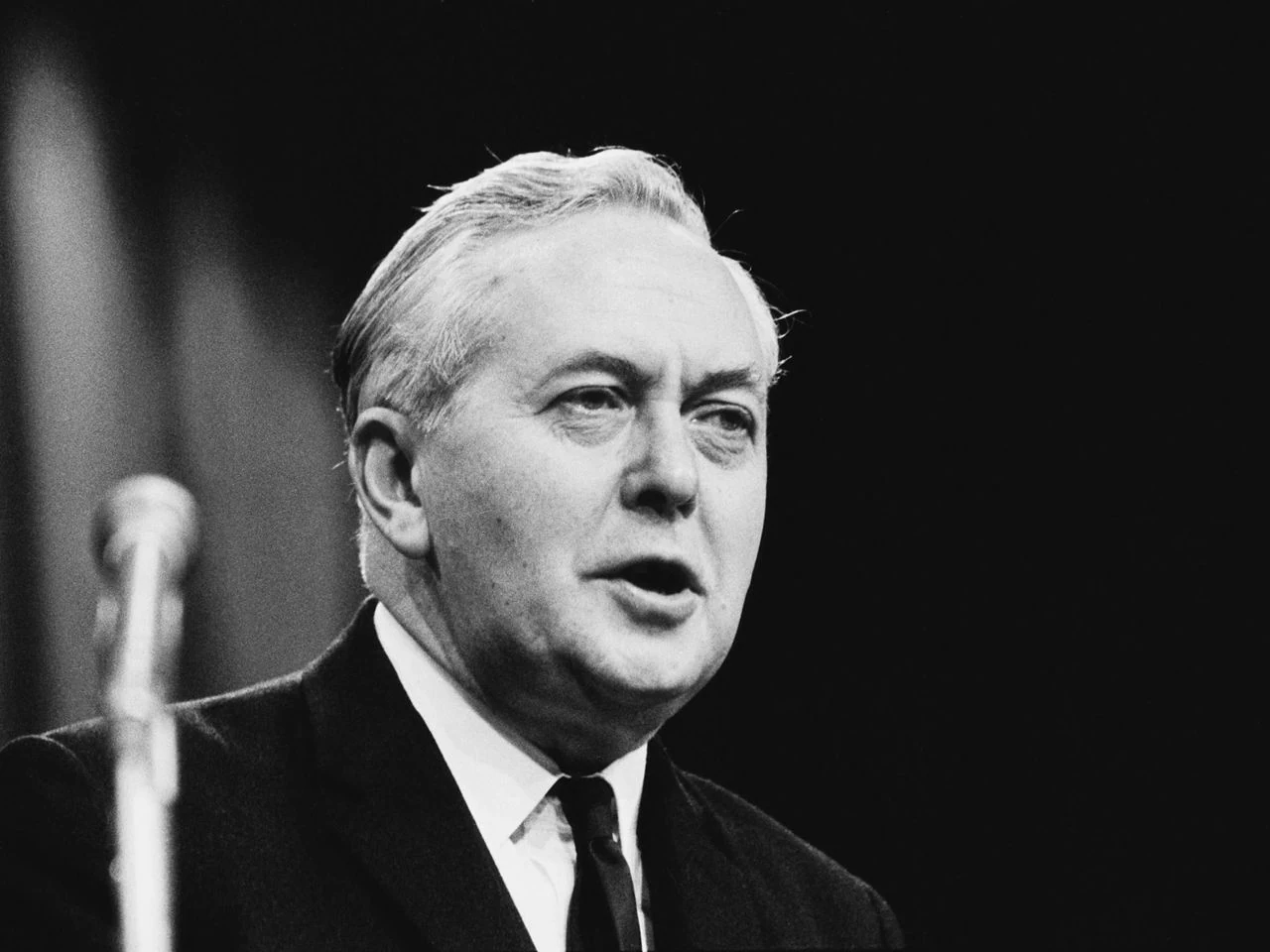
Harold Wilson’s premiership joined an ambitious argument for modernising Britain to the practical difficulties of governing it. He spoke of the “white heat” of technological change, created a Ministry of Technology and expanded educational opportunity. Yet his governments also faced pressure on sterling, inflation and industrial relations. Wilson’s record is therefore not a simple story of success or failure: it is the account of a politician who won four general elections for Labour, introduced important reforms and repeatedly had to adjust his plans to economic and political constraints.
From Huddersfield to the Labour front bench
James Harold Wilson was born on 11 March 1916 in Cowlersley, on the western edge of Huddersfield in the West Riding of Yorkshire. His father, James Herbert Wilson, was a works chemist who had been active in the Liberal Party before joining Labour; his mother, Ethel Seddon, had been a schoolteacher. Wilson won a scholarship to Royds Hall Grammar School, then continued his education at Wirral Grammar School for Boys after his father’s redundancy led the family to move to the Wirral.
He entered Jesus College, Oxford, in 1934 to study philosophy, politics and economics. His academic results were exceptional. After graduating, he worked in Oxford as a lecturer and research assistant to the economist William Beveridge. During the Second World War, Wilson served in the civil service rather than the armed forces. He worked on unemployment and the trade cycle, and later became a statistician and economist in the coal industry. In 1943 he was appointed an Officer of the Order of the British Empire for his work at the Ministry of Fuel and Power.
Wilson stood for Labour in Ormskirk at the 1945 general election and entered the House of Commons. Clement Attlee appointed him Parliamentary Secretary to the Ministry of Works. In 1947, Wilson became Secretary for Overseas Trade and, later that year, President of the Board of Trade. At 31, he was the youngest member of a British Cabinet in the twentieth century. As a minister he sought to remove wartime controls and licences, presenting the reductions as a way to speed the transition to peacetime life. After a boundary change, he was elected for Huyton in 1950 and represented it until 1983.
Labour’s defeat in 1951 moved Wilson into opposition. He held senior shadow posts, first as Shadow Chancellor and then as Shadow Foreign Secretary. After Hugh Gaitskell’s death, Wilson won the Labour leadership in 1963 and became Leader of the Opposition. His best-remembered speech at that year’s party conference set out a case for embracing scientific and technological change. The phrase “the white heat of the technological revolution” captured a central theme of his political pitch: Britain, he argued, needed to modernise its industry and institutions.
Modernisation meets economic pressure
Wilson became prime minister after Labour’s narrow victory in 1964. In 1966, he called an early general election and secured a much larger majority. His government created the Department of Economic Affairs and a National Plan intended to encourage growth and investment. The Ministry of Technology was meant to promote research and help industry adopt new methods. These initiatives expressed a coherent ambition, but the government’s economic choices were constrained from the start. A large balance-of-payments deficit put the pound under pressure, and the government initially resisted devaluation, using measures to restrain demand and imports instead.
The National Plan aimed for annual growth of 3.8 per cent, but average growth from 1964 to 1970 was lower. The Department of Economic Affairs was wound up in 1969. The Ministry of Technology had more success in redirecting some research and development towards civilian purposes, although persuading industry to take up new technologies proved difficult. In November 1967, mounting pressure forced the government to devalue sterling by 14 per cent. Wilson’s broadcast assurance that the pound in people’s pockets was not worth less became one of the best-known lines of his premiership. By 1970 the trade balance had returned to surplus, but the timing and handling of devaluation remained contentious.
His government also sought to manage inflation through a Prices and Incomes Policy, using wage and price controls. The approach repeatedly drew ministers into disputes between employers and unions. A six-week seamen’s strike followed Labour’s 1966 election victory. In 1969, Employment Secretary Barbara Castle proposed changes to industrial-relations law in the White Paper In Place of Strife. Opposition from the Trades Union Congress and dissent inside the Cabinet forced the government to retreat from much of the proposal. The episode illustrates a recurring difficulty for Wilson: the government sought greater economic coordination, but could not easily secure agreement on the means.
Public ownership was another contested question within Labour. Wilson did not pursue a broad programme of nationalisation, but his government renationalised the steel industry through the Iron and Steel Act 1967, creating the British Steel Corporation. The measure was a substantial intervention, though narrower than the language of expanding public ownership in the original account suggests.
Changes to law, education and everyday life
Wilson’s first government presided over significant changes in social policy, although many reforms were introduced as private members’ bills rather than as a single government programme. The Race Relations Act 1965 was the first British legislation to address racial discrimination. Parliament abolished the death penalty for most offences, partially decriminalised male homosexuality in England and Wales, legalised abortion, ended theatre censorship and liberalised divorce law. These measures changed the legal landscape, but Wilson himself did not share equal enthusiasm for every element of the reform agenda.
Education was closely connected to his case for social mobility and scientific progress. The government supported the expansion of comprehensive schooling, and the proportion of children attending comprehensive schools rose from about 10 per cent in 1966 to more than 30 per cent in 1970. It continued the creation of new universities, while spending on education increased as a share of national income. The government could not, however, meet its longstanding promise to raise the school-leaving age to 16: in 1968 it concluded that the required investment in classrooms and teachers was beyond the available budget.
The Open University became the most distinctive educational institution associated with Wilson’s governments. Created to offer adults who had missed out on higher education a second chance through part-time and distance study, it opened a route into university-level learning beyond the conventional campus. Wilson described it as his “brain-child”. Its founding reflected his belief that education could widen opportunity as well as help Britain respond to technological change.
Other policies affected housing and welfare. The government built more homes between 1965 and 1970 than the previous Conservative government had built in its final six years, including a rising number of council homes. It also introduced the Option Mortgage Scheme in 1968 to help lower-income buyers with mortgage costs. On social security, it increased benefits and introduced redundancy payments; pensions and several other forms of support rose during the first government. Economic restraint nevertheless brought reversals: prescription charges, abolished after Labour’s 1964 victory, were reintroduced in 1968, with exemptions for groups including pensioners and children.
Europe, Vietnam and the return to office
Wilson’s first period as prime minister ended with Labour’s defeat by Edward Heath’s Conservatives in 1970. He remained party leader and led Labour back into government after the inconclusive February 1974 election. Labour won more seats than the Conservatives but not a majority; Wilson returned to Downing Street on 4 March. A second election in October gave Labour a small majority.
Europe was the defining public decision of his second premiership. Wilson’s government renegotiated the terms of Britain’s membership of the European Community and held a referendum on whether the country should stay. The referendum took place in June 1975, after ministers had been allowed to campaign on opposing sides. Voters chose continued membership by a substantial majority. The process addressed divisions inside Labour while giving the electorate a direct say in the question.
Wilson continued to refuse requests for British combat troops in Vietnam, despite pressure from the United States. His government offered some verbal support for the American position, and the two countries’ governments remained at odds over the extent of that support. The decision not to send troops was a significant limit on British participation in the war; the evidence does not make it necessary to attribute it to a general doctrine of non-intervention.
The second government faced a severe economic climate, shaped by the 1973 oil crisis and wider international recession. It negotiated a voluntary incomes policy with the Trades Union Congress, seeking to restrain wage increases and reduce inflation. Inflation fell from its 1975 peak over the following years, but unemployment passed one million in April 1975. The government also legislated on working conditions and equality: the Health and Safety at Work etc. Act 1974 established a framework for workplace safety, while the Sex Discrimination Act 1975 outlawed direct and indirect sex discrimination and created an Equal Opportunities Commission.
On 16 March 1976, Wilson announced his resignation; it took effect on 5 April. He said he had planned to leave at 60 and was physically and mentally exhausted. James Callaghan succeeded him. Wilson remained in the Commons until 1983, then entered the House of Lords as Baron Wilson of Rievaulx. He died in London on 23 May 1995, aged 79, after suffering from colon cancer and Alzheimer’s disease. He was buried on the Isles of Scilly.
A political style built for change
Wilson cultivated an image distinct from the aristocratic political establishment: his Yorkshire accent, Gannex raincoat and pipe became recognisable features of his public persona. He also used contemporary culture to signal that Labour was in touch with a changing country. In 1965, he supported the award of MBEs to the Beatles, a decision that attracted criticism from some quarters but helped associate his government with younger voters and popular culture.
His electoral record was exceptional for a Labour leader: he led the party to victory in four general elections. Yet election victories did not settle the argument about his record. His governments expanded educational access and changed important areas of social law, while failing to achieve the scale of economic transformation promised by the National Plan. Sterling’s 1967 devaluation, rising unemployment and disputes over wages and industrial relations all shaped how his premiership was judged. Wilson’s reputation declined after he left office and remains contested; neither his ambitions nor his accomplishments should be mistaken for an unbroken record of success.
Why Harold Wilson deserves a place in British Legacy
Harold Wilson deserves a place in British Legacy because his governments helped change both the institutions and the expectations of post-war Britain. The Open University stands out among those achievements: it made part-time and distance higher education a serious route for adults who had not entered university earlier in life. The expansion of comprehensive schooling and of public spending on education also formed part of a wider effort to extend opportunity. At the same time, legislation in areas including race relations, sexual offences, abortion, divorce and theatre censorship altered the boundaries of public life. These changes were not all Wilson’s personal creation, but they took place under governments he led and formed a lasting part of the period’s political settlement.
His legacy is also valuable because it resists an easy story of modernisation. Wilson’s plans for higher growth and technological renewal met economic limits; sterling was devalued, the National Plan fell short of its target and industrial-relations reform ran into opposition. Those difficulties matter alongside the reforms. The contrast helps explain what governing Britain involved: setting ambitious goals, negotiating competing interests and making choices under pressure. Wilson’s four general-election victories show how successfully he could lead Labour through changing political conditions, while the contested record of his governments reminds readers that electoral skill and national economic success are not the same thing. That combination of concrete reform and unresolved difficulty gives his career enduring significance in British political history.
Sources
Adapted in part from Harold Wilson by Wikipedia contributors, under CC BY-SA 4.0. Text has been edited and combined with the existing article; this adapted text is shared under the same licence. Contributor history.