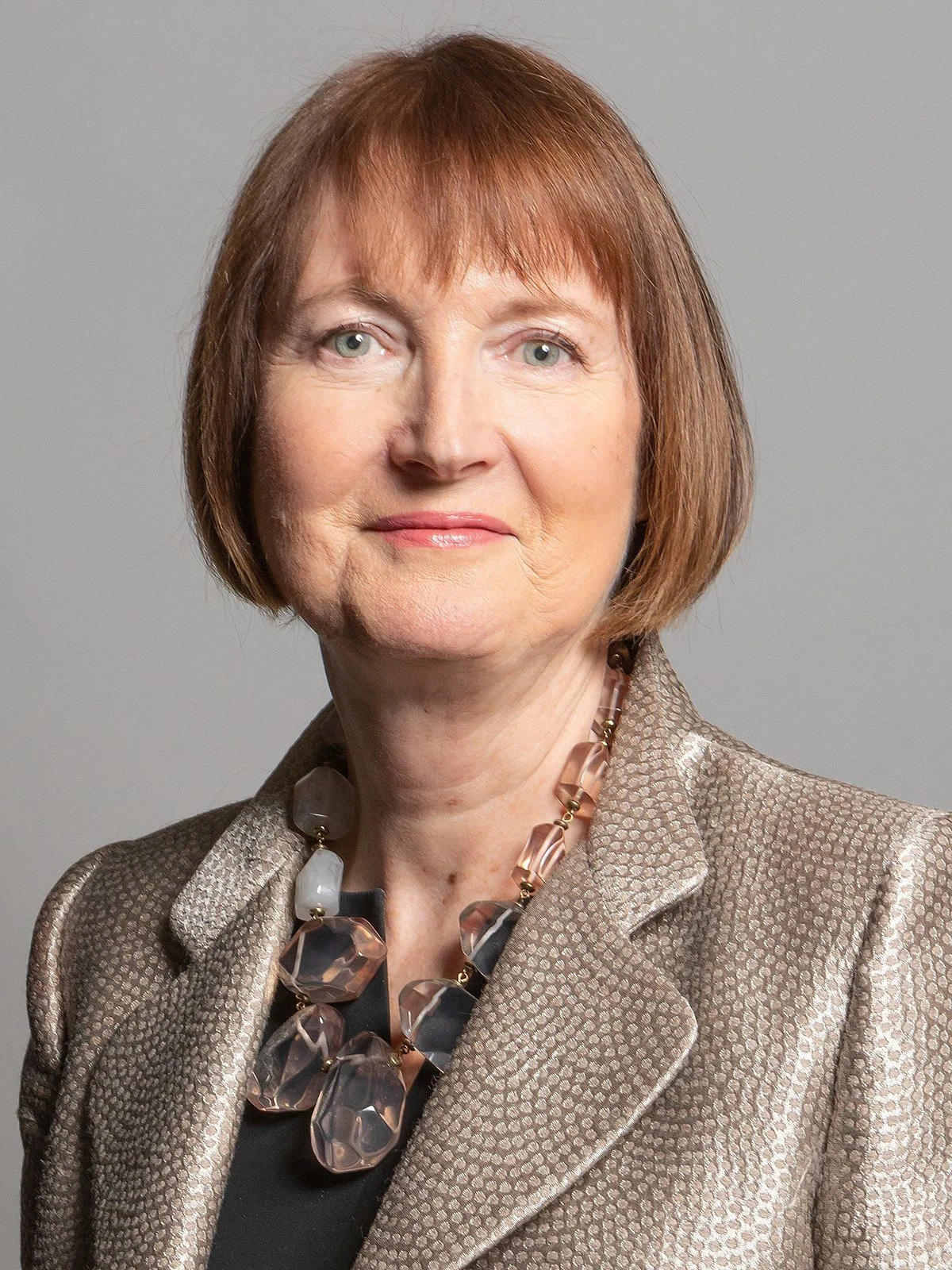
Harriet Harman entered the Commons as MP for Peckham in 1982 and represented the area, later renamed Camberwell and Peckham, until 2024. Over those four decades she moved between legal work, government and opposition, becoming Labour’s deputy leader and twice its temporary leader. Her career ranged from social-security reform and the Equality Act 2010 to the parliamentary inquiry into whether Boris Johnson had misled MPs. It was also marked by contested decisions, including the reduction of single-parent benefit while she was Secretary of State for Social Security.
From legal work to the Commons
Born in Marylebone, London, on 30 July 1950, Harriet Ruth Harman was the daughter of John B. Harman, a doctor, and Anna Spicer, a barrister. She studied politics at the University of York, graduating in 1972, qualified as a solicitor and worked at Brent Law Centre. From 1978 to 1982 she was a legal officer for the National Council for Civil Liberties (NCCL), now known as Liberty.
Her NCCL work included representing a prisoner held in solitary confinement at HM Hull Prison. Harman was found in contempt of court after sharing with a journalist documents she had read aloud in court. Her appeal to the Court of Appeal was rejected; she then took the case to the European Court of Human Rights, where she successfully argued that her right to freedom of expression had been breached. The case was settled after the British government agreed to change the law. In another case, concerning MI5 files held on Harman and her NCCL colleague Patricia Hewitt, a successful challenge led to the Security Service Act 1989.
Harman won the Peckham seat at a by-election on 28 October 1982. She became a shadow social services minister in 1984 and later held shadow health, employment and social-security roles. After the 1992 general election she joined the Shadow Cabinet as Chief Secretary to the Treasury. In 1997, following a change to constituency boundaries, she was elected MP for Camberwell and Peckham.
Government, welfare and equality
Labour’s 1997 victory brought Harman into government as Secretary of State for Social Security and the first Minister for Women. Her department’s work included welfare reform, a minimum income guarantee and winter fuel payments. The fuel-payment rules were amended after they were found to discriminate on grounds of sex: men had to wait longer than women to qualify. Harman also advocated improvements to childcare, family-friendly working hours and pension provision.
Her record in office included a decision that drew sharp opposition. Harman headed the government’s cut to single-parent benefit, affecting many women and children. She left the Cabinet in 1998. The episode complicates any account of her as an uncomplicated champion of equality: her stated concerns about women’s economic position sat alongside a policy that reduced support for some of the poorest families.
Harman returned to government in 2001 as Solicitor General for England and Wales, the first woman to hold the office. From 2005 she served as a Minister of State for Constitutional Affairs. In 2007 she won Labour’s deputy leadership contest by a narrow margin. Prime Minister Gordon Brown appointed her Leader of the House of Commons, Lord Privy Seal, Minister for Women and Equality, and chair of the Labour Party. She did not become Deputy Prime Minister.
As Minister for Women and Equality, Harman brought forward the Equality Bill in 2010. It became the Equality Act 2010, consolidating a range of earlier laws on discrimination and protections relating to sex, race, disability, religion or belief, sexual orientation and age. The legislation was the result of parliamentary work, not the achievement of one politician alone; Harman’s role was as the minister who brought the Bill forward.
She also backed measures intended to improve women’s representation in political life, including the continuation of all-women shortlists in Labour. She commissioned work on ways to increase the number of black and minority ethnic MPs. These efforts connected her interest in equal rights with a question about who takes part in political decision-making.
Deputy leader and acting Labour leader
After Labour lost office in 2010, Gordon Brown resigned as party leader and Harman became temporary leader of the Labour Party and Leader of the Opposition. She returned to the deputy leadership after Ed Miliband became leader, then held shadow cabinet roles in international development and culture, media and sport. When Miliband resigned after Labour’s 2015 general-election defeat, Harman again became acting leader and Leader of the Opposition until the party elected a successor.
These were interim periods of leadership at moments of transition, rather than terms as the party’s elected long-term leader. Harman had spent 28 years as a front-bench MP. In 2016 she became the longest-serving continuously serving woman MP in the Commons; the following year, Prime Minister Theresa May called her the “Mother of the House”. Harman stood for Speaker in 2019 but withdrew after the second ballot.
In 2015 she became chair of the Joint Committee on Human Rights. She later chaired the Commons Privileges Committee inquiry into whether Boris Johnson had misled Parliament about gatherings during Covid-19 restrictions. The committee concluded that Johnson had deliberately misled the House and that his conduct amounted to contempt of Parliament. The inquiry placed the relationship between a prime minister and the Commons, and the obligation to give truthful accounts to MPs, at the centre of parliamentary scrutiny.
Beyond the Commons
Harman stood down as an MP at the 2024 general election. In August that year she was made a life peer as Baroness Harman of Peckham. In 2023 she became chair of the Fawcett Society, a charity concerned with women’s rights and gender equality. On 8 March 2025 she was appointed the UK’s Special Envoy on Women and Girls, with a remit to coordinate international efforts concerning women’s and girls’ rights.
Her writing has also addressed women’s political participation. In 2017 she published A Woman’s Work, a personal examination of women’s progressive politics. Earlier publications included Winning for Women, written with Deborah Mattinson, and a pamphlet on sex discrimination in schools. Since 2024 she has co-presented the podcast Electoral Dysfunction with Ruth Davidson and Beth Rigby.
Why Harriet Harman deserves a place in British Legacy
Harman’s place in British political history rests on more than the length of her Commons career. She moved between legal work, government, opposition and senior party roles while repeatedly returning to questions of equality and representation. As Minister for Women and Equality, she brought forward the Equality Bill that became the Equality Act 2010, consolidating protections against discrimination across several grounds. Her support for all-women shortlists and work to increase the representation of black and minority ethnic MPs made the composition of political institutions part of the public argument about equality, not a separate concern.
Her career also connects individual rights with the responsibilities of public institutions. Before entering Parliament, she pursued human-rights cases concerning freedom of expression and MI5’s accountability. Later, as chair of the Commons Privileges Committee, she oversaw an inquiry into whether a prime minister had misled the House. These episodes represent distinct aspects of her public work: legal challenges to state power, legislative action on discrimination and parliamentary scrutiny of executive conduct. Her career should not be reduced to an unbroken story of progress; the single-parent benefit cut remains a significant counterpoint in her ministerial record. After leaving the Commons, her work continued through the Fawcett Society, the House of Lords and her appointment as the UK’s Special Envoy on Women and Girls. Together, these roles give her British legacy a specific substance: sustained involvement in the laws, institutions and public debates through which rights and representation are pursued.
Sources
Harriet Harman — Wikipedia revision 1379472524
Adapted in part from Harriet Harman by Wikipedia contributors, under CC BY-SA 4.0. Text has been edited and combined with the existing article; this adapted text is shared under the same licence. Contributor history.