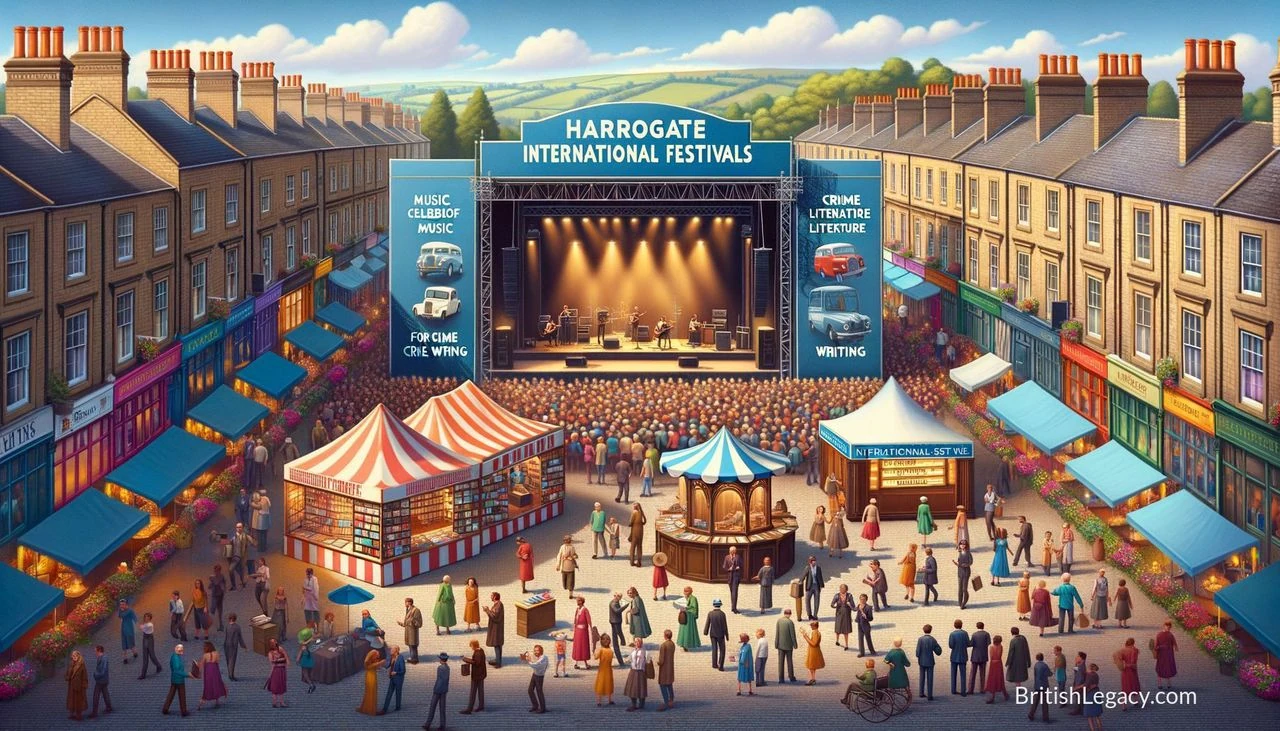
Harrogate International Festivals began in 1966 with a practical ambition: to restore the standard of cultural event that local people had known during the town’s inter-war spa heyday. What followed was not a single unchanging festival, but an organisation whose programme shifted with its audiences and circumstances. Music came to dominate its early years; later, literature, jazz, dance, world music and community work widened its reach. Today, its events range from chamber concerts and crime fiction to children’s arts programmes and large outdoor installations.
A festival shaped by its town
The festival was launched by Clive Wilson with help from composer Benjamin Britten and singer Peter Pears, both associated with the Aldeburgh Festival. Harrogate Borough Council and the Arts Council of England provided financial support. Its dates were initially set for mid-August, fitting around the town’s conference and exhibition calendar. The programme was broad at the outset, including music, literature, drama, visual arts and science.
That mix changed over time. In the following decades, music became the principal element, accounting for about 90 per cent of the programme. The shift was not simply a matter of artistic preference. In 1984, after the Arts Council’s national strategy review, “The Glory of the Garden”, funding was withdrawn from festivals north of Cheltenham. Harrogate had previously received a £38,000 guarantee against loss, described as the largest Arts Council grant awarded to a festival in England. Losing it meant the organisation had to seek more ticket income and expand corporate sponsorship, encouraging a more populist approach to programming.
A further reassessment came in 1991. To reach more people, including younger audiences and those beyond the immediate area, and to increase sponsorship, trust funding and box-office revenue, the festival began incrementally widening its performing arts offer. Jazz, contemporary dance, classical ballet, world music and literature joined the programme. This gradual adaptation helps explain the present-day plural in Harrogate International Festivals: the organisation’s identity grew through successive additions rather than a single defining event.
Music, crime fiction and literature
The Harrogate Music Festival is held across venues around the town during July. Alongside it, the organisation’s calendar includes the Theakston Old Peculier Crime Writing Festival, the Raworths Harrogate Literature Festival and the Harrogate International Sunday Series. The crime festival began in 2003 and takes place over four days in July at the Old Swan Hotel. Its opening night includes the announcement of the Theakstons Old Peculier Crime Novel of the Year Award.
Crime writing gives the programme a distinctive focus on a popular literary genre and brings readers and writers together around the craft of fiction. The festival has attracted attention beyond Harrogate: The Guardian described it in 2013 as one of the world’s best crime-writing festivals, while Elle included it among six leading literary festivals in 2016. Those assessments provide a more specific measure of its profile than broad claims of global pre-eminence.
The Raworths Harrogate Literature Festival, launched in 2012, is held in October. It brings writers and other speakers to share their work and experiences; its announced guests have included authors, politicians, comedians and performers. The 2019 programme included David Cameron, Simon Weston, Sir Tim Waterstone and Louise Minchin. During the COVID-19 pandemic, the 2020 festival moved online, with Bernard Cornwell, Lee Child, Matt Haig, Rory Bremner and Ken Follett among its speakers.
Another strand is the Harrogate International Sunday Series, launched in 1993. It presents international chamber concerts at the Old Swan between January and April. The range of dates and formats means the festivals’ activity is not confined to the summer music and crime-writing season: the programme extends across much of the year.
Beyond the concert hall
Harrogate International Festivals also runs Berwins Salon North, where three speakers explore ideas drawn from art, science and psychology. Its Spiegeltent and Children’s Festival programme brings together entertainment and activities for younger audiences. A week-long festival of club classics, soul and jazz takes place in a Spiegeltent on Crescent Gardens; during the day, the space is used for children’s arts, music, science and literature events, traditionally held in May and June.
The organisation’s work extends beyond ticketed performances. Its community outreach includes literacy, music and arts programmes for young people and communities with less access to the arts because of rural isolation, geographical location or social exclusion. In an average 12-month period, the festivals stage more than 300 distinct events and attract over 90,000 people to their activities. Alongside box-office income, they rely on sponsorship, grants and charitable giving. These figures give a sense of the operational scale behind the public-facing events, while the outreach programme addresses barriers that a town-centre festival alone would not remove.
Outdoor installations have also brought art into public spaces. Projects have included Cie Carabosse’s Fire Garden in 2016, Architects of Air’s Pentalum Luminarium in 2018, Luke Jerram’s Museum of the Moon in 2019 and his In Memoriam in 2021. In October 2021, an installation titled 1571 The Water That Made Us was placed beside the Royal Pump Room Museum. Created by sound and light artists Dan Fox and James Bawn with the festivals, it marked Harrogate’s 450-year spa heritage. Such projects connect contemporary work to the town’s history without confining the programme to heritage subjects.
Building a lasting cultural presence
In 2017, Harrogate International Festivals won the Northern Soul Arts Festival of the Year Award. Its leadership and supporters have included figures with their own connections to the region and to British arts. Dame Fanny Waterman, the pianist and music educator, served as honorary president from 2009 until her death in 2020; she followed Clive Leach in the role. Harrogate historian Malcolm Neesam was a past vice-president. The organisation’s listed patron is King Charles III, and Peter Blackburn CBE is its honorary president; Fiona Movley is chair of the trustees.
The festivals’ history shows how a cultural organisation can respond to changes in funding, audience and artistic ambition. A programme initially dominated by music broadened after financial pressure and a deliberate effort to extend its reach. That expansion now encompasses international chamber music, crime and general literature, ideas events, outdoor art and work with communities that face practical barriers to participation. The different strands are united less by a single genre than by their base in Harrogate and their recurring invitation to encounter the arts in varied settings.
Why Harrogate International Festivals deserves a place in British Legacy
Harrogate International Festivals merits a place in British Legacy because its history offers a concrete account of cultural life being built and sustained outside the largest cities. Founded in response to local demand, it drew on support from Harrogate Borough Council and the Arts Council, then adapted when that public funding was withdrawn. Its subsequent growth into several distinct festivals reflects both artistic range and the practical work of finding audiences, sponsorship and charitable support. The change from a largely music-based programme to a calendar that includes crime fiction, literature, science and psychology, children’s events and public installations is a record of continuing development rather than a claim of timeless success.
Its contribution is also visible in who the programme seeks to reach. More than 300 events in an average year, alongside outreach in literacy, music and arts, bring activity to people facing rural isolation, geographical barriers or social exclusion. Concerts at the Old Swan and installations beside the Royal Pump Room Museum place international and contemporary work within Harrogate’s own settings; the children’s programme creates another route into the arts. Together, these efforts make the festivals significant not only as a destination for performers and visitors, but as a locally rooted organisation connecting audiences with creative work. That combination of cultural ambition, regional identity and community participation is the British legacy worth preserving.
Sources
Harrogate International Festivals
Adapted in part from Harrogate International Festivals by Wikipedia contributors, under CC BY-SA 4.0. Text has been edited and combined with the existing article; this adapted text is shared under the same licence. Contributor history.