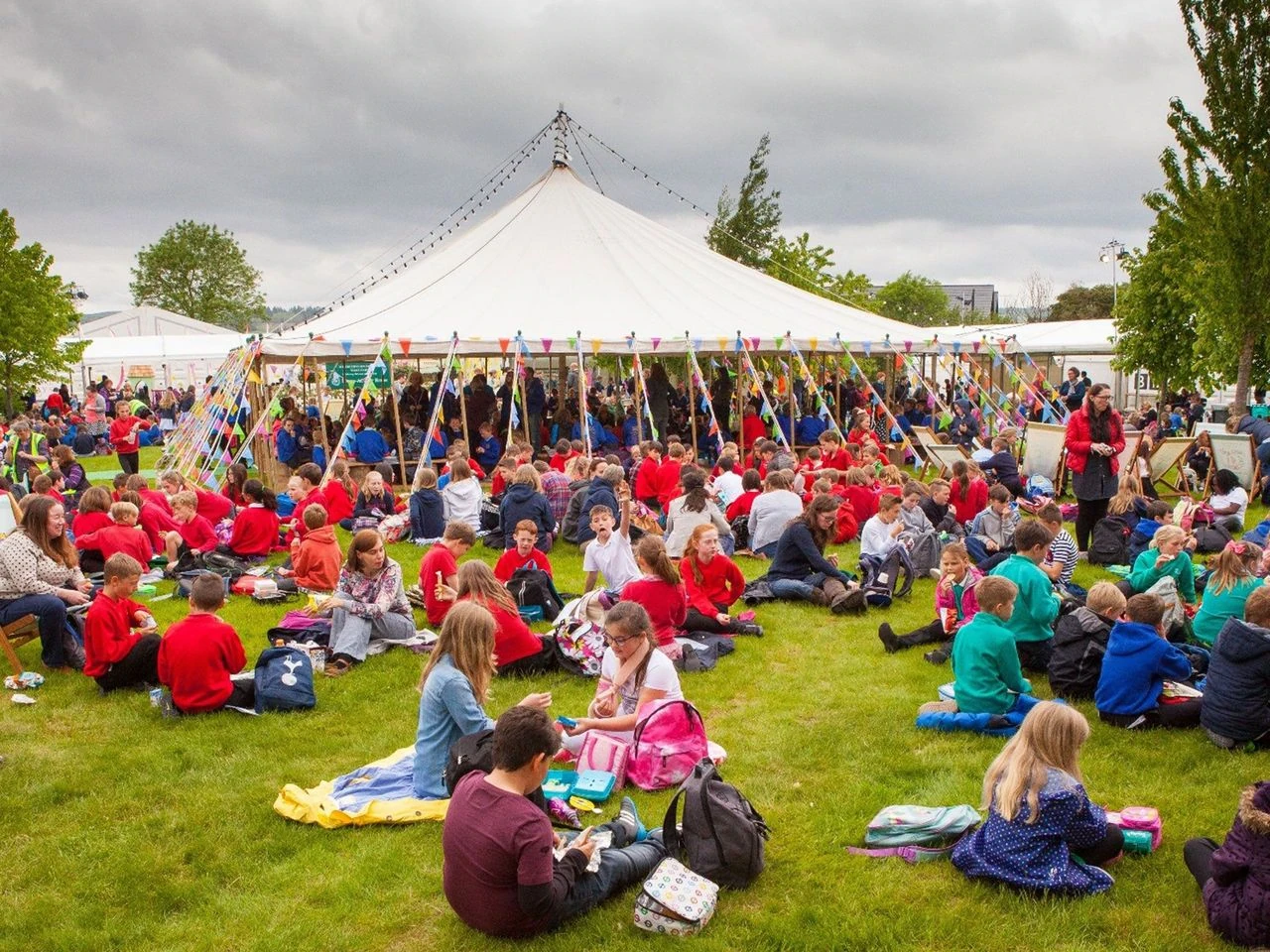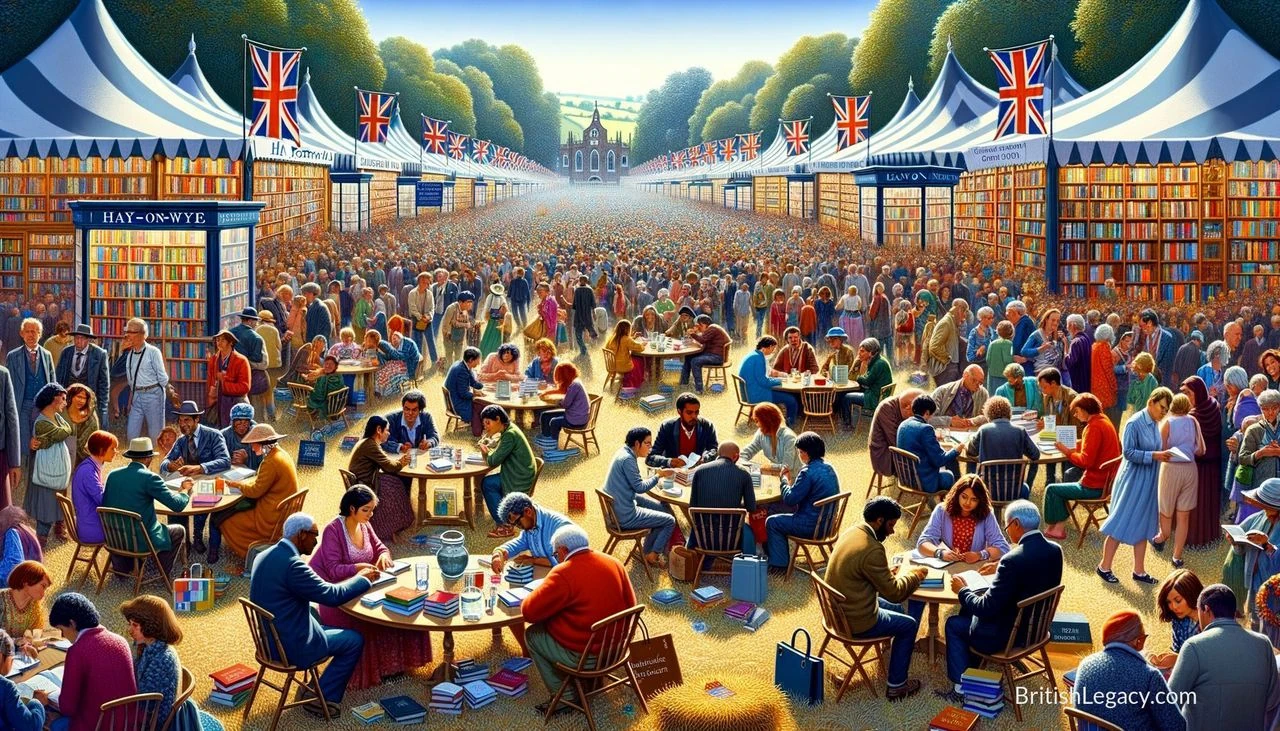
Each year, Hay-on-Wye becomes a meeting place for writers, artists, scientists, politicians and readers. The Hay Festival began in 1988 in a town already known for its bookshops; it has since developed into a major literary and arts festival, with international editions and a regular presence in British broadcasting. Its story is rooted in a particular Welsh place, but its programme has always ranged widely across subjects and borders.
A festival takes shape in the Town of Books
The festival was devised by Peter Florence and his parents, Rhoda and Norman, and first held in 1988. Hay-on-Wye was a natural setting for an event centred on books. Richard Booth opened his first bookshop there in 1962, and by the 1970s the town had acquired its familiar nickname, the “Town of Books”. The festival added a large public event to that existing bookselling identity rather than creating it from scratch.
In its early years, the festival used a range of venues around Hay, including the local primary school. In 2005 it moved to a single site just south of the town. The change brought the programme together in one place while keeping the event close to the community that had given it its name. The annual festival runs for ten days from May into June.
Bill Clinton described it as “The Woodstock of the mind” in 2001, a phrase that helped convey the scale of its intellectual programme. The festival has also become part of British cultural life through broadcasting: sessions have appeared in programmes including The Readers’ and Writers’ Roadshow and The One Show. All the BBC’s national radio channels except BBC Radio 1 have broadcast from it. Sky Arts showed highlights between 2010 and 2013, before the BBC took over the main coverage for the 2014 event.
More than books on the programme
Literature remains the festival’s centre of gravity, but the programme brings different kinds of public conversation together. Novelists and poets share the stage with scientists, economists, comedians, politicians and musicians. Sessions address subjects including history, science, politics and the arts, as well as writing. The event also includes book signings, giving readers a chance to meet authors after their talks.
The festival’s history includes appearances by writers and speakers from a broad range of fields. The 2009 programme, for example, included poets Carol Ann Duffy and Melvyn Bragg, novelist David Nicholls, scientists Martin Rees and Sabine Bahn, economists Nicholas Stern and Howard Davies, and comedians Dylan Moran and Sandi Toksvig. Desmond Tutu, Rowan Williams and Rhodri Morgan were among the other speakers that year. Such programmes show how the festival’s remit reaches beyond literary celebrity to public discussion across disciplines.
Music and film screenings have also become part of the event. A children’s programme, Hay Fever, runs alongside the main festival, extending the gathering to younger audiences. The festival’s work with writers also includes the Eccles Centre & Hay Festival Writer’s Award. Supported by the British Library’s Eccles Centre for American Studies, it offers two writers support for a forthcoming work of fiction or non-fiction relating to the Americas. The award includes funding, a research residency and opportunities to promote the work at festival events.
From Hay to an international network
The festival’s name now reaches well beyond Powys. Its international editions have included events in Arequipa, Jericó, Cartagena, Querétaro and Segovia. Smaller events known as forums bring panels and group discussions to other cities, among them Dallas, Moquegua, Panama City, Medellín, Seville, Ayacucho and Santiago de Chile. These events carry the festival format into different settings while retaining its emphasis on conversation and ideas.
The expansion has not displaced the Welsh gathering at the heart of the organisation. Hay-on-Wye remains the original setting and the point of reference for the wider programme. In 2020, when the festival could not take place in its usual form, it was held digitally online. That edition demonstrated how the event could adapt its programme beyond its physical site while maintaining a connection with audiences.
The festival’s growth has also brought questions about sponsorship and its relationship with the places in which it operates. The Guardian sponsored the event from 2002 to 2010, following The Sunday Times. The Daily Telegraph and associated Telegraph Media Group brands then sponsored two three-year terms beginning with the 2011 festival. From 2017, Tata Group and Baillie Gifford were among its principal sponsors, alongside the BBC, the Arts Council of Wales, the British Council and other organisations. In 2024 the festival announced that it would suspend Baillie Gifford sponsorship after campaigners raised objections and some speakers said they would boycott the event.
Local character and public debate
Hay Festival’s presence in a small town has prompted debate about who benefits from its prominence. In 2009, bookseller Paul Harris staged a mock trial and symbolic beheading in effigy of Richard Booth as a protest. Harris argued that attention and commercial influence had become too concentrated on the festival, to the detriment of Hay’s independent booksellers. He cited falling sales among the shops in the years before the protest.
Others disputed that account. Peter Florence argued that booksellers needed to reconsider their individual business strategies, while novelist Robert Harris pointed to the recession and the internet as factors affecting their fortunes. Commentators also differed over whether festival visitors helped or harmed the town’s book trade. The disagreement matters because the festival’s reputation and the bookselling community share the same setting: its success has never made the question of local impact irrelevant.
The organisation has faced difficult decisions beyond Hay as well. In 2020, its chair announced that the festival would not return to Abu Dhabi. Later, Peter Florence resigned as director in July 2021. The festival also received a Queen’s Award for Enterprise in 2009, one of eleven Welsh recipients that year. These milestones form part of a story that includes institutional change and public scrutiny alongside expansion and recognition.
Why Hay Festival deserves a place in British Legacy
Hay Festival deserves a place in British Legacy because it shows how cultural life can grow from a specific local history without remaining confined to it. Hay-on-Wye already had a strong association with books before 1988; the festival built on that identity by bringing writers, readers and speakers from many fields into the town. Its programme has made room for literature, science, politics, music and the arts, while Hay Fever and the Writer’s Award extend that work to younger audiences and to writers developing new books.
Its British connection is concrete: the festival was founded and continues to be anchored in Hay-on-Wye, Powys, and its development has involved Welsh cultural institutions as well as national broadcasters. BBC radio and television coverage has carried discussions from the festival to audiences well beyond the town. International editions have widened that reach, but have not erased the Welsh place from which the event takes its name. The arguments over booksellers and sponsorship also make its legacy more than a story of growth: they show why cultural institutions must consider the communities and values attached to their platforms. Hay Festival’s contribution lies in creating a durable setting for public exchange and connecting a Welsh bookselling town with a wider conversation.
Sources
Hay Festival — Wikipedia revision 1370297982
Adapted in part from Hay Festival by Wikipedia contributors, under CC BY-SA 4.0. Text has been edited and combined with the existing article; this adapted text is shared under the same licence. Contributor history.