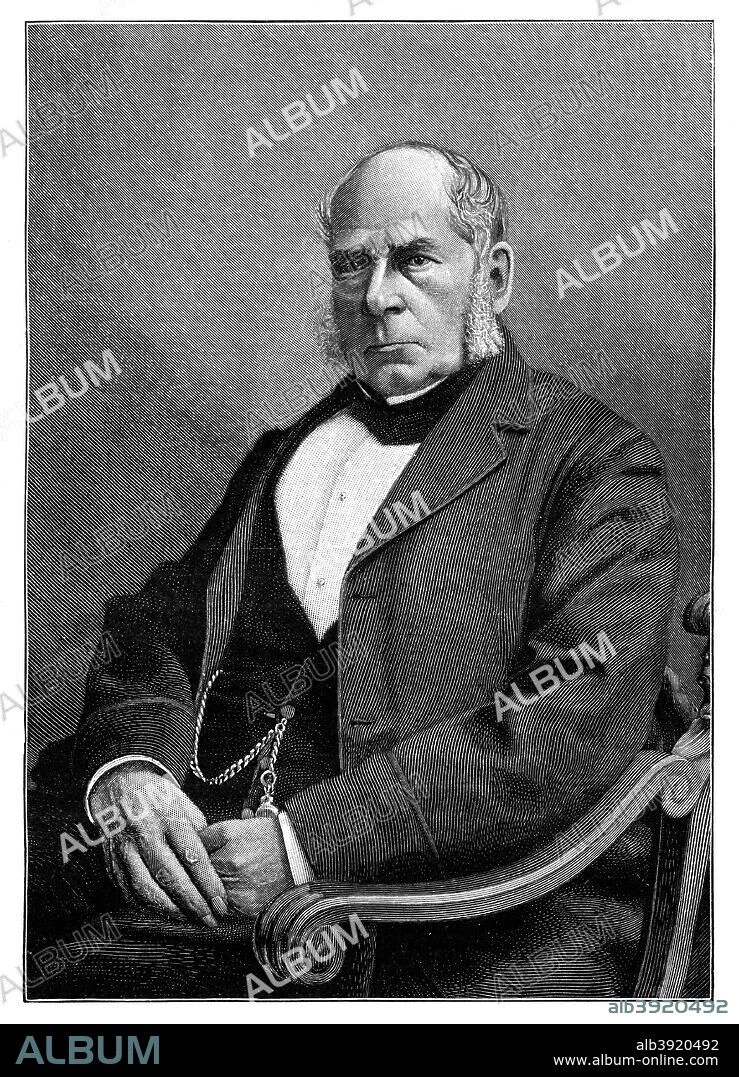
Henry Bessemer’s steelmaking process helped turn steel from a costly material into one that could be produced on an industrial scale. Developed to address the expense of making steel for military guns, it used air blown through molten pig iron to remove impurities. The process was not an instant triumph: early producers struggled to make reliable steel, and Bessemer had to take on manufacturing himself. Its eventual success helped reshape steelmaking and played a significant part in establishing Sheffield as a major industrial centre.
An inventor before the steelworks
Bessemer was born on 19 January 1813 in Charlton, Hertfordshire. His father, Anthony, was also an inventor. Anthony had worked at the Paris Mint, where he made a machine for producing medallions, and later developed a successful process for making gold chains after returning to Britain. The family’s inventive background is part of Bessemer’s story, but his own career was built on a succession of practical experiments rather than a single early revelation.
One of his first commercial successes came from making bronze powder, which was used in gold paint. At the time, the powder sold in London was made by hand in Nuremberg. Bessemer examined the product and devised a way to manufacture it with a series of six steam-powered machines. He kept the process secret and reduced the price substantially, using the resulting profits to pursue other inventions.
His work ranged beyond metals. In 1848 he patented a method for making a continuous ribbon of plate glass, although it was not commercially successful. Designing furnaces for that project gave him experience that would prove useful when he turned to steel. Across his career, Bessemer held at least 129 patents, covering subjects including iron, steel and glass, as well as military ordnance, embossed postage stamps and sugar extraction.
Developing a new way to make steel
From 1850 to 1855, Bessemer worked on making cheap steel for military ordnance. The method he developed forced air through molten pig iron, burning off impurities and converting the iron into steel. He patented the process in 1855. On 24 August 1856, he described it to a meeting of the British Association in Cheltenham, under the title “The Manufacture of Malleable Iron and Steel without Fuel”.
The broad principle was promising, but the first results exposed a serious production problem. Bessemer licensed the patent to five ironmasters, yet the companies struggled to turn out good-quality steel. The purity of the iron and the control of its carbon content affected the outcome. Swedish ironmaster Göran Fredrik Göransson was the first to make good steel using the process, after repeated attempts and with the purer charcoal pig iron available in Sweden.
Bessemer also had to improve his own results. He tried purer iron from Cumberland hematite, but found that the carbon content remained difficult to control. Robert Forester Mushet’s experiments offered a solution: remove almost all the carbon, then add a measured amount of carbon and manganese in the form of spiegeleisen. This improved the steel’s quality and malleability. Bessemer’s process was therefore developed through technical work that extended beyond his own experiments.
From patent to production in Sheffield
Despite the improved method, Bessemer initially met resistance from manufacturers. He eventually decided to exploit the process himself, establishing steelworks in Sheffield in partnership with others, including W & J Galloway & Sons. Production began on a small scale and grew. The firm’s ability to undercut competitors helped persuade steel traders to take notice, and demand for licences increased. Royalties from use of the process ultimately brought Bessemer more than a million pounds, according to the article.
The change mattered because industries had been limited by the cost and availability of steel, relying instead on cast iron and wrought iron. Making steel more quickly and cheaply allowed it to be used more widely, including in railway structures. Cast-iron bridges and other structures had suffered sudden failures; steel offered a way to replace cast iron in such applications. Bessemer’s process was of enormous industrial importance in its time, lowering production costs and helping steel displace cast iron and wrought iron.
Its adoption was not a simple story of one inventor receiving all the benefit. Mushet, whose experiments had helped solve the carbon-control problem, received no payment at first. In 1866, his daughter Mary went to Bessemer’s London offices to challenge him over the use of her father’s work. Bessemer then paid Mushet an annual pension of £300, which continued for more than 20 years. The episode illustrates how technical contributions and commercial rewards could be unevenly shared.
Other designs, honours and remembrance
Bessemer continued to pursue inventions beyond steelmaking. After suffering from seasickness, he designed a passenger ship with a cabin mounted on gimbals, intended to remain level in rough water. The mechanism worked in a model and in a trial version built in his garden, but the ship was never properly tested at sea. On its maiden voyage it damaged part of the Calais pier, investor confidence fell, and the vessel was scrapped.
He also patented, in 1857, a method of casting metal between counter-rotating rollers, an early precursor to continuous casting. Bessemer was knighted by Queen Victoria in 1879 for his contribution to science and elected a Fellow of the Royal Society that year. He died in London on 15 March 1898, aged 85, and was buried at West Norwood Cemetery.
His name remains attached to industrial and civic commemoration. Sheffield’s Kelham Island Industrial Heritage Museum displays an early Bessemer converter. The Bessemer Gold Medal, established by the Iron and Steel Institute during his presidency, continues to be awarded by the Institute of Materials, Minerals and Mining for outstanding service to the steel industry.
Why Henry Bessemer deserves a place in British Legacy
Bessemer’s place in British industrial history rests on more than the name given to a process. He helped make steel production faster and less expensive at a point when the material’s cost restricted its use. That change mattered to railways and structural engineering, where steel could replace cast iron in applications in which brittle failures had been a danger. The process contributed to Sheffield’s rise as a major centre of steel production, linking an individual invention to the development of a British industrial city.
His career also shows the work required to make an invention usable. The initial process did not consistently produce good steel; progress depended on further experiments, including Mushet’s work on carbon control. Bessemer then built production capacity when manufacturers were reluctant to adopt the system. His story therefore includes both collaboration and the difficult question of who receives credit and reward for technical advances. The enduring medal named for him, alongside the converter preserved in Sheffield, keeps that industrial history visible. Bessemer deserves a place in British Legacy as an inventor whose practical engineering changed steelmaking, and whose story offers a specific account of how invention, manufacture and industrial change became connected in Britain.
Sources
Henry Bessemer — Wikipedia, revision 1379089428
Adapted in part from Henry Bessemer by Wikipedia contributors, under CC BY-SA 4.0. Text has been edited and combined with the existing article; this adapted text is shared under the same licence. Contributor history.