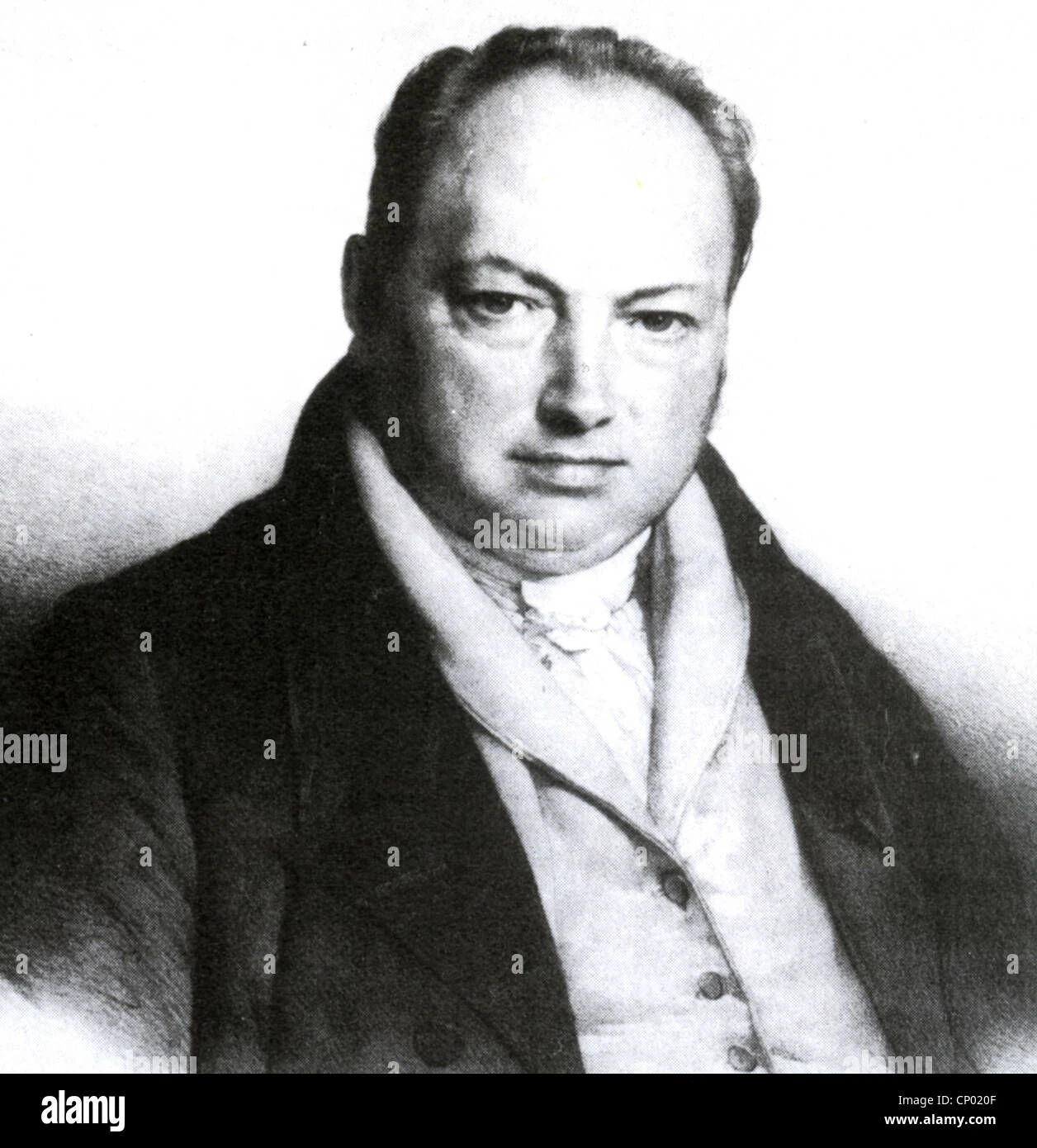
Before a screw thread could be cut reliably on a machine, making one depended on skilled hands working metal with chisels and files. Henry Maudslay helped change that. His industrially practical screw-cutting lathe brought a controlled, repeatable method to the work, helping standardise threads and making interchangeable nuts and bolts practical. It was one achievement in a career that also encompassed factory machinery, precision measurement and marine engines.
From Woolwich workshops to Joseph Bramah
Maudslay was born in Woolwich, London, on 22 August 1771. His father, also named Henry, was a wheelwright working for the Royal Engineers; after being wounded, he became an artificer at the Royal Arsenal. The younger Henry began work at the Arsenal at 12, filling cartridges as a powder monkey. He moved to a carpenter’s shop and then a blacksmith’s forge, where he trained from the age of 15.
That early work gave him experience with tools and metal before he joined the workshop of inventor and locksmith Joseph Bramah. Bramah had heard of Maudslay’s ability through an employee and was surprised to find that the young man was only 18. Maudslay soon became manager of the workshop. He made specialised tools and machines that helped Bramah manufacture his lock economically, and devised a leather cup washer that solved a sealing problem in Bramah’s hydraulic press. Although this was an important contribution, Maudslay received little credit for it.
In 1797, after eight years with Bramah, Maudslay left when his request for a wage increase was refused. He set up his own business, first in a small shop and smithy in Wells Street, then in larger premises in Margaret Street. In 1810, as the business and workforce grew, he moved to a larger Lambeth works on Westminster Bridge Road.
A lathe that brought threads under control
Maudslay’s screw-cutting lathe did not appear from a single isolated idea. Lathes already existed, and the slide-rest—the support that guides a cutting tool—was not his invention. What he developed was an especially effective combination of a lead screw, slide-rest and changeable gears. In his machine, the cutting tool was clamped in a holder and travelled along accurately planed surfaces. Gears linked its movement to the turning workpiece; changing the gears allowed different thread pitches to be cut.
Before such controlled cutting, metal threads were commonly formed by hand, with a chisel and file. Maudslay’s arrangement made it possible to cut them more precisely and consistently. He standardised screw threads in his own workshop and made sets of taps and dies so that nuts and bolts could be produced to matching standards. This made the practical use of interchangeable threaded parts possible: a bolt of a given size could fit a nut made to the same size.
The machine is usually dated to around 1800. Maudslay did not invent every component used in it, and there is uncertainty over whether Jesse Ramsden had previously combined similar elements on one lathe. The significance of Maudslay’s contribution lies in the practical three-part arrangement and the advance it brought to machine tools and workshop use of screw threads. His original lathe is now in the Science Museum in London.
Machinery for production and measurement
Maudslay’s work extended beyond the lathe. His first major commission was a series of 42 machines for making wooden rigging blocks for the Royal Navy. Developed following earlier work by Samuel Bentham, the machines were installed at the Portsmouth Block Mills. Each ship required thousands of blocks; the new system could produce 130,000 a year with ten unskilled operators, compared with 110 skilled workers previously. It became a notable early example of specialised machinery arranged for factory production.
He also developed a bench micrometer capable of measuring to one ten-thousandth of an inch. He called it the “Lord Chancellor” because it could settle arguments about the accuracy of work. The instrument illustrates a principle that ran through his engineering: dependable manufacture required not only machines that could make parts, but also ways to judge whether those parts had been made accurately.
As the Lambeth works expanded, Maudslay brought in Joshua Field, a talented Admiralty draughtsman who became his partner. The company later became Maudslay, Sons and Field, with Maudslay’s sons joining the business. His workshop trained a generation of engineers, including Joseph Whitworth, James Nasmyth, Richard Roberts, David Napier and Joseph Clement. Their work carried machine-tool skills and ideas about precision into other workshops and enterprises.
Marine engines and the Thames Tunnel
The Lambeth works became an important producer of marine steam engines. Maudslay used a side-lever design, with a beam alongside the cylinder, which reduced the engine’s height for use in steamers’ confined engine rooms. His first marine engine, built in 1815, had 17 horsepower and was fitted to the Thames steamer Richmond. In 1823, a Maudslay engine powered Lightning, the first steam-powered vessel commissioned by the Royal Navy. A 400-horsepower side-lever engine completed for HMS Dee in 1829 was then the largest marine engine in existence.
His firm also contributed machinery to Marc Isambard Brunel’s Thames Tunnel, which connected Rotherhithe and Wapping. Maudslay, Sons & Field built the tunnelling shield and supplied steam-driven pumps to keep the works dry. The tunnel was completed in 1842, after Maudslay’s death. His sons and Joshua Field continued the marine-engine business, which later supplied engines for ships including Isambard Kingdom Brunel’s SS Great Western.
Family, final years and an enduring workshop
Maudslay married Sarah Tindel, a housemaid at Bramah’s, in 1791. They had a daughter, Isabel, and four sons. Thomas Henry and Joseph later joined their father’s business; William became a civil engineer and was one of the founders of the Institution of Civil Engineers.
In later life Maudslay became interested in astronomy and planned to build a private observatory at Norwood. He died in Lambeth on 14 February 1831, aged 59, after becoming ill following a crossing of the English Channel. He was buried at St Mary Magdalen, Woolwich, where he had designed his own memorial. The company he founded remained a significant British engineering manufacturer after his death and eventually closed in 1904.
Why Henry Maudslay deserves a place in British Legacy
Maudslay’s place in British engineering history rests on more than the familiar label of inventor. His screw-cutting lathe brought together a lead screw, slide-rest and change gears in a practical system that made accurate, repeatable thread cutting possible. Standardised threads helped make interchangeable nuts and bolts workable, an important step in producing machine components consistently. The point is not that one lathe created modern manufacturing on its own, but that Maudslay helped turn precision from a matter of individual hand skill into something a workshop could organise and reproduce.
His contribution also reached beyond the lathe. The Portsmouth block-making machinery showed how specialised equipment could transform the production of essential naval fittings; his micrometer put unusually precise measurement within reach; and his Lambeth firm built marine engines and machinery for major engineering projects. The engineers trained in his workshop carried their experience into the wider trade. Together, these achievements connect Maudslay’s work to practical benefits: more consistent components, new production methods, accurate measurement and the spread of engineering skill. His British legacy lies in this combination of invention, manufacture and training—in making precision useful to other people and capable of being carried forward.
Sources
Henry Maudslay — Wikipedia, revision 1341785022
Adapted in part from Henry Maudslay by Wikipedia contributors, under CC BY-SA 4.0. Text has been edited and combined with the existing article; this adapted text is shared under the same licence. Contributor history.