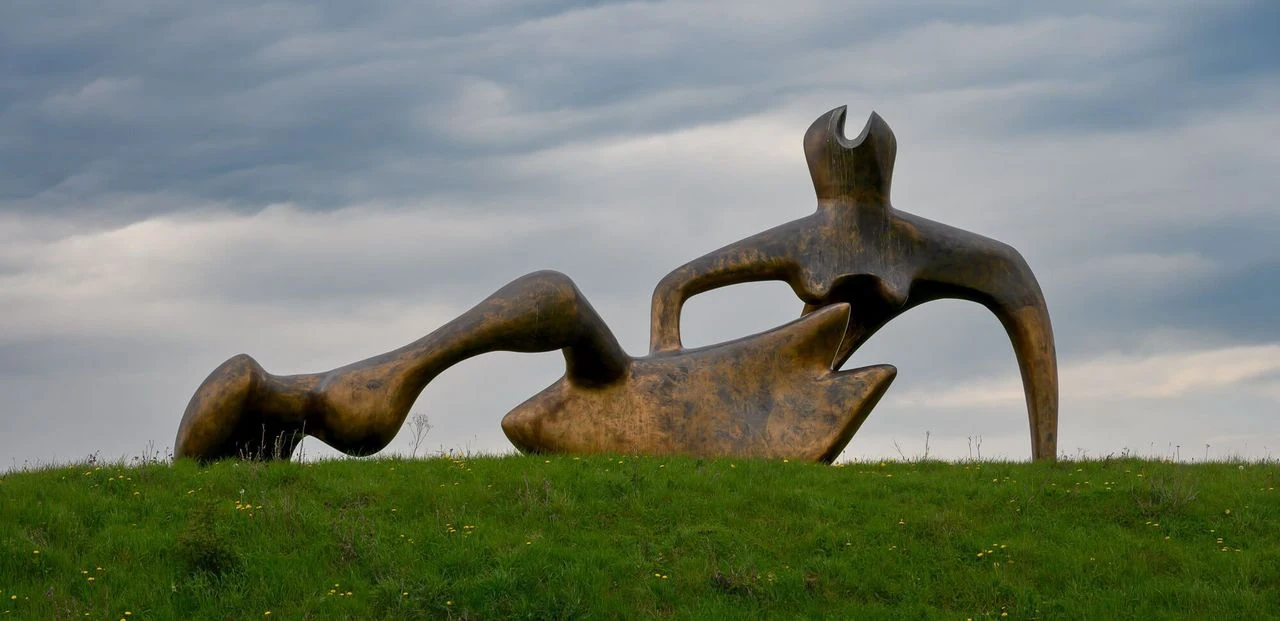
Henry Moore made sculpture that asked viewers to look at what was solid, and at what passed through it. His reclining figures, pierced by openings and shaped in bronze, stone or wood, brought abstraction into public places without losing sight of the human body. The work travelled widely, but its roots remained visible: Moore was born in Castleford, Yorkshire, and some of the forms that defined his art have been compared with the hills of his native landscape.
From Castleford to art school
Henry Spencer Moore was born in Castleford on 30 July 1898, the seventh of eight children of Mary and Raymond Spencer Moore. His father worked at the Wheldale colliery, first as a pit deputy and later as its under-manager. The family often struggled with poverty, but Raymond wanted his children to have opportunities beyond the mines. At school, Moore began modelling clay and carving wood. He later recalled deciding to become a sculptor at 11, after hearing about Michelangelo at a Sunday School reading.
Moore’s first ambition was interrupted by the First World War. After briefly becoming a teacher, he volunteered for army service at 18. Serving with the Prince of Wales’s Own Civil Service Rifles, he was injured in a gas attack at Bourlon Wood in November 1917. After recovering, he worked as a physical training instructor and returned to France as the Armistice was being signed.
An ex-serviceman’s grant enabled Moore to study at Leeds School of Art, where a sculpture studio was set up for him. There he met Barbara Hepworth, beginning a long friendship and professional rivalry. In 1921 he won a scholarship to the Royal College of Art in London. At the British Museum he studied ethnographic collections; a travelling scholarship later took him to Northern Italy to see the work of Renaissance masters. In Paris, a plaster cast of a Toltec-Maya reclining figure at the Trocadero made a lasting impression. Its pose would become a recurring motif in his sculpture.
Carving towards a new language
Moore’s early student work followed established figurative styles. He moved away from academic ideals under the influence of direct carving and sculptors including Constantin Brâncuși, Jacob Epstein and Henri Gaudier-Brzeska. Rather than treating the material as a surface to be concealed, direct carving allowed the block, its imperfections and the marks of tools to shape the finished work.
In 1928 he received his first public commission: West Wind, one of the reliefs on the London Underground headquarters at 55 Broadway. The same year, he held his first solo exhibition. After teaching at the Royal College of Art, he became head of sculpture at Chelsea School of Art in 1932. In Hampstead, Moore worked among a community of artists that included Hepworth, Naum Gabo and Roland Penrose. His encounters with contemporary artists in Paris, including Pablo Picasso, Georges Braque and Alberto Giacometti, accompanied a gradual shift towards greater abstraction.
The reclining figure remained central, but Moore changed how he worked with it. Earlier carvings emphasised mass; later sculptures used hollows and openings to set solid form against the space around and through it. Viewers have often associated the undulating lines of these figures with the Yorkshire landscape. Moore also drew on objects collected around his home at Much Hadham—among them pebbles, shells, driftwood and bones—for forms that seemed to grow from natural materials.
His working methods changed with the scale of his ambitions. After the war, he increasingly modelled forms in clay or plaster and had them cast in bronze, often using assistants on large commissions. The move from direct carving did not mean abandoning the hand-made character of a work: Moore developed smaller maquettes and refined full-sized plaster models before casting.
War drawings and public sculpture
When the Second World War began, Moore’s teaching post at Chelsea was disrupted by the school’s evacuation. He became known for drawings of Londoners sheltering in Underground stations during the Blitz. The War Artists’ Advisory Committee bought some of the drawings and commissioned more. In 1941, Moore also drew miners working at the Wheldale colliery where his father had worked. The shelter drawings, made between 1940 and 1941, helped establish his international reputation.
After a bomb damaged the Moores’ Hampstead home, Henry and his wife, Irina, moved to Hoglands, a farmhouse near Much Hadham in Hertfordshire. It remained his home and workshop for the rest of his life. Their daughter, Mary, was born in 1946. Family life became a subject in his art, including the mother-and-child compositions that developed alongside his reclining figures.
In 1950, Moore completed Family Group for a school in Stevenage. It was his first large-scale public bronze. A planned sculpture for a village college near Cambridge had been cancelled for lack of funds, but Moore was able to adapt its design for the later commission. Public works and exhibitions brought him greater prominence in the 1950s. His sculpture appeared at the Festival of Britain in 1951, and in 1958 he completed a large marble reclining figure for UNESCO’s building in Paris.
Moore’s public art was not confined to international commissions. Knife Edge Two Piece, made between 1962 and 1965, was given to the City of London by Moore and the Contemporary Art Society in 1967. Installed in Abingdon Street Gardens opposite the Houses of Parliament, it became a familiar presence in televised views of Westminster. Moore valued the site because people walking nearby could pause and consider the sculpture.
A working estate and a lasting institution
Moore’s reputation and the size of his commissions grew, but he continued to live at Hoglands rather than moving to a larger home. The estate accumulated studios and outbuildings as his work expanded. In 1972, he and his daughter established the Henry Moore Trust to protect his estate. Five years later, he founded the Henry Moore Foundation with Irina and Mary as trustees, with a purpose that included encouraging public appreciation of the visual arts and supporting the presentation of his work.
The Foundation now runs Moore’s former home and estate at Perry Green as a public destination, with sculpture grounds, his restored house and studios. It also operates the Henry Moore Institute in Leeds, which organises exhibitions and research on international sculpture. Moore’s legacy therefore extends beyond the sculptures themselves: it includes institutions that preserve his work and make sculpture available for study and public experience.
Moore received the International Sculpture Prize at the Venice Biennale in 1948. He declined a knighthood in 1951, concerned that the title might separate him from other artists, but later accepted appointment to the Order of the Companions of Honour in 1955 and the Order of Merit in 1963. He died at Perry Green on 31 August 1986, aged 88.
Why Henry Moore deserves a place in British Legacy
Moore’s place in British cultural history rests on a distinctive achievement: he helped establish a form of modern sculpture in which the human figure could be both recognisable and radically transformed. His reclining figures connect body and landscape, while the hollows and openings in his later work make surrounding space part of the sculpture. These were not ideas confined to a studio or gallery. Works such as West Wind and Knife Edge Two Piece placed his art in the daily life of London, where passers-by could encounter it without needing to visit a museum.
His British connection is also grounded in the course of his life and work. A childhood in Castleford, shaped by a mining family and a local education, led to study in Leeds and London, then to a long working life in Hertfordshire. The Yorkshire landscape remained one point of reference even as his bronzes reached audiences abroad. Through the Henry Moore Foundation and the Institute in Leeds, his work continues to support public access, exhibitions and research. That combination of artistic invention, visible public commissions and lasting provision for the arts makes his legacy more substantial than international fame alone: Moore changed what sculpture could do in Britain and helped create ways for future generations to encounter it.
Sources
Henry Moore — Wikipedia revision
Adapted in part from Henry Moore by Wikipedia contributors, under CC BY-SA 4.0. Text has been edited and combined with the existing article; this adapted text is shared under the same licence. Contributor history.