Howard Hodgkin made paintings that could hold the feeling of a remembered encounter without describing it in conventional detail. Colour, shape and the physical edge of the work did much of the telling. He is best known as a painter associated with abstraction, but he was also a printmaker, and his career joined a distinctive personal language to a sustained presence in British art: from his first London solo exhibition in 1962 to representing Britain at the Venice Biennale and winning the Turner Prize.
A childhood decision, and an education in art
Gordon Howard Eliot Hodgkin was born in Hammersmith, London, on 6 August 1932. During the Second World War, he and his mother and sister were evacuated to Long Island, New York. Back in England, he attended Eton College and Bryanston School in Dorset. He had decided in childhood that he wanted to be an artist and ran away from school to pursue that ambition.
Hodgkin studied at Camberwell Art School and then at the Bath Academy of Art in Corsham. His earliest recorded painting, Memoirs (1949), shows a 17-year-old Hodgkin listening to a woman reclining on a sofa. Its angular shapes and black outlines belong to an earlier phase than the abstract style for which he became known, but the work already makes an encounter its subject. In later paintings, recognition often depends less on a depicted scene than on the feeling that remains attached to it.
His first solo show took place in London in 1962. That early exhibition began a career which developed through British galleries and institutions, while his art also took him into international settings. In 1975, the Arnolfini Gallery in Bristol reopened in new premises with simultaneous solo exhibitions of Hodgkin and Keith Milow. In 1980 he was invited by John Hoyland to take part in the Hayward Annual at the Hayward Gallery, alongside artists including Gillian Ayres, Patrick Caulfield and Ben Nicholson.
When the frame becomes part of the painting
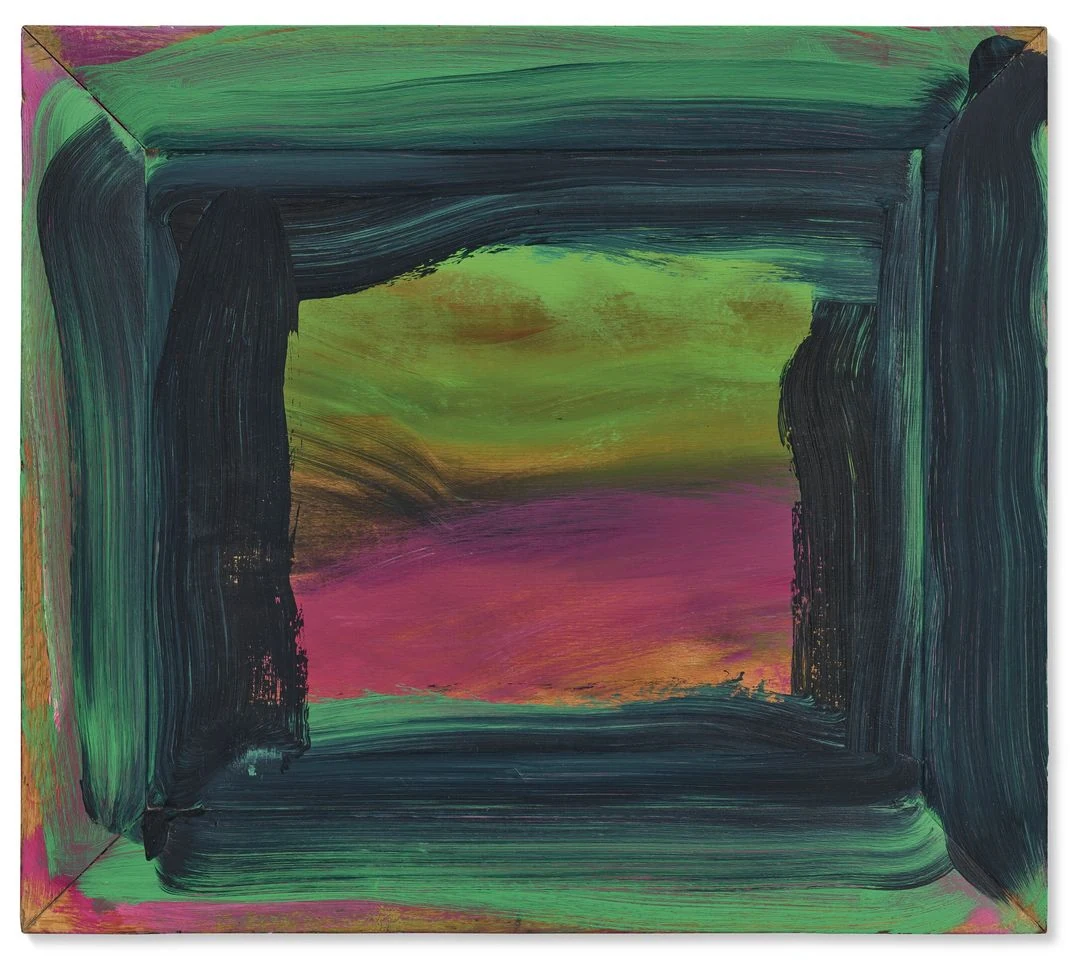
Hodgkin’s paintings are often described as abstract, but abstraction did not mean that they had no subject. The starting point was commonly a person, a place or an experience; the finished work conveyed the memory and emotional charge of that subject rather than offering a straightforward illustration. The strong colours and layered forms in the paintings give the work a sense of movement, while leaving room for the viewer to register its changing moods.
A defining feature of Hodgkin’s practice was his treatment of the frame. Rather than treating it simply as a boundary added after the painting was finished, he made it part of the work: physically incorporated or suggested as an illusion that gives definition to the subject. This decision makes the edges of a painting active. The viewer is not only looking at a scene contained within a frame; the frame itself helps shape what can be seen and how the image is experienced.
He frequently painted on wooden boards rather than canvas. When asked why he preferred wood, he answered, “Because wood answers back.” The phrase gives a glimpse of the responsive, material quality he valued in his work. The board is not a neutral surface: it is part of the exchange between the artist and the image. The result can feel close to an object as well as a painted view, with the surface and the edges contributing to its presence.
Hodgkin worked in printmaking as well as painting. His prints were hand-painted etchings, made with master printer Jack Shirreff at 107 Workshop. In 1995, he produced the Venetian Views series, four prints showing the same view of Venice at different times of day. Venice, Afternoon was built from 16 sheets, or fragments, in a complex printing process that produced a painterly, colourful effect. The series shows how his concern with variations in light and feeling could be pursued through a different medium.
Britain, India and a wider public career
Hodgkin’s connection with India became visible in an important public commission. He was invited to design a mural for the front of Charles Correa’s 1992 headquarters for the British Council in India. The mural depicts a banyan tree whose branches spread across the walls, a design described as symbolising the Council’s work rooted in the Indian cultural scene. Correa had suggested an idea of an Indian flag turning into a Union Jack; Hodgkin rejected it. The resulting work made a different kind of connection between the institution and its setting, using the tree as its central image.
His engagements with other art forms included two collaborations with choreographer Richard Alston and Rambert Dance Company. Hodgkin worked with Alston on 1981 for the production of Night Music, and later on Pulcinella in 1987. These projects placed his visual work in conversation with dance, extending his practice beyond the gallery without requiring his paintings to become literal illustrations of movement.
In 1984, Hodgkin represented Britain at the Venice Biennale. The following year he won the Turner Prize. He was knighted in 1992, and his honours later included the Shakespeare Prize, awarded by the Alfred Toepfer Foundation in 1997, and an honorary fellowship from the London Institute in 1999. In 2000, the University of Oxford awarded him an honorary DLitt. He was made a Member of the Order of the Companions of Honour in the 2003 New Year Honours for services to art.
A major exhibition of his work at Tate Britain in 2006 brought his paintings to a prominent national stage. In 2010, he was among the British artists included in The Independent Eye: Contemporary British Art From the Collection of Samuel and Gabrielle Lurie at the Yale Center for British Art. His professional life continued late into his career: before his death in 2017, he was working on exhibitions planned for the Hepworth Wakefield and the National Portrait Gallery.
A life beyond the gallery
Hodgkin’s family history included both artistic and public service. His father, Eliot Hodgkin, managed for the chemical company ICI and was an amateur horticulturist; his mother, Katherine, was a botanical illustrator. During the war, his father served in the RAF and became an assistant to Sefton Delmer in the black propaganda campaign against Nazi Germany. Hodgkin’s maternal grandfather, Gordon Hewart, was a journalist, lawyer, MP and Lord Chief Justice. These details sit alongside, rather than explain, Hodgkin’s own decision to make art his life’s work.
He married Julia Lane in 1955, and they had two children. He later left the marriage. Hodgkin died in a London hospital on 9 March 2017, aged 84. Tributes came from figures in British art, including Tate director Nicholas Serota. His death came while two further UK exhibitions were in preparation, a reminder that his working life remained closely connected to British public galleries until its end.
Why Howard Hodgkin deserves a place in British Legacy
Howard Hodgkin’s place in British Legacy rests on a body of work that made abstraction a means of addressing lived experience. His paintings did not depend on detailed likeness or conventional storytelling to give a subject emotional weight. Instead, memory, colour, the painted surface and the frame worked together. His preference for wooden boards and his insistence that the frame could belong to the painting were not incidental stylistic quirks: they helped define how a viewer encounters the image as both a remembered subject and a physical object.
His British contribution is also visible in the institutions and settings through which he worked. He exhibited in London and Bristol, took part in the Hayward Annual, represented Britain at the Venice Biennale and received the Turner Prize and major national honours. His British Council mural in India offered a more specific cultural connection: designed for a British institution abroad, it answered its Indian setting with the image of a spreading banyan tree rather than a simple fusion of national symbols. His collaborations with Rambert and his printmaking with Jack Shirreff further show the range of his practice. Together, these achievements make his legacy more than a reputation for vivid colour: they record a British artist developing an individual visual language and carrying it into galleries, print workshops, dance and public architecture.
Sources
Adapted in part from Howard Hodgkin by Wikipedia contributors, under CC BY-SA 4.0. Text has been edited and combined with the existing article; this adapted text is shared under the same licence. Contributor history.