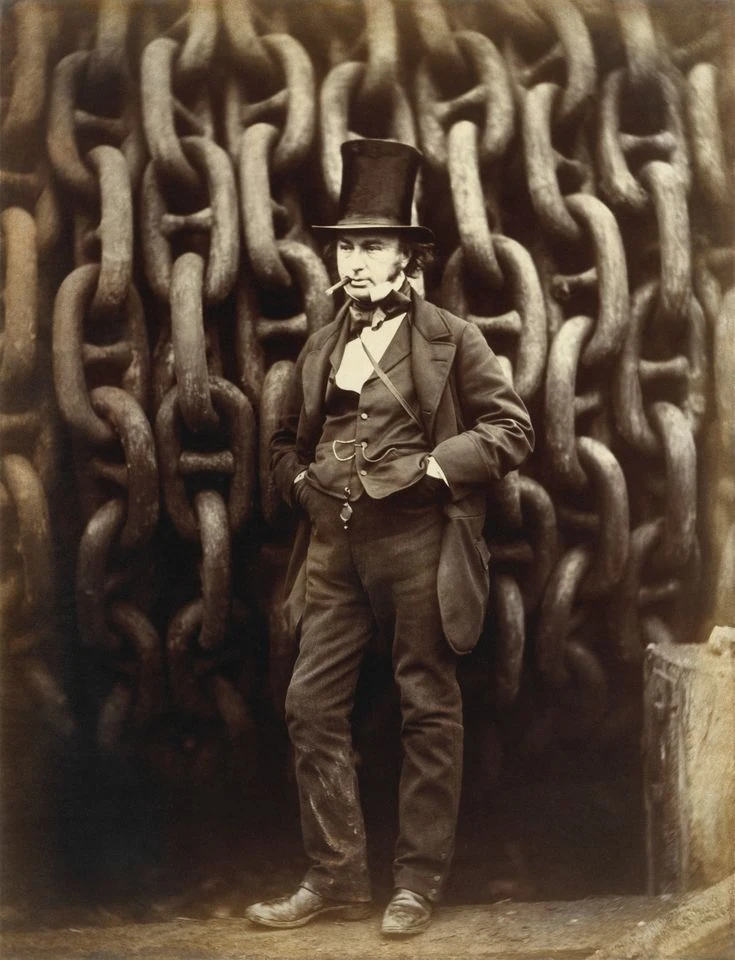
Isambard Kingdom Brunel connected engineering projects that might otherwise have seemed separate: a railway from London to Bristol, bridges across difficult terrain and steamships capable of crossing the Atlantic. His designs made movement faster and linked distant places, but they also brought costly setbacks. The breadth of his work, and the tension between technical ambition and practical limits, is central to his story.
Learning to engineer
Brunel was born in Britain Street, Portsea, Portsmouth, on 9 April 1806. His father, Marc Isambard Brunel, was a French-born engineer; his mother was Sophia Kingdom. His father introduced him to drawing, geometry and mechanics, and the younger Brunel learned French fluently. At 14 he went to study in France, first at the Henri Quatre college in Caen and then at the Lycée Henri-IV in Paris. Ineligible for the École Polytechnique because he was a foreigner, he trained instead under the Parisian clockmaker Abraham-Louis Breguet. He returned to England in 1822 and became his father's assistant the following year.
His early work included helping his father with projects such as bridges on Réunion and a proposed floating pier for Liverpool. In 1824, Marc Brunel took charge of the Thames Tunnel project and Isambard became an assistant engineer. He assumed responsibility for the work in 1827. The tunnel under the Thames was a hazardous undertaking: the riverbed consisted of waterlogged sediment and loose gravel, and the workers faced flooding and polluted air. A collapse in January 1828 killed six miners and seriously injured Brunel. The project stopped, and he spent months recovering. It was during his convalescence in Clifton that he began work on a design for a suspension bridge across the Avon Gorge.
A railway from London to Bristol
In 1833, Brunel was appointed engineer to the Great Western Railway. He surveyed a route between London and Bristol and argued for what he considered the best line, rather than the cheapest one. His design sought to keep curves and gradients to a minimum. He selected a broad gauge of 7 feet ¼ inch, believing it could provide faster, more comfortable travel and greater capacity. That choice later proved difficult as the GWR connected with the many British railways built to the narrower standard gauge.
Building the line was a long and expensive undertaking. The GWR opened its first section in 1838, but the early track and locomotives had problems, and construction fell behind schedule. Brunel's route included major works such as Maidenhead Railway Bridge and the Box Tunnel. At 1.83 miles, the Box Tunnel was the longest on the British railway network when completed. The full London–Bristol line was ready for trains in June 1841; the journey took about five and a half hours, compared with 15 to 20 hours by road.
Brunel's work extended beyond the main line. He designed railway stations, including the original Bristol Temple Meads, and Paddington's later trainshed. He also developed Swindon as a centre for GWR locomotive works; the works opened in 1843. His attempts to improve railway technology did not all succeed. The atmospheric railway on the South Devon line used stationary pumping engines to draw trains through pipes. It reached Newton Abbot and could achieve high speeds, but leaky valves, winter freezing and other practical problems brought the experiment to an end in 1848. The GWR also eventually abandoned broad gauge, converting its remaining broad-gauge track in 1892.
Bridges, ships and a hospital
Brunel's bridge projects show both his inventiveness and the limits of what he could complete. Work on the Clifton Suspension Bridge began in 1831 but was halted after the Bristol riots and resumed only after his death. It opened in 1864. He also designed the Royal Albert Bridge over the Tamar at Saltash. Its construction used wrought-iron trusses, and Prince Albert opened it in May 1859, shortly before Brunel died. The bridge was one of the major successes of his final years.
In the 1830s Brunel proposed extending the Great Western Railway's reach across the Atlantic by connecting it with a steamship service from Bristol. The SS Great Western made regular ocean voyages and became commercially successful. His next ship, the SS Great Britain, combined an iron hull with a screw propeller. It became the first iron-hulled, propeller-driven ship to cross the Atlantic, but ran aground in Northern Ireland in 1846; the resulting financial failure of its parent company was a serious setback.
The SS Great Eastern was larger still, designed for long-distance voyages to India and Australia. Its construction was beset by financial and technical problems, and it did not find commercial success as a passenger ship. In 1865 it was put to use laying telegraph cable, including the first lasting transatlantic cable. The vessel’s later usefulness did not erase the difficulties of its original enterprise, but it demonstrates how a design conceived for one purpose could be adapted for another.
During the Crimean War, Brunel also designed a prefabricated field hospital for Renkioi in the Dardanelles. Its planned features included ventilation, flushing toilets and temperature control. Designed, built and shipped within five months, it was ready for patients by July 1855. This work applied engineering to a practical and urgent need beyond transport and commercial shipping.
Private life and public remembrance
Brunel married Mary Elizabeth Horsley in 1836. They had three children, including Henry Marc Brunel, who also became an engineer. Brunel was closely involved with the Institution of Civil Engineers, serving as its vice-president from 1850, and was elected a Fellow of the Royal Society in 1830.
His health deteriorated in 1859. After suffering a stroke in September, he died at his home in Westminster on 15 September, aged 53. He was buried at Kensal Green Cemetery alongside his father. His career had included works that succeeded, projects that were abandoned and designs that struggled commercially. That mixed record is more revealing than an image of uninterrupted triumph: ambition shaped his engineering, but so did financial constraints, technical problems and decisions that proved difficult to sustain.
Brunel’s reputation has been carried forward through his surviving works and through commemorations. He came second in the BBC’s 2002 public poll of the 100 Greatest Britons. In 2006, the bicentenary of his birth was marked by commemorative coins and stamps featuring, among other works, the Royal Albert Bridge, Box Tunnel and Paddington Station. The SS Great Britain is preserved in Bristol, while the Thames Tunnel is now part of the London Overground network.
Why Isambard Kingdom Brunel deserves a place in British Legacy
Brunel deserves a place in British Legacy because his work changed how people and goods could move across Britain and beyond. The Great Western Railway joined London and Bristol by a route whose tunnels, bridges and stations were designed as part of a single system. Its broad gauge was eventually abandoned, but the project’s construction, including the Box Tunnel and Maidenhead Railway Bridge, shows the scale of engineering required to build a railway across difficult terrain. The line shortened a journey that had taken up to 20 hours by road to about five and a half by train.
His influence was not limited to railways. The SS Great Britain helped establish the possibilities of iron-hulled, propeller-driven transatlantic travel, while the Great Eastern later served as a cable-layer. The Royal Albert Bridge remains a working crossing, and the preserved SS Great Britain and the Thames Tunnel keep parts of this engineering history visible. Brunel’s Renkioi hospital also demonstrates a different application of his skill: prefabricated design intended to improve conditions for patients during wartime. His record includes costly failures as well as lasting achievements. Remembering both gives British Legacy a more useful account of engineering: innovation can expand what is possible, but its success depends on execution, finance and the needs it is meant to meet.
Sources
Isambard Kingdom Brunel · Isambard Kingdom Brunel
Adapted in part from Isambard Kingdom Brunel by Wikipedia contributors, under CC BY-SA 4.0. Text has been edited and combined with the existing article; this adapted text is shared under the same licence. Contributor history.