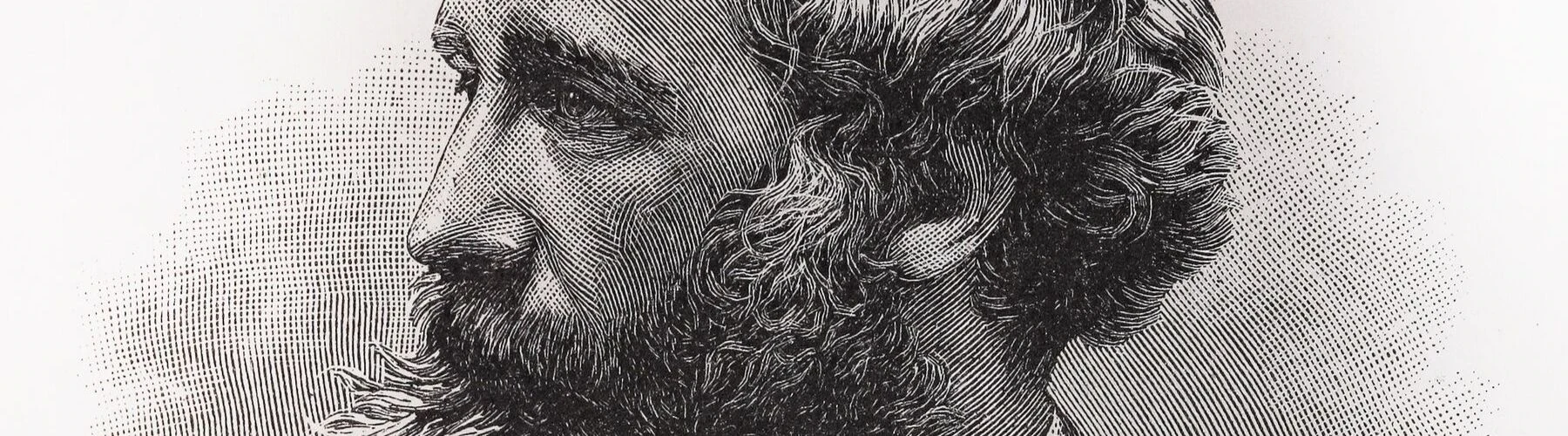
James Clerk Maxwell’s most far-reaching insight was that light, electricity and magnetism could be understood as aspects of one physical phenomenon. His mathematical account of electromagnetic fields predicted waves travelling through space at the speed of light, opening a path towards the later discovery of radio waves. Yet Maxwell’s work ranged well beyond electromagnetism: he investigated the behaviour of gases, colour vision, the stability of Saturn’s rings and the control of steam engines. His career connected abstract mathematics with problems that could be tested, measured and built upon.
A Scottish education shaped by experiment
Maxwell was born in Edinburgh on 13 June 1831, the only surviving child of John Clerk Maxwell, an advocate, and Frances Cay. The family later moved to Glenlair, their estate in Kirkcudbrightshire. Frances took charge of his early education, but died of cancer when he was eight. His father and aunt Jane then helped oversee his schooling.
At ten, Maxwell entered the Edinburgh Academy. His country upbringing and Galloway accent set him apart from some classmates, but he found lasting friends in Lewis Campbell and Peter Guthrie Tait. Mathematics soon became a particular strength. At fourteen, he wrote a paper on oval curves and curves with multiple foci. Because he was considered too young to present it himself, a professor delivered it to the Royal Society of Edinburgh on his behalf.
Maxwell began university study in Edinburgh in 1847. His interests included the properties of polarised light, and he experimented with stressed blocks of gelatine to observe coloured patterns. The work led to an early investigation of photoelasticity: the use of changes in light to reveal stresses within a material. In 1850, he moved to Cambridge, first entering Peterhouse and then transferring to Trinity College. He graduated in mathematics in 1854, achieving distinction in the examinations.
His university work already showed the range of his curiosity. He investigated how red, green and blue light could combine to produce other colours, and presented his findings to the Royal Society of Edinburgh in 1855. That year he became a fellow of Trinity. In 1856 he took up the chair of natural philosophy at Marischal College in Aberdeen, where one of his major early investigations concerned the rings of Saturn.
Saturn’s rings, colour and the work of fields
The stability of Saturn’s rings posed a mathematical problem: a single solid ring, Maxwell argued, would not remain stable, while a fluid ring would break apart. He concluded that the rings must consist of numerous small particles, each orbiting Saturn independently. His essay on the subject won the Adams Prize in 1859. Later observations by spacecraft confirmed the essential particle-based account, although the rings are not entirely stable.
Maxwell married Katherine Mary Dewar in Aberdeen in 1858. She assisted with laboratory experiments, including work on viscosity. When Marischal College merged with King’s College in 1860, Maxwell moved to London to take the chair of natural philosophy at King’s College. There, he continued research into colour and gases while developing his theory of electromagnetism.
In 1861, Maxwell presented the first public demonstration of colour photography, based on combining images taken through red, green and blue filters. The experiment was carried out using photographs taken by Thomas Sutton. The materials available at the time did not record all three colours well, so the result was imperfect, but the demonstration put Maxwell’s colour theory into practice. His related work on colour vision earned him the Royal Society’s Rumford Medal in 1860.
Maxwell’s electromagnetic theory developed over several years. In “On Physical Lines of Force”, published in parts in 1861 and 1862, he explored the relationship between electric and magnetic fields, including the concept of displacement current. In 1865, his paper “A Dynamical Theory of the Electromagnetic Field” set out the argument that electromagnetic disturbances could travel as waves at the speed of light. Maxwell concluded that light itself was an electromagnetic disturbance. His fully developed equations appeared later, in his 1873 treatise A Treatise on Electricity and Magnetism.
The importance of this connection lay in what it made possible to predict. Maxwell’s theory suggested that electromagnetic waves could exist beyond visible light. His work did not itself produce radio technology, but it provided a mathematical foundation for the subsequent investigation of such waves and, eventually, technologies including radio and telecommunications.
Gases, measurement and the Cavendish Laboratory
Maxwell also helped establish statistical mechanics. Between 1859 and 1866, he developed a statistical description of the distribution of molecular velocities in a gas. The Maxwell–Boltzmann distribution expresses the proportions of gas molecules moving at different speeds at a given temperature; Ludwig Boltzmann later generalised the work. Maxwell also devised the thought experiment known as Maxwell’s demon, which asks how an imagined being sorting particles by energy would challenge the second law of thermodynamics.
His practical interests included the regulation of machinery. In “On governors”, published in 1868, Maxwell gave a mathematical account of governors: devices that regulate the speed of steam engines. The paper became an important foundation for control theory. He also studied the rigidity of frameworks, wrote Theory of Heat in 1871 and Matter and Motion in 1876, and helped establish the CGS system of measurement. He made explicit use of dimensional analysis, a way of reasoning about physical quantities through their dimensions.
In 1871, Maxwell returned to Cambridge as the first Cavendish Professor of Physics. He oversaw the design and construction of the Cavendish Laboratory and the acquisition of its apparatus. The role brought his mathematical and experimental interests together in an institution intended for systematic physical research. Maxwell also edited Henry Cavendish’s research, adding extensive notes that helped bring the earlier scientist’s work to wider attention.
His own writings continued to range across physics. Alongside electromagnetism, his research and teaching addressed heat, gases, mechanics and measurement. Maxwell’s mathematical treatment of fields and his account of how light fitted into that theory later became important to the development of modern physics, including relativity and quantum mechanics. Albert Einstein recognised the significance of Maxwell’s equations to the origins of special relativity.
Final years and scientific remembrance
Maxwell left King’s College London in 1865 and returned to Glenlair with Katherine. He continued writing and researching before accepting the Cavendish professorship in 1871. His health began to fail in 1879; he died of abdominal cancer in Cambridge on 5 November, aged 48. He was buried at Parton Kirk in Galloway, near the area where he grew up. His friend and former schoolfellow Lewis Campbell published a biography in 1882, and Maxwell’s scientific papers were collected in two volumes in 1890.
Maxwell’s significance rests not on a single invention but on the reach of his methods and ideas. His theory linked previously separate accounts of electricity and magnetism, while his work on gases connected molecular motion with measurable properties. His investigations into colour produced an early demonstration of three-colour photography; his analysis of governors helped establish a mathematical approach to controlling machinery. Across these subjects, he repeatedly used mathematics to make relationships visible and to produce predictions that others could test.
Why James Clerk Maxwell deserves a place in British Legacy
James Clerk Maxwell deserves a place in British Legacy because his work changed the framework through which scientists understood light, electricity and magnetism. His account of electromagnetic fields showed that light belonged within the same theory as electrical and magnetic phenomena. By predicting waves that travel at the speed of light, Maxwell provided a foundation for later work on radio waves and the technologies that use them. That contribution connects a nineteenth-century Scottish physicist to the history of modern communications without confusing theoretical discovery with the engineering that followed.
His legacy is also broader than the theory for which he is best known. Maxwell’s research into the motion of gas molecules helped shape statistical mechanics; his work on governors helped lay foundations for control theory; and his experiments on colour contributed to colour photography. At Cambridge, he helped establish the Cavendish Laboratory as a centre for physical research. These achievements show a scientist moving between mathematical reasoning, experiment and institution-building. They give British Legacy a specific and enduring story: one rooted in Scotland and carried through universities and scientific institutions, whose ideas continue to inform physics and engineering far beyond his lifetime.
Sources
Adapted in part from James Clerk Maxwell by Wikipedia contributors, under CC BY-SA 4.0. Text has been edited and combined with the existing article; this adapted text is shared under the same licence. Contributor history.