
Mary Wollstonecraft’s best-known book, A Vindication of the Rights of Woman, was not a request that women be treated more pleasantly within an unchanged society. Published in 1792, it challenged the assumptions that made women appear intellectually lesser: if girls were taught to prize beauty, obedience and dependence, Wollstonecraft argued, their constrained lives could be mistaken for evidence of a natural incapacity. Education, judgement and the means to live independently were not ornaments. They were conditions of full moral and civic life.
Wollstonecraft was born in Spitalfields, London, on 27 April 1759. She became a teacher, translator, reviewer, novelist, political writer and travel writer, making her living in a literary world in which few women could support themselves by writing. Her case for women’s equality grew out of both argument and experience: she knew the precarious employment available to women without money, and she used the pamphlet, the review and the book to contest the ideas that kept them dependent.
Work, friendship and an education in dependence
Wollstonecraft’s family became financially unstable as her father spent its money and the household moved repeatedly. She later faced the narrow options open to a respectable woman without a fortune. In 1778 she took work as a companion to Sarah Dawson in Bath; after returning home to care for her dying mother, she lived with her close friend Frances “Fanny” Blood and Blood’s family. These jobs and experiences were not incidental to her writing. They brought into view how women’s security could depend on other people’s money, decisions and goodwill.
Wollstonecraft and Blood hoped to build an independent life together. In 1784, Wollstonecraft helped her sister Eliza leave an unhappy marriage and arranged for her to escape with her infant daughter. The decision challenged expectations about marriage and family duty, and left Eliza facing social condemnation and economic hardship. It also makes clear that Wollstonecraft’s questions about women’s choices were not confined to abstract political writing.
With her sisters and Blood, Wollstonecraft established a school at Newington Green, a dissenting community in north London. Blood’s health deteriorated after she married and went to Lisbon; Wollstonecraft travelled there to nurse her, but Blood died in 1785. The school failed after Wollstonecraft left. The loss helped shape her first novel, Mary: A Fiction, and strengthened her attention to the gap between women’s emotional attachments and the material conditions in which they had to live.
Before she left teaching, Wollstonecraft worked as a governess to the daughters of the Kingsborough family in Ireland. Some of this experience informed Original Stories from Real Life, a book for children. Her earlier Thoughts on the Education of Daughters and these educational writings emphasised qualities such as honesty, self-command and the ability to reason. Education, in her view, should help a person govern herself; it was not simply preparation for pleasing other people.
A professional writer and political controversialist
In the 1780s, Wollstonecraft chose to make a living as a writer, an unusual and difficult course for a woman with limited means. In London she found work with the publisher Joseph Johnson. She translated books from French and German, wrote reviews for the Analytical Review, and produced fiction and educational works. Johnson’s circle brought her into contact with writers and political thinkers; the work itself gave her a place in the networks through which ideas and controversies circulated.
Her first major intervention in political debate came in 1790. Edmund Burke’s Reflections on the Revolution in France defended established hierarchy and criticised the French Revolution. Wollstonecraft answered with A Vindication of the Rights of Men, attacking hereditary privilege and the deference paid to rank. She challenged Burke’s use of sentiment and spectacle to defend an unequal social order, arguing instead for a society judged by reason. The book established her as a public political writer before she turned her attention more directly to women’s position.
In A Vindication of the Rights of Woman, Wollstonecraft argued that women should receive an education suited to their place in society and be regarded as rational beings, not as ornaments or property transferred through marriage. She criticised the culture that trained girls to value beauty and submission, then treated the resulting limits as natural. Women’s apparent weakness, she contended, was produced by their education and circumstances rather than proving that their minds were inferior.
Her argument went beyond access to schooling. Wollstonecraft wanted women to develop judgement, support themselves where possible, and enter marriage as companions rather than dependants. She linked women’s education to the public good: women helped educate children and could contribute to civic life, but they could do so fully only if they were allowed to cultivate their minds. Her proposed national education included mixed-sex schooling. She also criticised the model of femininity that praised women for being compliant, flirtatious or excessively governed by feeling while withholding the discipline of serious thought.
This was not a simple call to replace feeling with reason. Wollstonecraft’s ideal joined reason and feeling, virtue and freedom, affection and self-respect. She believed that dependence damaged women’s character and weakened relationships, and that a more equal marriage required women to be treated as thinking partners. Her writing also reflected the limits and assumptions of its period; the supplied account of her educational plan, for example, describes different schooling for poorer children after the age of nine. That context belongs alongside the force of her challenge to women’s exclusion.
Revolution, travel and private life
Wollstonecraft’s political writing developed alongside her engagement with the French Revolution. She went to Paris in December 1792 and lived through a period of increasing danger for foreigners and political opponents. She associated with the moderate Girondins and witnessed the upheaval at close quarters. Her An Historical and Moral View of the French Revolution, published in 1794, considered the conditions behind the revolution while addressing its violence and political reversals. Her response to events was not a fixed celebration: her hopes were tested by what she saw.
In France she formed a relationship with the American Gilbert Imlay and had a daughter, Frances “Fanny” Imlay, in 1794. The relationship ended, and Wollstonecraft returned to England in 1795. Later that year she travelled through Scandinavia on a business matter connected with Imlay. Her account, Letters Written in Sweden, Norway, and Denmark, appeared in 1796. It combines observations about people, commerce and place with reflections on feeling, the self and society. It is also distinct from her political treatises: the letters use personal experience and landscape to develop their questions.
Wollstonecraft’s other writing included the novels Mary: A Fiction and the unfinished Maria: or, The Wrongs of Woman. Both examine the restrictions and injustices surrounding marriage. She also wrote children’s literature, educational works and a history of the French Revolution, and translated books for young readers and adults. This breadth matters: she was not only the author of one celebrated argument, but a working writer moving between genres and subjects.
In 1797 she married the philosopher William Godwin. Their daughter, Mary Wollstonecraft Godwin, was born on 30 August and later became the writer Mary Shelley, author of Frankenstein. Wollstonecraft died in London on 10 September 1797, aged 38, from an infection following the birth. Several manuscripts remained unfinished. Her short life had included a professional writing career, political interventions, educational work and sustained reflection on how social arrangements shape women’s choices.
Reputation, recovery and commemoration
After Wollstonecraft’s death, Godwin published a memoir that disclosed details of her relationships and personal life. Although he wrote about her with sympathy, many readers were shocked by what he revealed, and hostile critics used her unconventional life to discredit her arguments. For much of the nineteenth century, her reputation was damaged by the memoir’s reception. That response exposed a double standard: her private choices were treated as though they settled the value of her public reasoning.
Her work did not vanish. New editions appeared, and women’s suffrage campaigners in Britain later reclaimed her as an important predecessor. Millicent Garrett Fawcett wrote an introduction to a centenary edition of A Vindication of the Rights of Woman in 1892. In the twentieth century, writers including Virginia Woolf returned to Wollstonecraft’s arguments and to the force of her writing. Modern feminist scholarship has likewise treated her work as more than a biographical curiosity, examining her political thought, educational ideas and writing across different genres.
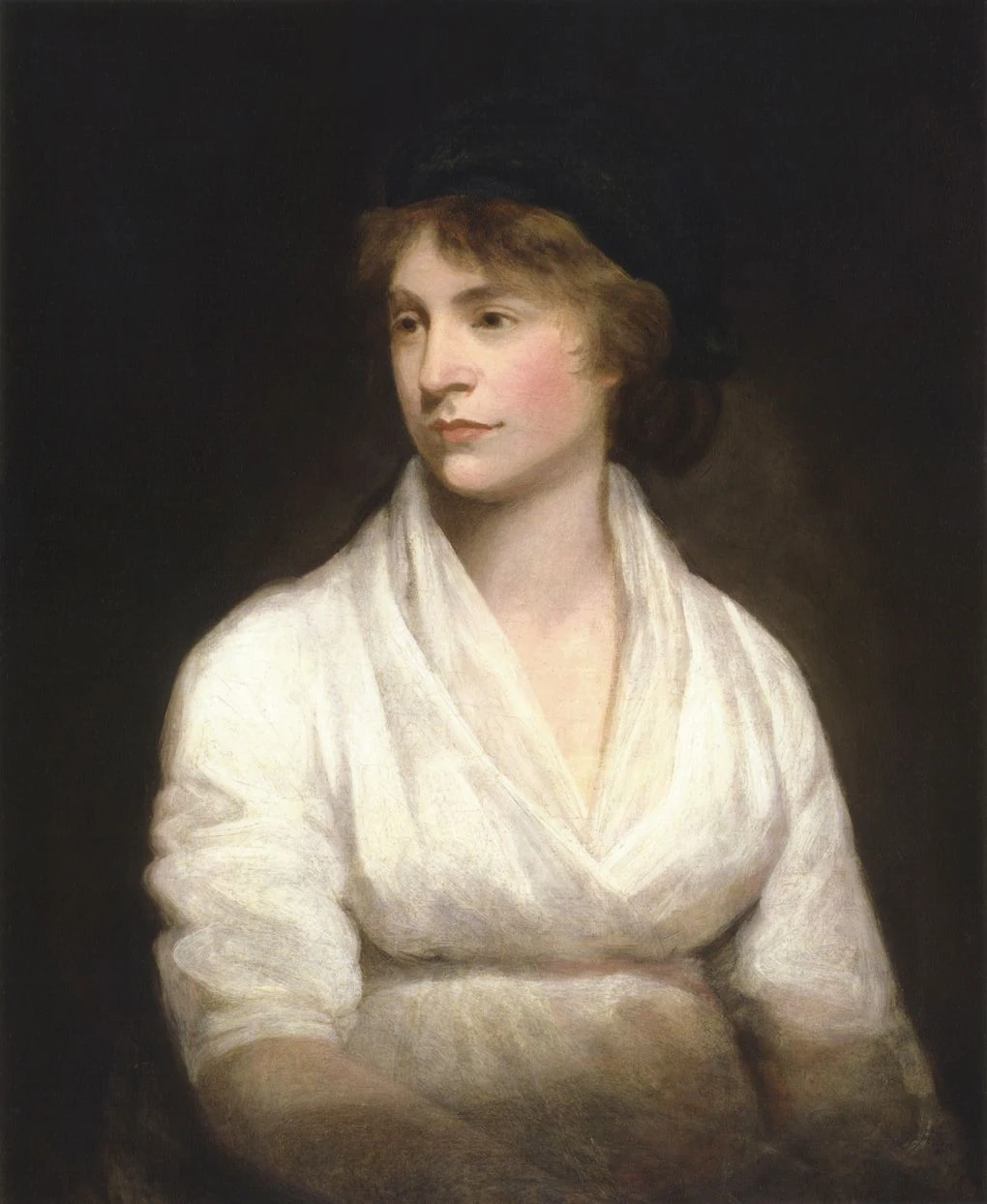
Wollstonecraft’s public remembrance has also changed. The National Portrait Gallery holds a portrait of her by John Opie. In 2009, the Royal Mail included her in its “Eminent Britons” commemorative stamp issue. A sculpture by Maggi Hambling was unveiled at Newington Green in 2020; its symbolic representation prompted criticism from commentators who felt it repeated restrictive ideas about women’s appearance. These acts of commemoration show both her established place in public memory and the continuing argument over how women are represented.
Why Mary Wollstonecraft deserves a place in British Legacy
Mary Wollstonecraft deserves a place in British Legacy because she used the means of British public debate to challenge the limited education and social roles assigned to women. Her books and pamphlets addressed readers directly, answering influential political arguments and asking what a society loses when it cultivates women for dependence rather than judgement. In A Vindication of the Rights of Woman, education was not a decorative privilege or merely a way to make women more useful to men. It was a condition of moral independence and participation in the life of a community. That claim connected individual opportunity with public benefit: children, marriages and civic society would all be poorer if half the population were denied the chance to develop its abilities.
Her legacy also rests on the breadth and persistence of her work. Wollstonecraft earned a living through translation, reviewing and authorship; wrote on education, politics, fiction and travel; and continued to test her arguments against changing circumstances. Her experience of precarious work and the constrained choices available to women gave her criticism practical stakes, while her response to Burke made her a participant in the political controversies of her time. Later suffragists reclaimed her writing when campaigns for women’s rights sought their own history, and subsequent readers have continued to find questions in it about education, marriage, independence and public voice. Remembering her in British history means recognising not a convenient slogan or a token precursor, but a writer whose argument about women’s full intellectual and civic lives remains central to understanding reform and equality.
Sources
Mary Wollstonecraft — Wikipedia, revision 1375562955 · Mary Wollstonecraft — Wikipedia
Adapted in part from Mary Wollstonecraft by Wikipedia contributors, under CC BY-SA 4.0. Text has been edited and combined with the existing article; this adapted text is shared under the same licence. Contributor history.
.jpg)