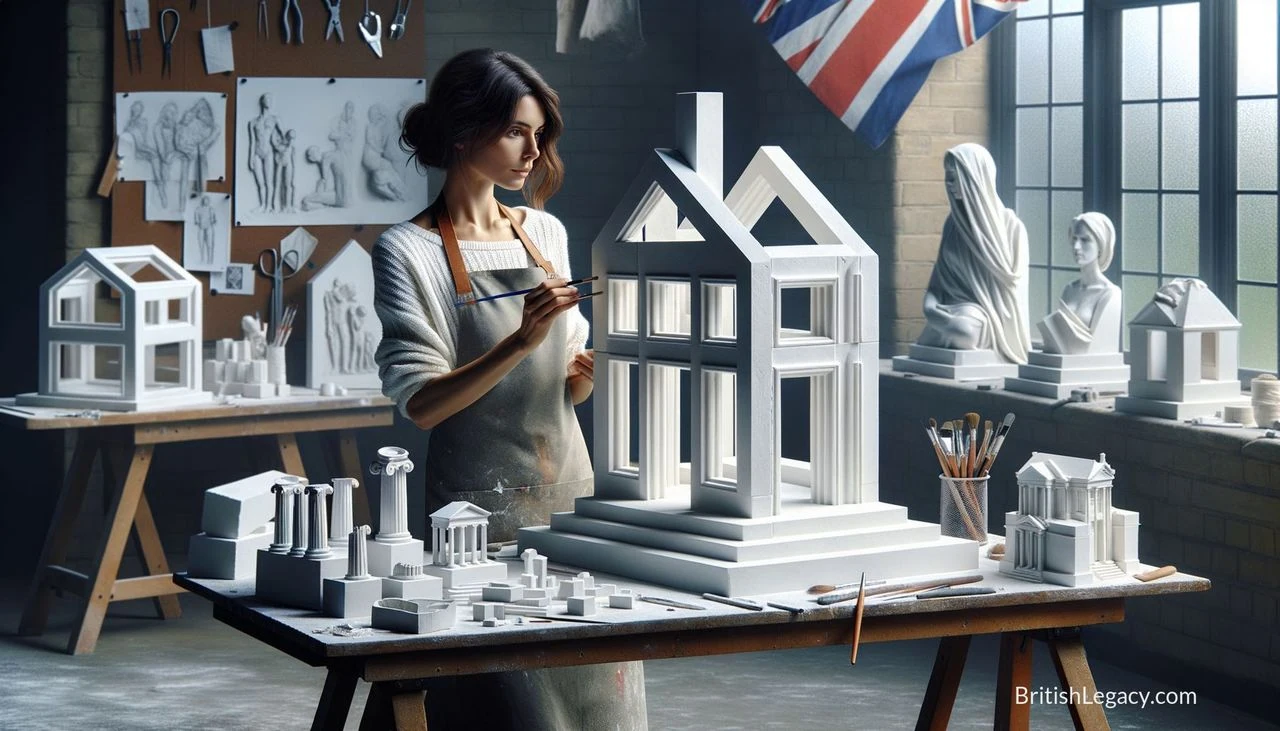
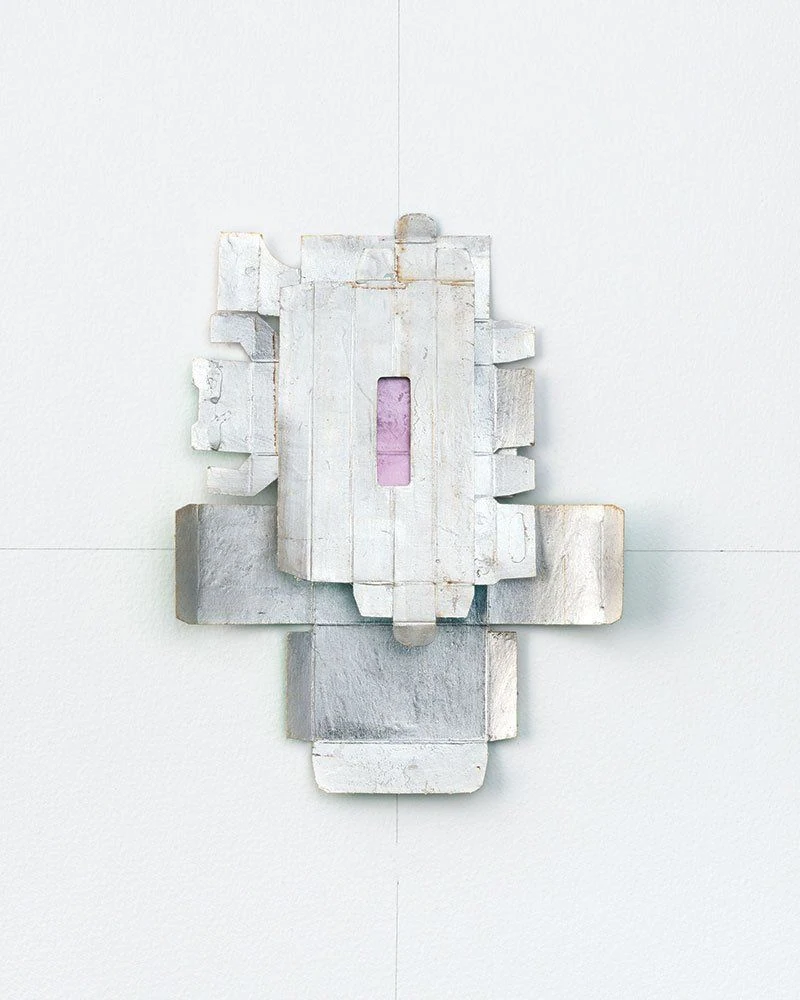
Rachel Whiteread makes solid objects from spaces that usually go unnoticed: the inside of a room, the space beneath a chair, the volume enclosed by a shed. Her sculptures turn these absences into physical forms. The result can look at once familiar and strange, inviting viewers to consider how buildings and objects hold traces of use, memory and change.
Learning to cast the unseen
Born in Ilford, Essex, on 20 April 1963, Whiteread studied at Brighton Polytechnic and briefly at the Cyprus College of Art before taking a sculpture course at the Slade School of Fine Art, University College London. She graduated with an MA in 1987. A workshop with sculptor Richard Wilson helped her recognise the possibilities of casting. While still at the Slade, she made Closet, a plaster cast of the interior of a wooden wardrobe, covered in black felt. After her father died, she made Shallow Breath (1988), a cast of the underside of a bed.
These early works established a method she would develop across domestic objects, rooms and buildings. Rather than reproduce an object’s outward surface, she often casts the space inside or around it. The resulting solid form records the shape of an absence. Whiteread has described casts as carrying “the residue of years and years of use”. That idea is central to the work: an ordinary room or item of furniture becomes a record of a space shaped by human presence.
Whiteread began exhibiting in 1987 and held her first solo exhibition in 1988. The works in that show sold, enabling her to seek funding for larger projects. In 1990 she completed Ghost, a plaster cast made from the walls and ceiling of a room in a north London house. She cast it in sections and assembled them on a metal frame. First shown at Chisenhale Gallery, Ghost moved her practice from the scale of furniture towards architecture, while keeping its attention on the domestic interior.
House: a temporary landmark
In October 1993, Whiteread completed House, a concrete cast of the inside of a Victorian terraced house at 193 Grove Road in east London. The project had taken shape over several years. With Artangel’s James Lingwood, she looked for a suitable house due for demolition; the chosen site was on a street where the other houses had already been knocked down by the council. The cast occupied the location of the original building, making the lost interior visible as a solid mass.
House brought Whiteread both the Turner Prize and intense public attention. She was the first woman to win the prize. Its reception was not unanimous: the K Foundation gave her its art award for the worst British artist. The work’s presence in a changing urban neighbourhood, and the decision to remove it, became part of its public story. Tower Hamlets London Borough Council demolished it on 11 January 1994. The work lasted only a short time, but its scale and location made the question of what a sculpture can memorialise unusually immediate: a building no longer existed, yet its interior had been made monumental.
Whiteread continued to test how casts could work in different materials and settings. For the 1997 Sensation exhibition at the Royal Academy, she showed Untitled (One Hundred Spaces), resin casts of the spaces beneath chairs. In 1998, her translucent resin Water Tower was installed on a rooftop in New York’s SoHo district; it later entered the Museum of Modern Art’s collection. In 2001, she made Untitled Monument for the empty Fourth Plinth in Trafalgar Square. The work inverted a cast of the plinth, turning the support itself into a transparent resin sculpture and drawing attention to the emptiness the plinth had been designed to hold.
Public memory and domestic forms
In Vienna, Whiteread’s 2000 Judenplatz Holocaust Memorial, also known as the Nameless Library, addresses a different kind of absence. The work commemorates the Austrian Jews murdered in the Holocaust. Its cast, concrete books have their spines turned inwards, so that their titles cannot be read. The sealed library offers no access to its contents. Its form makes remembrance inseparable from the limits of what can be recovered or known about lives destroyed.
The memorial was built in Judenplatz, on the site of excavations associated with Vienna’s oldest synagogue. The location and design prompted debate. Some residents considered the archaeological remains sufficient as a memorial; other criticism concerned the work’s representation of Jewish identity. These responses belong to the history of the commission as well as its form. Whiteread’s sculpture does not provide a conventional figurative image; it asks visitors to encounter an inaccessible interior in a public square.
Her 2005–06 installation Embankment brought the language of domestic storage into Tate Modern’s Turbine Hall. Around 14,000 translucent white polyethylene boxes, each cast from the inside of a cardboard box, were arranged in piles and peaks. The boxes made a vast gallery feel more like a space of packing, storage and movement. Whiteread has connected the work to experiences of packing and moving, as well as to the death of her mother. The installation’s repeated forms could suggest both an immense landscape and the familiar contents of a home.
Other projects have continued to shift between private and public space. Detached 1, Detached 2 and Detached 3 (2012) cast the empty interiors of garden sheds in concrete and steel. In 2016, Cabin, a concrete reverse cast of a wooden shed, was installed on Governors Island in New York Harbour. In Britain, Nissen Hut (2018), made for Dalby Forest in collaboration with Forestry England and 14-18 NOW, draws on the history of the huts and the workers who lived and worked in the forest. Its form gives a local structure a permanent presence within the landscape it once served.
Recognition and range
Whiteread’s work spans sculpture, installation and public commissions, but casting remains its defining thread. She was among the Young British Artists shown in the Royal Academy’s Sensation exhibition in 1997. Her commissions have included Angel of the South, for which she was shortlisted in 2008, and a 2023 Christmas tree of white neon hoops for Carlos Place in London. She has also made smaller works, including a plaster sculpture for a charity auction supporting a primary school in Islington.
Her work has been shown and collected internationally. Ghost entered the collection of the National Gallery of Art in Washington, DC, in 2004, and Water Tower is in the collection of the Museum of Modern Art in New York. In 2006 Whiteread was appointed a Commander of the Order of the British Empire; in the 2019 Birthday Honours she was appointed Dame Commander of the Order of the British Empire for services to art. These honours and collections sit alongside a career in which public response has ranged from prize-winning recognition to sharp disagreement.
Why Rachel Whiteread deserves a place in British Legacy
Rachel Whiteread deserves a place in British Legacy for the way she has expanded what sculpture can make visible. Her casts do not simply reproduce objects: they give shape to the space inside a wardrobe, beneath a bed or within a house. That approach made an everyday interior the subject of major contemporary art, and House brought the idea into a public argument about a changing east London neighbourhood. Its brief existence did not diminish its impact; the demolition became part of the work’s history and sharpened the questions it raised about memory, place and what a community chooses to preserve.
Her contribution also connects British art to wider public histories. The Vienna memorial uses an inaccessible cast library to commemorate murdered Austrian Jews, while Nissen Hut gives a structure associated with forestry workers a lasting presence in a British landscape. Works such as Embankment and the Fourth Plinth commission show how her practice can transform a large public space without abandoning the intimate scale of domestic objects. Whiteread’s career offers a distinctive British contribution to contemporary sculpture: an art of precise materials and familiar forms that asks viewers to attend to what is missing, and to the traces people leave behind.
Sources
Rachel Whiteread — Wikipedia, revision 1368205235 · Rachel Whiteread — Wikipedia
Adapted in part from Rachel Whiteread by Wikipedia contributors, under CC BY-SA 4.0. Text has been edited and combined with the existing article; this adapted text is shared under the same licence. Contributor history.