Lucian Freud made the act of looking feel strenuous. His sitters are often shown at close range, in unposed interiors or sprawled across a bed, their faces and bodies built up through layers of paint that resist easy idealisation. The paintings can be intimate and unsettling at once. Over a career that lasted six decades, Freud developed a form of figurative painting in which sustained observation, the physical presence of the model and the texture of the painted surface were inseparable.
From Berlin to London
Freud was born in Berlin on 8 December 1922, the second of three sons of Lucie Brasch and Ernst L. Freud, an architect and son of the psychoanalyst Sigmund Freud. The family emigrated to London in 1933 to escape Nazism. Lucian became a British subject in 1939, and London remained his home for the rest of his life.
His education was unsettled before it became distinctly artistic. He attended Dartington Hall School in Devon and Bryanston School, from which he was expelled for disruptive behaviour. He briefly studied at the Central School of Art in London, then worked with the painter Cedric Morris at the East Anglian School of Painting and Drawing. The school moved from Dedham to Benton End, near Hadleigh in Suffolk, in 1940. Freud also attended Goldsmiths’ College in 1942–43. In 1941 he served in an Atlantic convoy as a merchant seaman; he was invalided out the following year.
His first solo exhibition was held at the Lefevre Gallery in 1944. Early paintings such as Man with a Thistle (1946) and Girl with a Kitten (1947) show a precise, thinly painted approach, with carefully controlled lines and muted colour. The large-eyed figures and close attention to detail differ markedly from the thick brushwork associated with his later reputation. Freud’s early work was linked to surrealism and German expressionism; neither label alone explains the changes in his painting.
Learning to paint from life
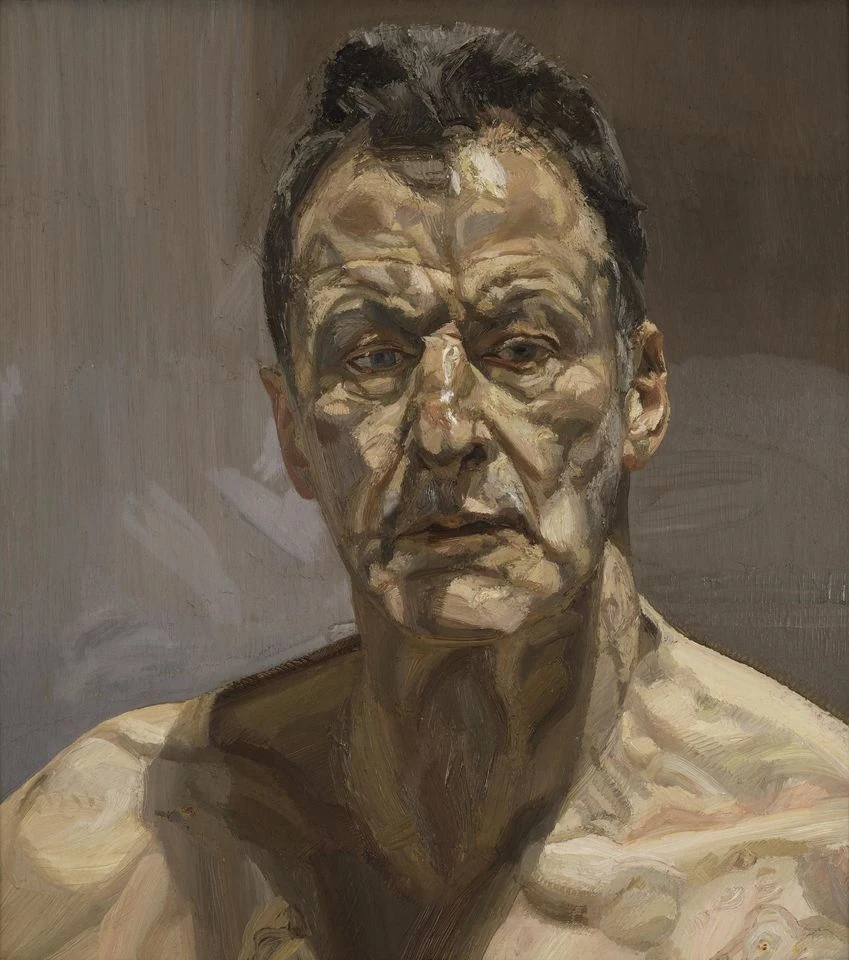
Freud’s work shifted towards portraiture during the 1950s. He increasingly concentrated on people, often nude, and developed a freer technique with larger hog’s-hair brushes and heavier paint. Flesh became a subject in itself: its changing colour, weight and texture could be made visible through impasto, rather than smoothed into an idealised surface. By about 1960 he had established the broad approach that, with changes, he would use for the rest of his career.
He painted from life and required his sitters to spend long periods with him. Sessions could continue while he worked on the background, and he commonly began with the head before moving out across the canvas and returning to it. His process accumulated slowly: he might leave an area of canvas bare until the painting was finished, and the work grew through repeated observation and layers of pigment. He separated daytime sittings in natural light from night sittings under artificial light.
The people who sat for him were often drawn from his own life: friends, family, fellow painters and lovers. Their poses could be unguarded, and his pictures frequently place a single figure on a bed or floor, sometimes beside an animal. The resulting intimacy is not simply a matter of subject matter. The long sittings and the visible effort of the paint make the relationship between painter and model part of the experience of looking. Freud’s work can feel psychologically penetrating, but it does not offer a simple explanation of what a sitter thinks or feels.
A distinctive place in British figurative art
Freud became one of the best-known British painters working in a representational style. He was among the artists later grouped under the loose label “School of London”, alongside figures including Francis Bacon, Frank Auerbach and R. B. Kitaj. They worked in London at a time when abstract painting was also prominent, but the group had no single programme. Freud’s continued engagement with the human figure was his own sustained answer to the artistic possibilities of painting from life.
He taught as a visiting tutor at the Slade School of Fine Art from 1949 to 1954. A major retrospective at the Hayward Gallery in 1988 brought wider attention to his work, and he was shortlisted for the Turner Prize in 1989. His subjects included Bacon and Auerbach, the performance artist Leigh Bowery and Henrietta Moraes. In later years, he also made etchings, working in London with the printer Marc Balakjian. The National Portrait Gallery’s collection includes 143 of Freud’s prints.
His portrait of Queen Elizabeth II, completed in 2001, prompted criticism in the British media for its unsparing approach to a royal subject. The picture was a conspicuous encounter between a familiar public image and Freud’s close scrutiny. Rather than adopting the conventions of flattering royal portraiture, he remained committed to the particular appearance of the person sitting before him.
Benefits Supervisor Sleeping and public attention
Freud’s best-known later nudes include a series depicting Sue Tilley, a civil servant whom he sometimes identified in titles by her job. Benefits Supervisor Sleeping (1995) shows her asleep, her body occupying much of the canvas. Its scale and thickly worked paint make the sitter’s physical presence central, while the ordinary title refuses the distance of allegory or idealisation.
In 2008 Christie’s sold the painting for $33.6 million. At the time, that was the highest auction price for a work by a living artist. The sale brought market attention to a painting whose effect depends less on spectacle than on the sustained, material presence of its subject. Freud’s market profile continued after his death: Benefits Supervisor Resting sold for $56.2 million in 2015.
His later career included exhibitions in Britain and abroad, among them a 2002 exhibition at Tate Britain. He received the Rubens Prize from the city of Siegen in 1997. In the final years of his life, his studio assistant and friend David Dawson was a regular sitter and the subject of Freud’s last, unfinished work.
Why Lucian Freud deserves a place in British Legacy
Freud’s place in British Legacy rests on a career formed in Britain and on the particular contribution he made to its modern painting. His family arrived in London as refugees from Nazi Germany; he studied and worked in England, became a British subject in 1939 and spent the rest of his life as a Londoner. Those facts provide the setting, but the lasting importance lies in what he made there. While working in a period when abstraction was prominent, Freud sustained a demanding practice of figurative painting, developing a recognisable language from close observation, physical paint and long sittings. His association with the loosely connected School of London locates him within a wider British artistic world without making his work a product of a formal movement.
His portraits and nudes also widened what the public could expect from figurative art. They do not smooth away age, weight or awkwardness, and their directness can be uncomfortable; the paintings ask viewers to attend to people as bodies, individuals and sitters rather than as polished symbols. His portrait of Queen Elizabeth II brought that approach into contact with a defining British institution, while the reception of Benefits Supervisor Sleeping showed that an unidealised portrait of an ordinary working woman could become a major public and cultural event. Freud’s long London career, his influence within British figurative painting and the continuing encounter his works offer to viewers make his legacy specific, not merely a claim to national fame.
Sources
Lucian Freud — Wikipedia, revision 1378762123
Adapted in part from Lucian Freud by Wikipedia contributors, under CC BY-SA 4.0. Text has been edited and combined with the existing article; this adapted text is shared under the same licence. Contributor history.