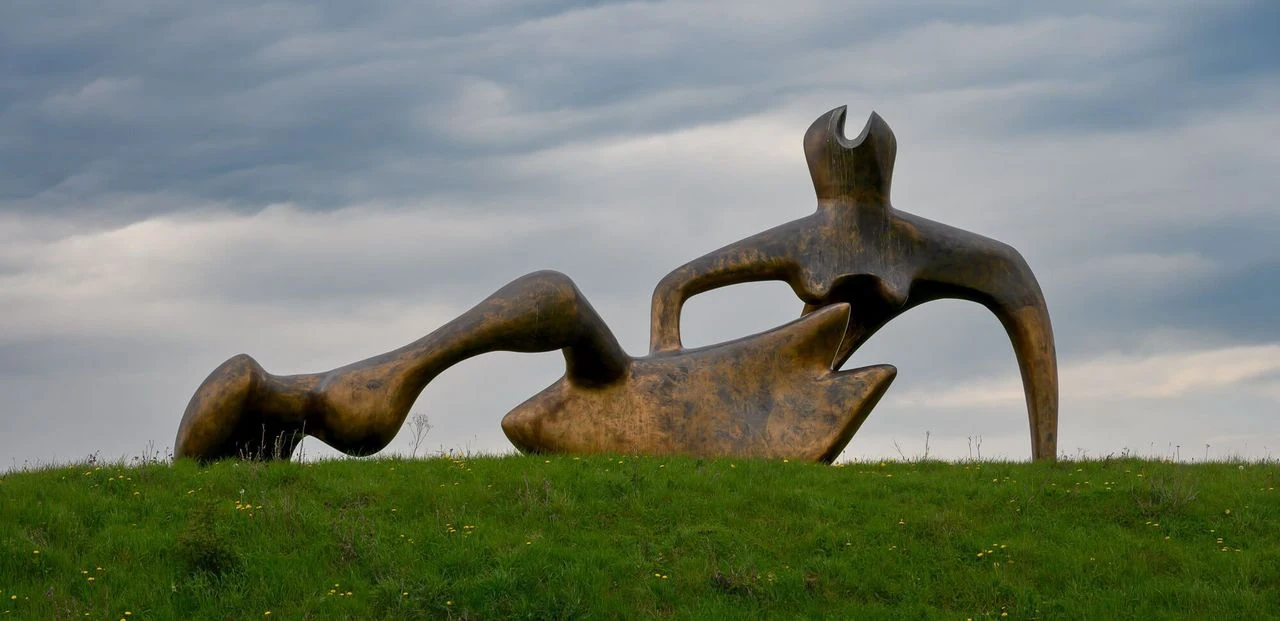
Henry Moore made the human figure monumental without making it rigid. His reclining forms, cast in bronze or carved in stone, often open into hollows and pierced spaces: the body becomes both solid object and a frame for the world around it. Born in Castleford, Yorkshire, Moore became one of the most prominent sculptors of the twentieth century. His work reached public spaces across Britain and abroad, while his wartime drawings recorded Londoners sheltering from the Blitz.
From Castleford to art school
Henry Spencer Moore was born in Castleford on 30 July 1898, the seventh of eight children of Mary and Raymond Spencer Moore. His father worked at the Wheldale colliery, first as a pit deputy and later as its under-manager. He wanted his children to have opportunities beyond the mines, though his parents initially opposed sculpture as a career: they regarded it as manual work with few prospects.
At school, Moore modelled in clay and carved wood. His art teacher, Alice Gostick, encouraged his interest, and he later recalled deciding to become a sculptor at the age of eleven after hearing about Michelangelo. Before pursuing that ambition, he briefly worked as a student teacher and then taught at his former school.
Moore volunteered for army service during the First World War. He was injured in a gas attack at Bourlon Wood in November 1917, during the Battle of Cambrai. After recovering, he served as a physical-training instructor for the remainder of the war. In 1919, with an ex-serviceman’s grant, he entered Leeds School of Art, which established a sculpture studio for him. There he met Barbara Hepworth, beginning a friendship and professional rivalry that would span many years.
A scholarship took Moore to the Royal College of Art in London in 1921. He studied sculpture and visited the British Museum’s ethnographic collections. In 1924, a travelling scholarship enabled him to study works by Italian masters, including Michelangelo, Giotto and Giovanni Pisano. In Paris, he saw a plaster cast of a Toltec-Maya figure known as the Chac Mool. Its reclining pose became a lasting point of reference for his own sculpture.
Finding a modern sculptural language
Moore’s early sculptures drew on conventional figurative styles, but his interests shifted towards direct carving and modernist approaches. Rather than reproduce a model by academic methods, he carved directly into material, allowing its texture and the marks of his tools to remain visible. He encountered resistance at the Royal College when he rejected a prescribed copying exercise in favour of carving a relief directly.
After completing his studies, Moore taught at the Royal College of Art and then became head of sculpture at Chelsea School of Art. In 1928, he received his first public commission: West Wind, one of the reliefs high on the London Underground’s headquarters at 55 Broadway. He held his first solo exhibition that year. The following year he married Irina Radetsky, a painting student at the Royal College; they later made their home in Hampstead, among a community of avant-garde artists.
Moore’s signature subject was the reclining figure. His work moved from solid, carved masses towards forms in which openings cut through the body, making the surrounding space part of the sculpture. Mother-and-child compositions became especially important after the birth of his daughter, Mary, in 1946; he also made family groups and continued to return to reclining figures. Natural objects collected at his home—among them bones, driftwood, pebbles and shells—provided starting points for organic forms.
His materials and methods changed with the scale of his commissions. Before the war he concentrated on direct carving. Afterwards, he increasingly modelled small forms in clay or plaster, then developed them into larger works for casting in bronze. Assistants helped him realise ambitious projects, while the underlying designs began as maquettes shaped by hand. Moore continued drawing throughout his life, even when arthritis made working more difficult.
War drawings and public commissions
When the Second World War began, Moore’s teaching post at Chelsea School of Art was disrupted by its evacuation to Northampton, and he resigned. The War Artists’ Advisory Committee commissioned drawings of Londoners sheltering in Underground stations during the Blitz. Moore’s images are not simply records of military events: they observe people waiting together in confined spaces. In 1941, he also drew miners working underground at Wheldale Colliery, the mine where his father had worked.
After the war, Moore’s commissions grew in number and scale. Family Group, made for a school in Stevenage, became his first large-scale public bronze. He showed Reclining Figure: Festival at the Festival of Britain in 1951, and in 1958 completed a large marble reclining figure for the UNESCO building in Paris. His work appeared in public settings around the world, where the abstract forms asked viewers to consider the relationship between figure, material and space.
In London, Knife Edge Two Piece was completed in 1962–65 for a site near the Houses of Parliament. Moore valued its setting beside a path and seating, rather than an isolated position in a large park. Given to the City of London by Moore and the Contemporary Art Society in 1967, the bronze is now part of the Parliamentary Art Collection and is displayed in Abingdon Street Gardens. Its placement puts sculpture into the everyday view of people walking through Westminster.
Moore’s public work was not confined to Britain. In 1967, Nuclear Energy was unveiled at the University of Chicago, on the site associated with the first controlled, self-sustaining nuclear chain reaction. Moore hoped people would walk around the sculpture and look through its open spaces. The work demonstrates how his forms could prompt interpretation without being tied to a single prescribed meaning.
A home, a collection and a foundation
In 1940, after bomb shrapnel hit the Moores’ Hampstead home, Henry and Irina moved to Hoglands, a farmhouse in Perry Green, Hertfordshire. It became his home and working base for the rest of his life. The estate’s studios gave him room to develop large models and sculptures, while his collection of natural forms remained close at hand.
As his career prospered, Moore turned his attention to preserving his work and supporting the arts. He established the Henry Moore Trust with his daughter in 1972. In 1977, he and his family created the Henry Moore Foundation as a registered charity to encourage public appreciation of the visual arts, particularly his own work. The foundation now manages his former home and estate at Perry Green, including its sculpture grounds, house and studios, and runs the Henry Moore Institute in Leeds, with exhibitions and research devoted to international sculpture.
Moore’s influence was both celebrated and contested. He became a leading figure in British sculpture, and later sculptors were often measured against his success. Some resisted his establishment status and the idea of sculpture as an expression of endurance and continuity. That response is part of his place in modern art: his work established a powerful model, but also gave subsequent artists something to challenge.
He received the International Sculpture Prize at the Venice Biennale in 1948. Moore declined a knighthood in 1951, concerned that it would distance him from fellow artists. He was appointed to the Order of the Companions of Honour in 1955 and the Order of Merit in 1963. He died at Perry Green on 31 August 1986, aged 88, and was buried at St Thomas’s Church.
Why Henry Moore deserves a place in British Legacy
Moore deserves a place in British Legacy because he changed how sculpture could occupy public space. His work carried the human figure out of the self-contained statue and into a more open relationship with its surroundings: holes, curves and hollows make landscape and air part of the composition. His commissions in Britain, including West Wind and Knife Edge Two Piece, made modern sculpture part of the fabric of public life. His international commissions show that this visual language travelled well beyond its Yorkshire origins, without losing its grounding in the forms of the human body and the natural world.
His British legacy also rests on more than bronze and stone. Moore’s drawings of people sheltering in the Underground brought close observation to the record of wartime London, while his drawings of miners connected that work to the industrial community in which he grew up. The foundation he established with his family has carried his commitment into the present: Perry Green preserves the place where he worked, and the Henry Moore Institute in Leeds supports exhibitions and research in sculpture. These continuing resources make his achievements accessible to audiences and artists, and help keep the study and practice of sculpture active. Together, the public works, drawings and institutions offer a specific, lasting account of how one British artist helped shape modern art.
Sources
Henry Moore — Wikipedia, revision 1378170721
Adapted in part from Henry Moore by Wikipedia contributors, under CC BY-SA 4.0. Text has been edited and combined with the existing article; this adapted text is shared under the same licence. Contributor history.