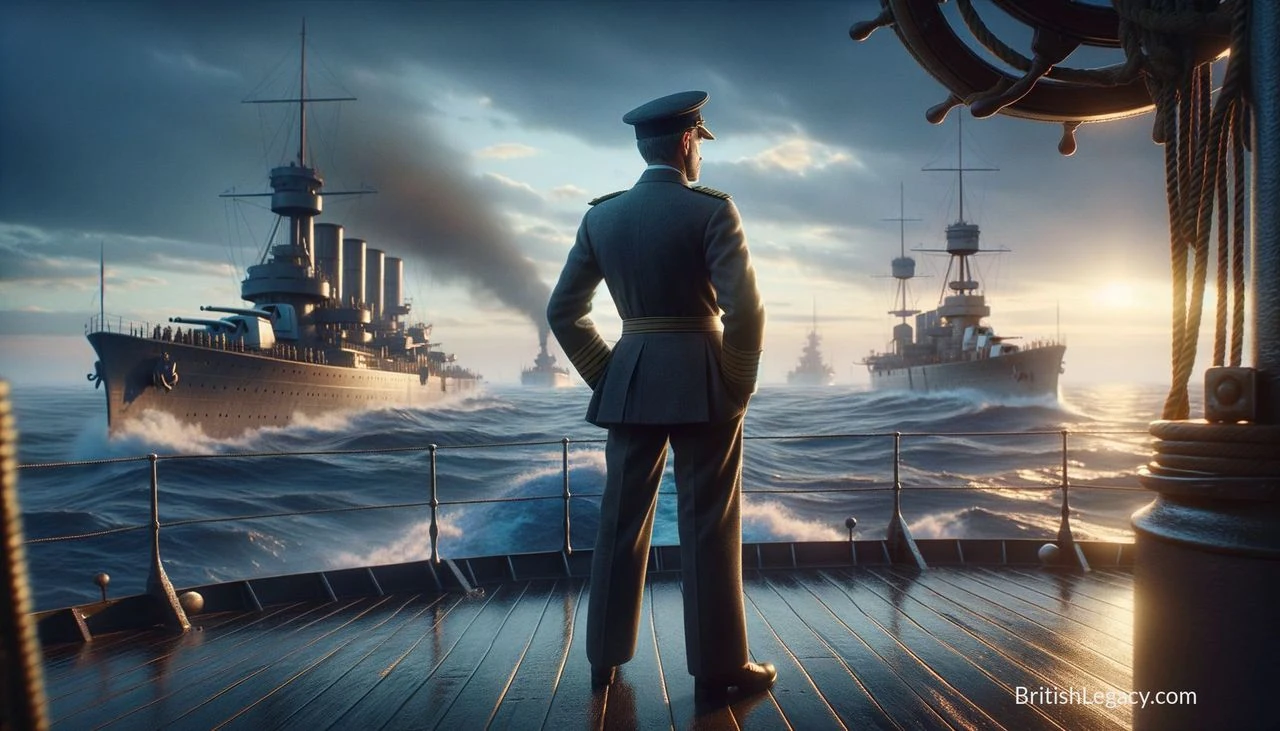
On 1 November 1914, Rear Admiral Sir Christopher Cradock found the German East Asia Squadron off the coast of Chile and chose to engage. His two armoured cruisers were outmatched, and the high seas made some of their guns unusable. By nightfall, HMS Good Hope and HMS Monmouth had been sunk, with the loss of all 1,660 men aboard them, including Cradock. The defeat at Coronel was a disaster for the Royal Navy. To understand its human and operational cost, it matters that Cradock’s final decision came after years spent serving across the empire and beyond, and amid orders that he understood as requiring him to seek out the enemy.
A Yorkshire-born officer at sea
Christopher George Francis Maurice Cradock was born at Hartforth, near Richmond in the North Riding of Yorkshire, on 2 July 1862. He was the fourth son of Christopher and Georgina Cradock, née Duff. On 15 January 1875, aged 12, he joined the Royal Navy’s cadet training ship, HMS Britannia. His first posting followed the next year, to the armoured corvette HMS Pallas in the Mediterranean. He became a midshipman in 1877 and was present during the British occupation of Cyprus the following year.
After further service in the Mediterranean and on the China Station, Cradock passed his lieutenant’s examinations and completed gunnery and torpedo courses. During the Mahdist War, he served with a naval brigade formed for the campaign. In 1891 he joined the Eastern Sudan Field Force and took part in the capture of Tokar. He later served as aide-de-camp to Colonel Charles Holled Smith, Governor-General of the Red Sea Littoral. For his service in the campaign he received the Ottoman Order of the Medjidie and the Khedive’s Star with the Tokar Clasp.
Cradock’s duties were not confined to combat. In 1893 he helped rescue the crew of the Brazilian cruiser Almirante Barroso after it was wrecked on the Red Sea coast. In 1894 he joined the royal yacht Victoria and Albert; he later served as a pallbearer at the funeral of Prince Henry of Battenberg. His connection with the royal household continued: he became a naval aide-de-camp to Edward VII in 1909 and remained at Portsmouth after the King’s death to assist his son, George V.
Commands, rescue work and rising rank
Cradock’s command of HMS Alacrity took him to China during the Boxer Rebellion. In 1900 he led a mixed contingent of British, German and Japanese sailors in the capture of the Taku forts, then led British and Italian sailors into Tientsin and took part in the relief of Vice-Admiral Edward Seymour’s besieged force. He was promoted to captain in 1901 and received the Prussian Order of the Crown with swords for his actions. The following year he became a Companion of the Order of the Bath. His subsequent appointments included command of the cruisers HMS Bacchante and HMS Leviathan and the battleship HMS Swiftsure.
Promoted to rear-admiral in 1910, Cradock later served with the Atlantic Fleet. In December 1911, the liner SS Delhi ran aground near Cape Spartel in heavy seas, with its lifeboats smashed. Cradock was ordered to take HMS London and HMS Duke of Edinburgh to assist. The rescue took five days and included the passengers and crew, among them the Duke and Duchess of Fife and their daughters. Cradock was appointed a Knight Commander of the Royal Victorian Order in recognition of his efforts and later received the Sea Gallantry Medal.
He also took part in early shipboard aviation trials. In May 1912, he shifted his flag to HMS Hibernia, where the Royal Navy was testing aircraft launched from ships. On 9 May, at a fleet review in Weymouth Bay, Commander Charles Samson took off in a Short Improved S.27 biplane while Hibernia was under way. It was the first take-off from a moving ship.
In 1913 Cradock took command of the 4th Cruiser Squadron, formerly the North America and West Indies Station. During the Mexican Revolution, his orders were to protect British lives and property while avoiding actions that could be interpreted as interference in Mexico’s internal affairs. Working with American Rear Admiral Frank Friday Fletcher, he helped evacuate British and American citizens from Tampico when rebels threatened the city. In 1914 he also helped evacuate about 1,500 refugees from Tampico, Mexico City and Veracruz, amid growing tensions between Mexico and the United States.
Orders, uncertainty and Coronel
At the outbreak of war, Cradock’s responsibilities included finding and tracking German cruisers in the Atlantic. He pursued the light cruiser Karlsruhe and, after rendezvousing with HMS Good Hope at Halifax, transferred his flag to that faster ship. As reports indicated that German vessels were moving south, the Admiralty ordered him to take his force towards South America. He was later placed in command of the South American Station, with the elderly pre-dreadnought battleship HMS Canopus sent as a reinforcement.
The Admiralty’s instructions changed as it tried to follow the German East Asia Squadron under Vice-Admiral Maximilian von Spee. An order in September envisaged Cradock keeping Canopus and a Monmouth-class cruiser with Good Hope until a stronger force became available. HMS Defence was to reinforce him, but that transfer was cancelled after the Admiralty’s assessment of the German movements changed. Cradock was not informed that Defence would no longer be sent. Later messages directed him to search the south-west coast of South America, but did not resolve what he should do if he found the enemy.
By late October he had reliable information that von Spee’s squadron had reached the west coast of South America. Cradock’s ships were substantially weaker, with ageing vessels and largely inexperienced crews. He interpreted his orders as requiring him to seek and engage the Germans. Clarifying instructions from the Admiralty were not issued until 3 November, two days after the battle.
Cradock found the German force off Chile on the afternoon of 1 November. He sent the armed merchant cruiser Otranto away and tried to close the range, where his ships’ shorter-ranged guns could be used and the setting sun might trouble the enemy’s aim. Von Spee kept his ships at a distance until dusk, when the British cruisers were silhouetted against the afterglow and the German ships were less visible. High seas prevented the main-deck six-inch guns on Good Hope and Monmouth from being used effectively. Both armoured cruisers were destroyed; HMS Glasgow escaped. The battle was the Royal Navy’s first defeat in a naval action for more than a century.
Before sailing from Port Stanley, Cradock had left a letter to be forwarded to Admiral Hedworth Meux if he died. In it, he referred to the court-martial of Rear-Admiral Ernest Troubridge, who had been charged after failing to engage German ships in August despite being heavily outmatched. The Governor of the Falklands and his aide both reported that Cradock had not expected to survive Coronel. That context makes the battle’s outcome more than a simple account of courage against superior firepower: it also exposes the consequences of uncertain instructions and a force ill-prepared for the encounter.
Books and memorials
Cradock wrote about seamanship and naval life as well as serving at sea. His books included Sporting Notes from the East, published during his early career, Wrinkles in Seamanship and Whispers from the Fleet. The last appeared in 1907, during a period of sharp disagreement within the Royal Navy over its leadership and direction. A passage in the book defended discipline and loyalty between officers and men, although his precise position in the wider dispute is not established.
Cradock never married. He kept a dog that accompanied him at sea and enjoyed hunting. With no known grave, he is commemorated on Portsmouth Naval Memorial. A monument by F. W. Pomeroy was placed in York Minster in 1916; further memorials to him stand in Catherington churchyard and at his parish church in Gilling West, where there is also a stained-glass window. The source text’s claim that an HMS Good Hope memorial stands in Charlton Cemetery, said to be his birthplace, is not supported by the biographical account: Cradock was born in Yorkshire, not South Kensington or Charlton.
Why Rear Admiral Sir Christopher Cradock deserves a place in British Legacy
Cradock’s place in British history rests on a career that combined naval command with responsibilities extending well beyond battle. His service in the Mahdist campaign and during the Boxer Rebellion, his role in the rescue of the passengers and crew of SS Delhi, and his part in evacuating civilians from Mexico show the varied work expected of a Royal Navy officer stationed far from home. The shipboard aviation trial aboard Hibernia also places him within a period when the Navy was testing new ways to use aircraft at sea. These are specific parts of his record, not simply a story of a doomed final stand.
Coronel remains central because its defeat exposes the distance between an officer’s decisions at sea and the information and resources available to him. Cradock believed his orders required him to find and fight von Spee’s squadron, while his ships were markedly inferior and promised reinforcement did not arrive. The loss of 1,660 lives gives that operational failure its human scale. His memorials in York, Hampshire, Gilling West and Portsmouth preserve different connections: his Yorkshire birth, his parish, his naval service and the place where he is formally commemorated. Remembering Cradock in British Legacy means holding together both the range of his service and the cost of Coronel, rather than turning defeat into uncomplicated praise.
Sources
Adapted in part from Christopher Cradock by Wikipedia contributors, under CC BY-SA 4.0. Text has been edited and combined with the existing article; this adapted text is shared under the same licence. Contributor history.