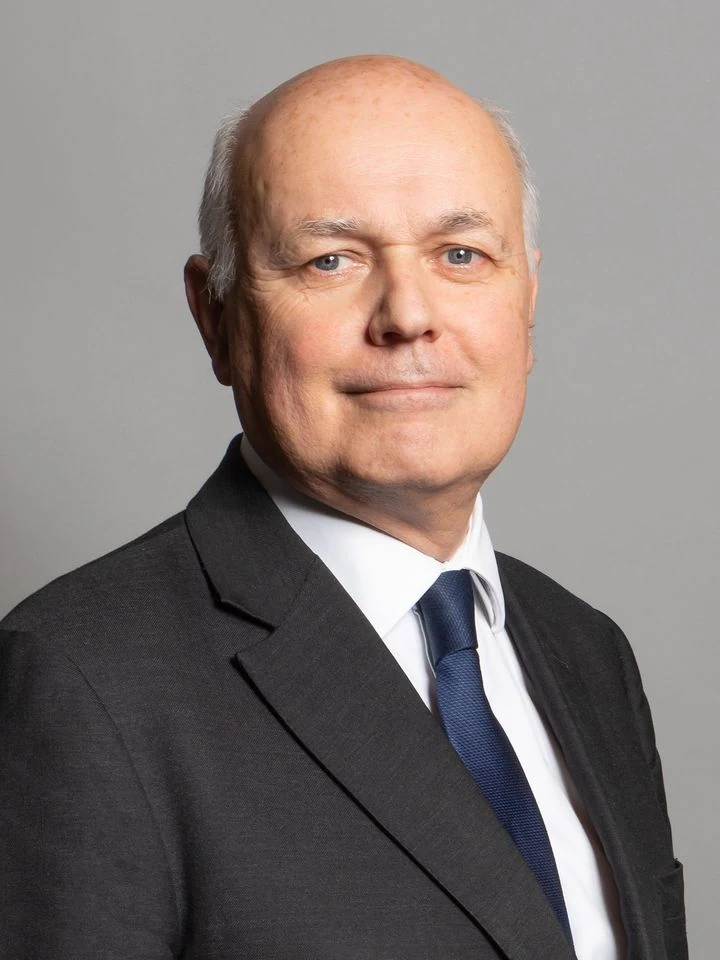
Iain Duncan Smith’s political career has moved between party leadership, government and the backbenches, but social policy has remained a recurring concern. As Secretary of State for Work and Pensions, he oversaw the introduction of Universal Credit. Before and after that period in government, he used the Centre for Social Justice to develop proposals on poverty and social disadvantage. His record is also marked by controversy: the design and implementation of welfare changes drew criticism, and in 2016 he resigned from the Cabinet over planned cuts to disability benefits.
From military service to Parliament
Born in Edinburgh on 9 April 1954, Duncan Smith was educated at Bishop Glancey Secondary Modern School and HMS Conway, a merchant navy training school on the Isle of Anglesey. He later attended the Royal Military Academy Sandhurst and was commissioned into the Scots Guards in 1975. He served in Northern Ireland and in Southern Rhodesia, where he was aide-de-camp to Major-General Sir John Acland during the Commonwealth Monitoring Force’s work around elections. He left the Army in 1981 and worked for GEC Marconi.
His first parliamentary contest came in 1987, when he stood unsuccessfully in Bradford West. In 1992 he was elected MP for Chingford, succeeding Norman Tebbit. After boundary changes, the constituency became Chingford and Woodford Green. He took his place in Parliament as a Conservative backbencher and was a committed Eurosceptic, at times opposing the European policy of John Major’s government.
When William Hague became Conservative leader, Duncan Smith joined the shadow cabinet, first as Shadow Secretary of State for Social Security and later as Shadow Secretary of State for Defence. Those roles placed him in opposition on policy areas that would define his later public profile: welfare and national security.
A short, turbulent party leadership
Following the Conservatives’ 2001 general-election defeat, Hague resigned and Duncan Smith won the party leadership election. He became Leader of the Opposition as well as leader of the Conservative Party in September 2001. His Euroscepticism helped distinguish him in a contest in which his final rival, Kenneth Clarke, was strongly associated with support for the European Union. Margaret Thatcher publicly backed Duncan Smith during the leadership campaign.
His time as leader lasted just over two years. The Conservatives gained council seats in the 2002 and 2003 local elections, but Duncan Smith faced continuing doubts among MPs about his ability to lead the party into a general election. In October 2003, a vote of confidence ended in his defeat, 90 votes to 75. He stepped down on 6 November, and Michael Howard succeeded him. The episode showed the limits of a leader’s position when parliamentary support falls away, whatever the party’s local-election results.
After leaving the leadership, Duncan Smith returned to the backbenches and turned much of his attention to social policy beyond the immediate work of party management.
The Centre for Social Justice
In 2004, Duncan Smith established the Centre for Social Justice, an independent centre-right think tank that worked with small charities to develop proposals for tackling poverty. He later chaired its Social Justice Policy Group. The group’s reports, Breakdown Britain and Breakthrough Britain, examined issues including economic dependence and unemployment, family breakdown, addiction, educational failure, debt and the voluntary sector. The latter proposed a broad set of policy ideas organised around similar themes.
The Centre gave Duncan Smith a platform for continuing to argue about poverty and social disadvantage outside government. Its approach linked research and policy proposals with the work of smaller charities. That focus on social conditions, and on ways of intervening in them, later overlapped with his responsibilities at the Department for Work and Pensions. It also provides a longer view of his political interest in welfare: it began before he held the Cabinet office and continued after he left it.
Universal Credit and the work of government
After the 2010 general election, Prime Minister David Cameron appointed Duncan Smith Secretary of State for Work and Pensions in the Conservative–Liberal Democrat coalition. He held the post from 12 May 2010 until 18 March 2016. His department introduced Universal Credit, a reform intended to bring six benefits and tax credits together in a single payment. Duncan Smith argued that simplifying the system and changing how support related to earnings could make work more rewarding.
The government also introduced the Work Programme, which used contracted providers to support unemployed people into sustained employment. Duncan Smith’s wider policy approach emphasised work as a route out of poverty and included work-related requirements and sanctions for some claimants. These were political choices as well as administrative reforms: they reflected his view of the relationship between benefits, employment and individual responsibility.
Implementation became a major point of contention. The Universal Credit rollout fell far behind the government’s early expectations: although the Department for Work and Pensions had said one million people would be on the system by April 2014, 15,000 had been assigned to it by October that year. Duncan Smith rejected the use of arbitrary deadlines for its final delivery. The department also faced criticism over its management of the programme and its systems. The gap between the reform’s stated aims and the difficult process of putting it into practice became an enduring part of its public and political reception.
Other welfare measures also provoked dispute. Duncan Smith’s department was criticised over benefit eligibility tests, changes to support for disabled people and the effects of its policies on claimants. In March 2016, he resigned from the Cabinet in opposition to planned cuts to disability benefits. He said the government’s approach to balancing the books placed an unfair burden on poor and vulnerable people. His resignation made the disagreement explicit: the minister who had led a far-reaching programme of welfare reform judged that this particular reduction in support crossed a line.
Backbenches, public roles and continued argument
After leaving government, Duncan Smith remained an active Conservative backbencher. He campaigned for the UK to leave the European Union in the 2016 referendum and chaired Boris Johnson’s Conservative leadership campaign in 2019. He was knighted in the 2020 New Year Honours for political and public service.
In June 2020, he helped launch the Inter-Parliamentary Alliance on China, becoming its UK co-chair with Labour peer Helena Kennedy. The organisation set out to encourage co-operation among democratic countries on issues relating to China. In 2021, the Chinese government sanctioned Duncan Smith and other parliamentarians over their statements about China; the sanctions were lifted in January 2026. His later work thus extended beyond domestic welfare policy, while remaining rooted in parliamentary politics.
Duncan Smith has continued to represent Chingford and Woodford Green, the seat first entered as Chingford in 1992. He was re-elected at the 2024 general election. Across more than three decades in Parliament, his roles have changed from backbencher to opposition leader, Cabinet minister and backbencher again; the questions of welfare, poverty and social responsibility have remained central to his public work.
Why Iain Duncan Smith deserves a place in British Legacy
Iain Duncan Smith’s place in British Legacy rests not on a claim that his reforms settled the argument about welfare, but on the scale of the argument he helped bring into government. As Work and Pensions Secretary, he was responsible for a major attempt to combine benefits and tax credits through Universal Credit and to change the incentives and obligations built into the welfare system. The policy’s troubled rollout and criticism of its effects are essential to its history. Recording both the stated purpose and the practical difficulties gives a more useful account than either celebrating reform in the abstract or treating its contested implementation as the whole story.
His work outside government adds another strand. Through the Centre for Social Justice and its policy group, Duncan Smith supported sustained attention to poverty, unemployment, family breakdown, addiction, education, debt and the voluntary sector. The reports sought to turn that analysis into proposals, while the Centre’s work with small charities connected policy debate with organisations working in communities. His 2016 resignation over disability-benefit cuts also records a consequential break between a minister and his government over the distribution of hardship. Together, these episodes make his career relevant to British Legacy: they show how a long-serving British parliamentarian sought to reshape welfare policy, how those choices were challenged, and how social justice remained a subject of political work beyond ministerial office.
Sources
Iain Duncan Smith — Wikipedia revision 1377324900
Adapted in part from Iain Duncan Smith by Wikipedia contributors, under CC BY-SA 4.0. Text has been edited and combined with the existing article; this adapted text is shared under the same licence. Contributor history.