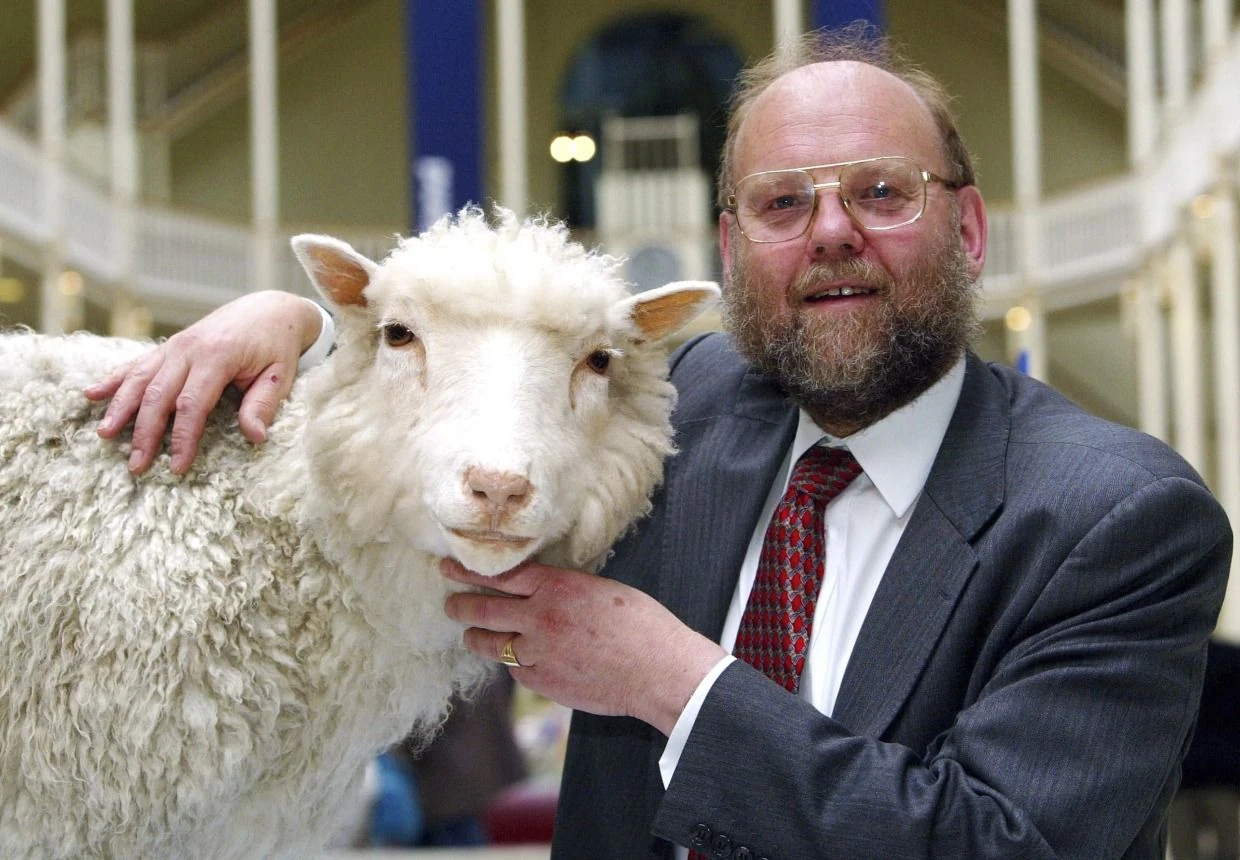
When Dolly the sheep was born in 1996, her arrival demonstrated something scientists had not previously achieved: a mammal could be cloned from an adult cell. The research team was led by embryologist Ian Wilmut, whose role placed him at the centre of a breakthrough that changed how researchers understood cell development and brought the possibilities and limits of cloning into public debate. Wilmut’s career reached beyond that single achievement, from early work in animal reproduction to research on regenerative medicine.
From farm work to embryology
Wilmut was born on 7 July 1944 in Hampton Lucy, Warwickshire. His father, Leonard, taught mathematics at the Boys’ High School in Scarborough, which Ian attended. He had wanted to join the navy, but colour blindness ruled out that ambition. Weekend work as a farm hand helped redirect his interests: he went on to study agriculture at the University of Nottingham.
In 1966, Wilmut spent eight weeks in the laboratory of Christopher Polge, a scientist associated with the development of cryopreservation. The following year, he joined Polge’s laboratory as a doctoral student at the University of Cambridge, where he was a postgraduate member of Darwin College. His PhD, completed in 1971, concerned the preservation of boar semen. The subject reflects the practical focus of his early research: understanding reproduction and how biological material might be preserved.
After Cambridge, Wilmut worked on gametes and embryogenesis, including at the Roslin Institute near Edinburgh. That work provided the setting for the research that would make him internationally known. The route to Dolly was not simply a matter of copying an animal: it depended on investigating whether an adult cell, already specialised for a particular function, could be directed to develop as part of a new organism.
How the Roslin team produced Dolly
Wilmut led the research group that cloned Dolly, a lamb, in 1996. The work used the nucleus of a cell from the mammary gland of a six-year-old Finn Dorset ewe. Researchers transferred it into an egg cell from which the nucleus had been removed, then implanted the resulting embryo into a surrogate. Dolly was the first mammal cloned from an adult somatic cell. She was named after singer Dolly Parton.
The result challenged the assumption that adult cells were permanently confined to their specialised roles. Dolly showed that genetic material from an adult cell could, under the right conditions, direct the development of an entire animal. This was a finding about the capacity of cells, not a demonstration that every desirable trait could be copied reliably or that the process was straightforward.
Wilmut led the group, but he did not claim sole authorship of the achievement. In 2006, he acknowledged that his colleague Keith Campbell deserved “66 per cent” of the credit for the work that made Dolly’s birth possible, and said that the statement “I did not create Dolly” was accurate. His role as group leader and principal investigator sits alongside Campbell’s substantial contribution: the breakthrough was produced by collaborative research.
Dolly died in 2003 from a respiratory disease. Her life and death formed part of the public story of cloning, but the importance of the research lay principally in what it revealed about cell differentiation and reprogramming. The experiment opened new lines of investigation into how cells acquire specialised functions and whether their development could be redirected.
Beyond the cloning breakthrough
The scientific and ethical consequences of cloning reached well beyond animal breeding. Dolly’s creation prompted questions about animal welfare, genetic diversity and the prospect of cloning humans. Those concerns became part of wider discussion about how new biological techniques should be used. The public significance of the work lay both in the research result and in the debate it made unavoidable.
Wilmut continued to work in regenerative medicine. In 2008, he announced that he would move away from somatic cell nuclear transfer, the technique used to create Dolly, in favour of a method developed by Shinya Yamanaka. That approach had been used in mice to derive pluripotent stem cells from differentiated adult skin cells, avoiding the need to generate embryonic stem cells. Wilmut considered it to have greater potential for treating degenerative conditions, including Parkinson’s disease, and for helping patients after stroke or heart attack.
His later work as an emeritus professor was associated with the Scottish Centre for Regenerative Medicine at the University of Edinburgh. He also helped explain the science and its wider implications in books. With Campbell and Colin Tudge, he published The Second Creation in 2000; with Roger Highfield, he wrote After Dolly: The Uses and Misuses of Human Cloning, published in 2006. Their subjects reflected a career in which technical discoveries could not be separated from questions about how they might be applied.
Recognition and final years
Wilmut was appointed Officer of the Order of the British Empire in 1999 for services to embryo development and elected a Fellow of the Royal Society in 2002. He was also a Fellow of the Academy of Medical Sciences and the Royal Society of Edinburgh. In 2008, he was knighted for services to science and shared the Shaw Prize in Life Science and Medicine with Campbell and Yamanaka for their work on cell differentiation in mammals.
Wilmut died on 10 September 2023, aged 79, from complications of Parkinson’s disease. His career had brought together agricultural study, reproductive biology and research into how adult cells might change their developmental course. Dolly remains its most recognised chapter, but his work continued after the experiment that made him famous.
Why Ian Wilmut deserves a place in British Legacy
Wilmut’s place in British Legacy rests on a specific scientific achievement made in a British research setting. At the Roslin Institute, near Edinburgh, he led the group that produced Dolly, the first mammal cloned from an adult somatic cell. The experiment changed scientific understanding of what a specialised adult cell could do. It also made a complex question about cell development intelligible beyond the laboratory: whether the course of a cell’s development could be redirected. That finding became a foundation for further work on cell differentiation and regenerative medicine, rather than a ready-made medical treatment in itself.
His contribution also illustrates why major research should be understood as collaborative. Wilmut acknowledged Campbell’s central role, while later work by Yamanaka offered an alternative approach that Wilmut judged more promising for some medical aims. His willingness to move towards that method shows a career shaped by continuing scientific inquiry, not simply by the fame of one result. The books he co-authored brought the uses and misuses of cloning into public discussion, while the ethical questions raised by Dolly’s creation made animal welfare, genetic diversity and human cloning matters of wider concern. Wilmut’s British legacy is therefore both experimental and civic: research undertaken in the UK altered scientific possibilities and helped give society clearer grounds on which to debate their responsible use.
Sources
Ian Wilmut — Wikipedia, revision 1372012041
Adapted in part from Ian Wilmut by Wikipedia contributors, under CC BY-SA 4.0. Text has been edited and combined with the existing article; this adapted text is shared under the same licence. Contributor history.