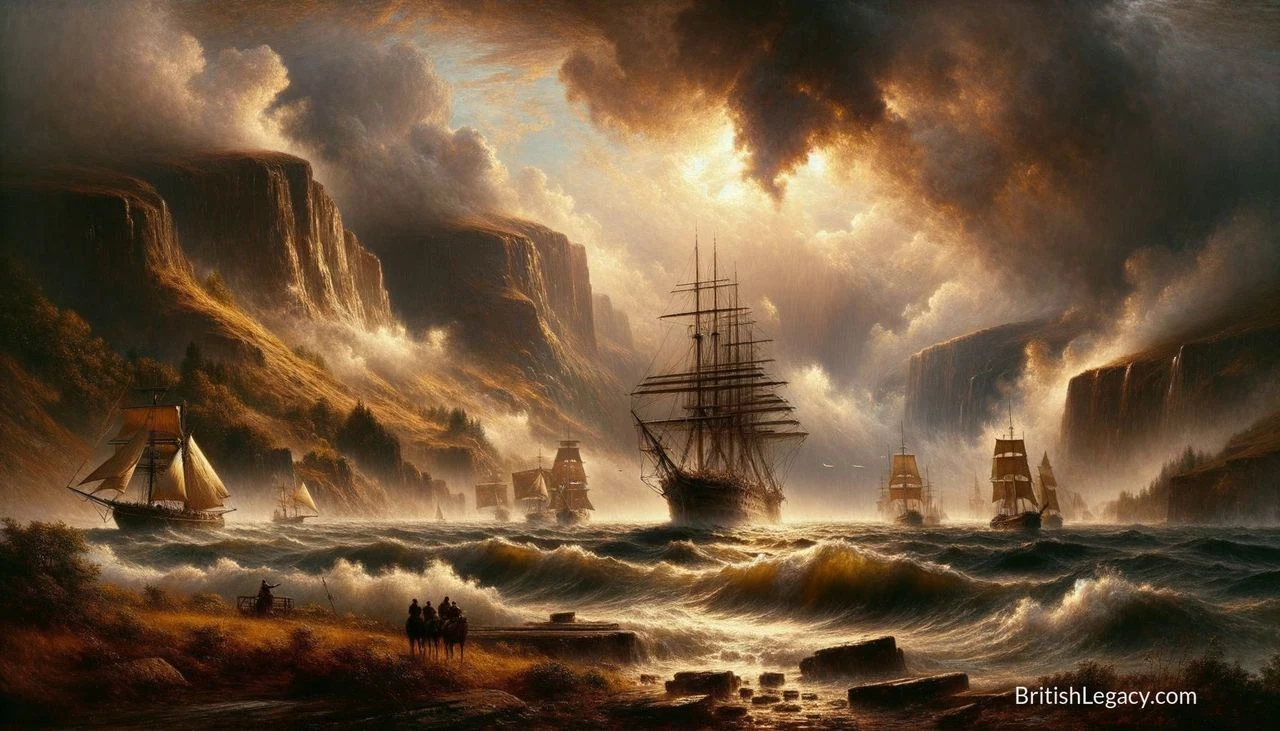
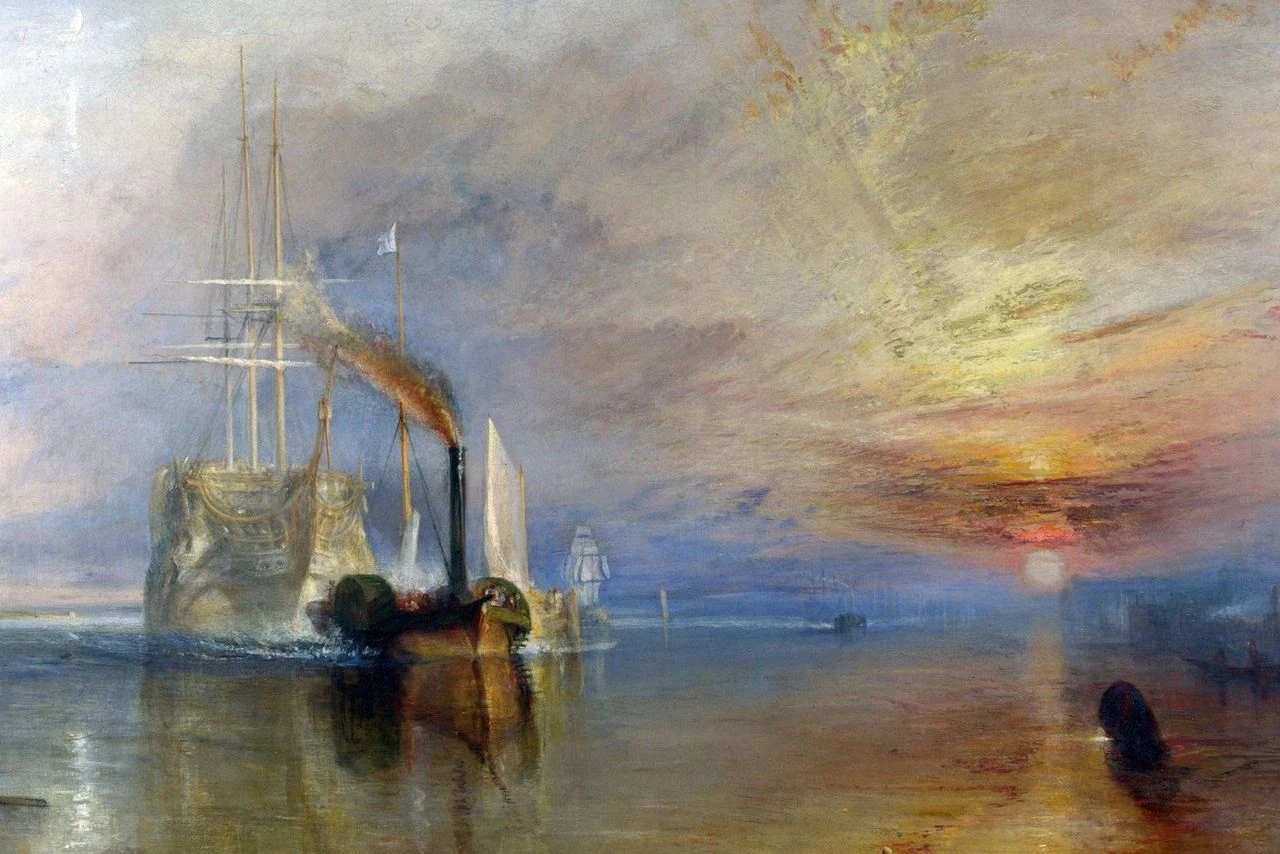
Joseph Mallord William Turner made light and weather more than features of a view: in his paintings, they could become the subject itself. A storm might engulf an army; a locomotive could appear to surge through rain and steam; a warship’s final passage could hold the weight of a vanished age. Born in London in 1775, Turner became one of the leading British painters of the nineteenth century. His career joined close observation of the natural world to an unusually bold willingness to experiment.
A London childhood and an early start
Turner was born on 23 April 1775 in Maiden Lane, in London’s Covent Garden. His father, William, ran a barbershop and wig shop; his mother, Mary Marshall, came from a family of butchers. His father encouraged his early drawings, displaying them in the shop window. Turner attended school in several places, including Brentford, Margate and Sunningwell, while his father helped him as his artistic work developed.
In 1789, aged 14, Turner entered the Royal Academy Schools. He was already earning money as a draughtsman, making architectural and topographical watercolours for clients including architects Thomas Hardwick, James Wyatt and Joseph Bonomi. He also painted theatre scenery. These forms of work rewarded accurate drawing, but they gave him room to study buildings, changing light and the effects of distance.
Turner’s progress at the Academy was swift. A watercolour was accepted for its annual exhibition in 1790. His oil painting Fishermen at Sea, exhibited in 1796, established his reputation in marine painting. Dutch Boats in a Gale, shown in 1801, drew strong attention, and in 1802 he became a Royal Academician, one of the youngest artists to achieve that distinction. His rise brought financial success, although his working-class origins remained a source of friction with some members of the artistic establishment.
Painting a country in motion
Turner’s subjects ranged from rivers and coastlines to historic buildings, shipwrecks and scenes of industrial change. He travelled extensively in Britain, filling sketchbooks with views and observations that he could develop into watercolours, prints and oil paintings. The Thames was a recurring subject throughout his career. His journeys also took him across Europe, including repeated visits to Switzerland and Italy. He did not simply record what he saw: sketches made on the road could become part of a finished composition years later.
His celebrated The Fighting Temeraire shows the old warship being towed to be broken up. The vessel had served at Trafalgar; Turner makes its final passage a meditation on change as well as a maritime image. In Rain, Steam and Speed – The Great Western Railway (1844), a train crosses a railway bridge through a blurred field of weather and light. Rather than offering a precise inventory of machinery, Turner conveys the force and speed of a new technology. He had been born into a world of sailing ships and horse-drawn transport, and he found artistic possibilities in the industrial landscape that was replacing it.
That interest did not mean he treated progress as uncomplicated triumph. His naval paintings could expose the human cost of combat, while works such as Snow Storm: Hannibal and his Army Crossing the Alps make people appear small against the violence of nature. In Keelmen Heaving in Coals by Moonlight, industrial workers and the furnaces of Newcastle become part of a landscape shaped by modern labour. Across these subjects, Turner explored how people live within forces they cannot fully control: weather, history, war and technological change.
Experiment, tradition and the status of landscape
Turner studied the Old Masters and could work in styles admired by the Royal Academy, but he never settled into a single manner. His paintings move between carefully composed classical scenes and increasingly expressive treatments of colour, atmosphere and form. He built on his early training in watercolour, developing the medium’s capacity for luminosity and emotional force. In oils, too, he experimented with ways of laying on colour and representing light.
For much of his career, history painting and portraiture stood above landscape in the academic hierarchy. Turner challenged that ranking. His print project Liber Studiorum, developed between 1806 and 1819, set out the range and seriousness of landscape art. Its categories included marine, mountainous, pastoral, historical, architectural and epic pastoral subjects. In Snow Storm: Hannibal and his Army Crossing the Alps, the storm and mountain landscape dominate a historical subject; in The Field of Waterloo, the aftermath of battle resists a simple celebration of victory.
His later work could puzzle audiences accustomed to more sharply defined forms. Some critics dismissed paintings that are now regarded as major achievements. Turner’s practice also drew on sustained attention to nature: he sketched weather, landforms, rivers and the sea, then used those observations to create images that conveyed not only a place but the experience of looking at it. The French painters Claude Lorrain and the Dutch marine artists were among the traditions he studied, but imitation became a starting point for his own investigations.
A bequest to the nation
Turner died in London on 19 December 1851, aged 76, and was buried in St Paul’s Cathedral. He left the nation a substantial body of work: around 100 finished and 200 unfinished oil paintings, together with more than 19,000 sketches, drawings and watercolours and some 200 sketchbooks. He had also specified that a gallery should house the paintings. Legal disputes delayed the settlement of his estate, and his wish for a gallery was not fulfilled at the time. Tate Britain’s Clore Gallery, opened in 1987, eventually provided a dedicated home for the Turner collection.
His influence continued beyond Britain. The Wikipedia account records that the young Claude Monet and Camille Pissarro saw Turner’s paintings in London in 1870, and that his treatment of colour and light influenced the early Impressionists. In Britain, the Turner Prize, established in 1984, carries his name; it is awarded to a British visual artist. His legacy is also present in the continued public display of his work at institutions including the National Gallery and Tate Britain. Those connections place his paintings within both the history of British art and its continuing conversation about what painting can do.
Why J. M. W. Turner deserves a place in British Legacy
Turner belongs in British Legacy not simply because he painted some of the country’s best-known landscapes, but because he changed what landscape painting could express. He brought weather, light and atmosphere to the foreground, giving the natural world a force that could rival the historical figures and events traditionally treated as art’s highest subjects. His experiments crossed media and styles: he developed watercolour as an expressive form, made prints to argue for landscape’s seriousness, and continued to test the possibilities of oil painting. The result was a body of work that could encompass a quiet river view, a naval disaster and the arrival of the railway without reducing any of them to a mere record.
His paintings also make British history visible through particular, tangible changes: sailing ships giving way to steam, industrial labour entering the landscape, and the legacy of naval power seen through both achievement and loss. The bequest of paintings, drawings and sketchbooks gave the nation an enduring collection, now accessible through public institutions. Turner’s influence on early Impressionists shows that this national inheritance travelled further, shaping artistic possibilities beyond Britain. His place in this story rests on those specific achievements: enlarging the ambitions of landscape art, finding new ways to depict a changing world, and leaving a collection that continues to support public engagement with art and history.
Sources
Adapted in part from J. M. W. Turner by Wikipedia contributors, under CC BY-SA 4.0. Text has been edited and combined with the existing article; this adapted text is shared under the same licence. Contributor history.