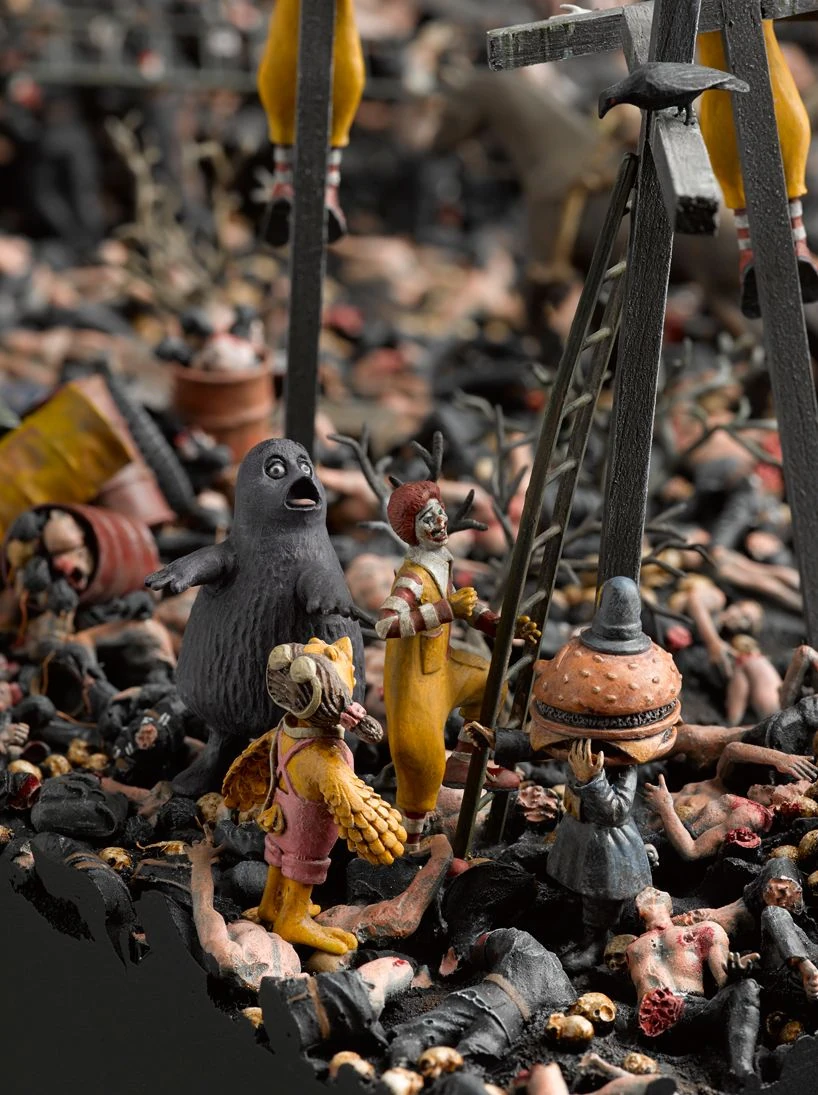
Jake and Dinos Chapman made work that was difficult to look at and harder to dismiss. The British brothers became known for unsettling images, dark humour and an interest in violence, mortality and the grotesque. Their sculpture Great Deeds Against the Dead (1994), with life-size mannequins of dismembered bodies hanging from a tree, established the force of their visual language. In Insult to Injury (2003), they altered Francisco Goya’s prints from The Disasters of War, bringing their own cartoonish figures into an existing record of conflict. Together, the works show how the Chapmans made historical images and contemporary responses to violence part of the same artistic argument.
From assistants to collaborators
Jake and Dinos Chapman were born in Cheltenham, Gloucestershire, in the early 1960s. Both attended the Royal College of Art, where they developed their artistic practice, and they worked as assistants to Gilbert & George before exhibiting their own work. By the early 1990s, the brothers were showing work as a duo. Their collaboration gave them a shared platform for making art that challenged conventional expectations of beauty and decorum.
Their work’s disturbing imagery is not simply a matter of shock. Violence, death and bodily distortion recur in the subjects they choose, while dark humour shapes how those subjects meet the viewer. This combination can unsettle: an image may be grotesque and comic at once, preventing an easy response. The brothers’ practice asks what happens when people encounter representations of violence, and how the meaning of such images changes when artists reuse or alter them.
Dead bodies and altered histories
Great Deeds Against the Dead (1994) is among the pair’s early and most controversial works. It presents life-size mannequins of dismembered and distorted bodies hanging from a tree. The work’s scale and subject make the violence difficult to keep at a distance. Rather than offer a reassuring image, the tableau confronts visitors with bodies transformed into a spectacle. Its unsettling effect became an early sign of the brothers’ interest in pushing at the limits of what audiences might encounter in an artwork.
Nearly a decade later, Insult to Injury (2003) took a different route into the same territory. The Chapmans intervened in Francisco Goya’s prints from The Disasters of War, adding grotesque, cartoon-like faces. Goya’s images already addressed the horrors of conflict; the brothers’ alterations placed a later visual language over that earlier work. The result brought past and present into collision. The series has been described as a comment on desensitisation to violence, while its title and treatment also make the act of changing another artist’s work part of the provocation.
These works help explain why the Chapmans’ reputation rests as much on debate as on subject matter. Their choices raise questions about the treatment of painful images, the limits of humour and the artist’s right to alter or reframe existing art. Their work does not prescribe a single response. Instead, the disturbing or comic elements can leave viewers weighing what they have seen and why it has been presented in that form.
Exhibiting and making a public argument
The brothers exhibited internationally, including at London’s Tate Gallery and the Venice Biennale. Their presence in those settings connected a recognisably British artistic partnership with a wider contemporary-art audience. At the same time, the subject matter kept attention on the questions their work raised: what art can show, how it can reuse images of violence, and whether provocation sharpens or complicates a viewer’s understanding.
Their public contribution also extended beyond objects and exhibitions. They took part in lectures and interviews and produced written work, adding commentary to a practice already built around debate. The brothers’ controversial approach has been associated with challenging accepted boundaries in art. Claims that they changed the direction of later artists or defined the limits of acceptable art are harder to establish from the account of their work alone; the more concrete legacy lies in the works, exhibitions and discussion they generated.
Why Jake and Dinos Chapman deserve a place in British Legacy
Jake and Dinos Chapman deserve a place in British Legacy because their work offers a distinctive account of British contemporary art: collaborative, visually forceful and willing to confront subjects that can repel as well as attract. The bodies in Great Deeds Against the Dead and the altered Goya prints in Insult to Injury are specific examples of how the brothers used grotesque imagery and dark humour to make violence a subject for sustained attention. Their art does not make difficult material comfortable. It makes the viewer consider how violence is pictured, how images acquire meaning and what happens when a familiar work is deliberately changed.
Their British connection is grounded in their origins in Cheltenham, their education at the Royal College of Art, their early work as assistants to Gilbert & George and their exhibitions in London and beyond. Their contribution is not a claim that they represent all British art, or that every provocation produces a clear answer. Rather, they form part of its continuing argument about what art can do and what audiences will accept. By combining memorable objects with public discussion through exhibitions, lectures, interviews and writing, the Chapmans made controversy part of a recognisable artistic practice. That record, rather than unsupported claims of universal influence, gives their work a considered place in British cultural history.