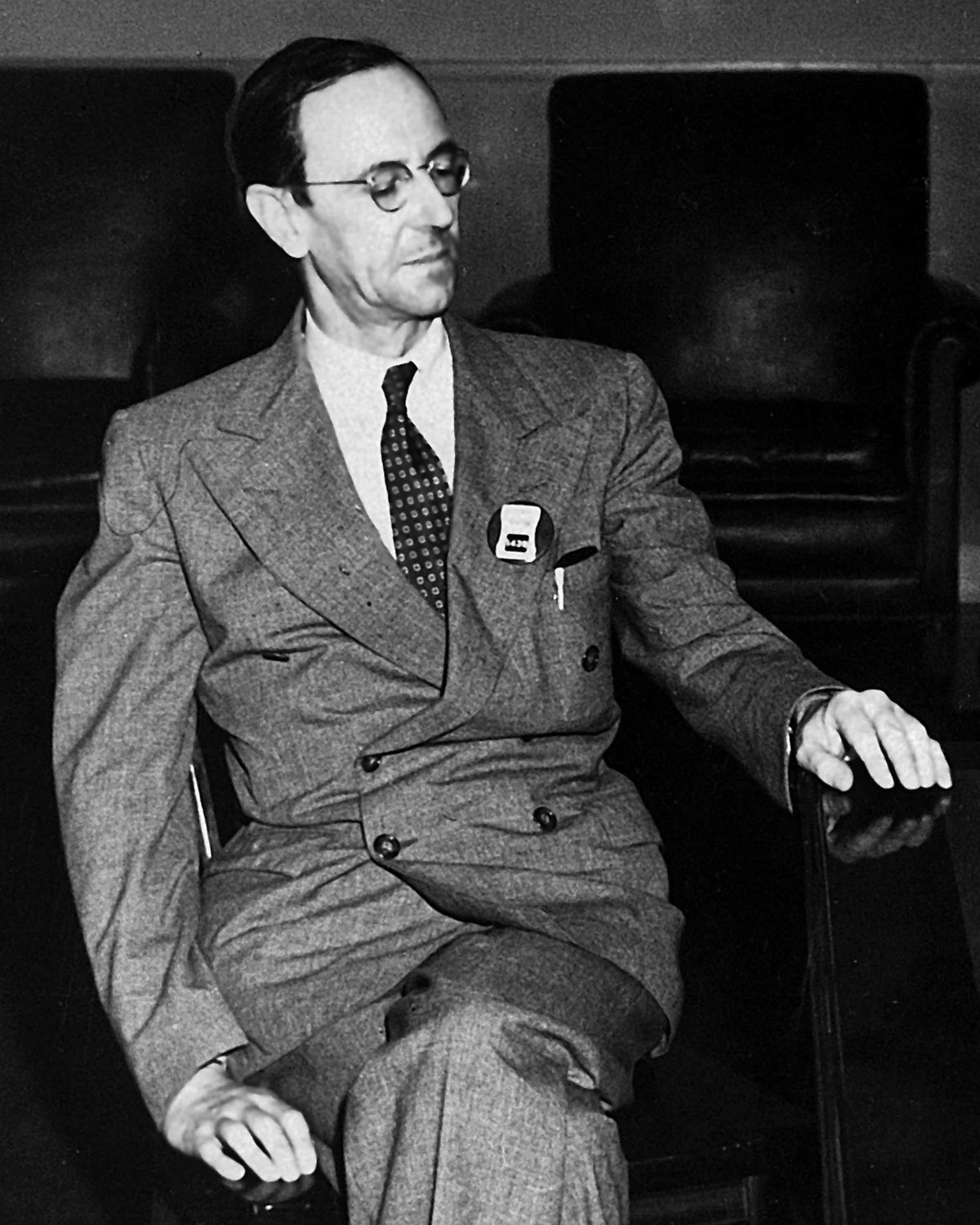
In 1932, James Chadwick identified a particle that had been sought for years: the neutron, with no electric charge and a mass close to that of a proton. The discovery helped explain the structure of atomic nuclei and opened new possibilities in nuclear research. It also formed part of a scientific story that reached from British laboratories to the wartime development of the atomic bomb. Chadwick’s career encompassed both the patient experimental work behind a fundamental discovery and the responsibilities that followed when nuclear physics became a matter of international policy.
From Cheshire to the Cavendish
Chadwick was born in Cheshire on 20 October 1891. The existing biographical account identifies Bollington as his birthplace. His parents, Anne Mary Knowles and John Joseph Chadwick, moved to Manchester in 1895, leaving him with his maternal grandparents. He attended Bollington Cross Primary School and later the Central Grammar School for Boys in Manchester; his family could not afford the fees at Manchester Grammar School, despite his having won a scholarship. At 16, he succeeded in two university scholarship examinations.
He entered Victoria University of Manchester in 1908, intending to study mathematics but enrolling in physics instead. Ernest Rutherford, who led the physics department, set him a problem involving the measurement of radioactive energy. Chadwick devised a method, and the resulting paper, published with Rutherford in 1912, was his first. He graduated with first-class honours in 1911, received an MSc in 1913 and won an 1851 Exhibition Scholarship to pursue research in Germany.
At the Physikalisch-Technische Reichsanstalt in Berlin, Chadwick studied beta radiation under Hans Geiger. Using Geiger’s counter, he showed that beta radiation produced a continuous spectrum rather than the discrete lines then expected. The First World War began while he was still in Germany. He spent four years interned at Ruhleben, near Berlin, where he was able to continue experiments with improvised equipment. He returned to England after the Armistice in 1918.
Rutherford, by then director of the Cavendish Laboratory at the University of Cambridge, brought Chadwick into his research work. Chadwick pursued questions about atomic numbers and the forces within the nucleus, earning a PhD from Gonville and Caius College in 1921. He later became Rutherford’s assistant director of research, helping to guide the laboratory’s work and its research students. He married Aileen Stewart-Brown in 1925; they had twin daughters, Joanna and Judith.
Proving the neutron
For decades, physicists had struggled to explain the mass and behaviour of atomic nuclei. The model then in use treated nuclei as combinations of protons and electrons, but it could not account satisfactorily for all the evidence. Chadwick and Rutherford had considered the possibility of a neutral nuclear particle. In 1930, Walther Bothe and Herbert Becker found that bombarding beryllium with alpha particles produced an unusual radiation. Chadwick recognised that this might be the evidence they needed.
A further clue came in early 1932, when Frédéric and Irène Joliot-Curie found that radiation from beryllium could knock protons out of paraffin wax. They interpreted it as gamma radiation. Chadwick and Rutherford thought that gamma rays could not readily account for the energy transferred to the protons. Chadwick set aside other work to test whether the radiation was made of neutral particles with a mass comparable to a proton.
With the physicist Norman Feather’s help, he used a polonium source and a beryllium target to produce the radiation, directing it at materials such as paraffin wax. The displaced protons could be detected in an ionisation chamber. In February 1932, Chadwick sent a short account of the possible neutron to Nature; he published a fuller paper, “The Existence of a Neutron”, later that year. The measurements supported the existence of a new nuclear particle, not a bound proton–electron pair. His work clarified the composition of nuclei and helped explain isotopes and nuclear spin.
The neutron’s lack of electric charge also made it a powerful research tool. Unlike positively charged particles, it could enter an atomic nucleus without first overcoming electrical repulsion. That made it possible to produce heavier elements by neutron capture and helped prompt further experiments in nuclear reactions. Chadwick’s discovery earned him the Royal Society’s Hughes Medal in 1932 and the Nobel Prize in Physics in 1935. He later received the Copley Medal and the Franklin Medal, among other honours.
Liverpool, research and war
In 1935, Chadwick left Cambridge to take the Lyon Jones Chair of Physics at the University of Liverpool. Its laboratory was old and poorly equipped, but he set about improving it and obtaining a cyclotron, a particle accelerator that would strengthen the university’s nuclear research. He raised money from the university and the Royal Society, recruited specialists and secured locally made components. The cyclotron was installed in 1939. Chadwick also saw potential for the study of radioactive isotopes in biomedical research, including work related to cancer.
War changed the direction and scale of his work. Chadwick contributed to Britain’s Tube Alloys project, which investigated the feasibility of an atomic bomb. In 1941, he wrote the final draft of the MAUD Report, an assessment that helped persuade the United States to pursue bomb research seriously. After Britain, the United States and Canada agreed to combine their efforts under the 1943 Quebec Agreement, Chadwick became head of the British Mission to the Manhattan Project and technical adviser to the Combined Policy Committee.
He worked with the project in the United States, including at Los Alamos, and played a leading part in connecting British scientists with the wider undertaking. His position brought him into contact with the project’s scientific and administrative leadership; he had unusually broad access to its facilities, although he was not permitted to visit the Hanford plutonium site during the war. In July 1945, he witnessed the Trinity nuclear test. The British government knighted him in the New Year Honours that year.
The work’s military purpose cannot be separated from its scientific significance. The neutron was central to the chain of discoveries that made nuclear fission and a bomb possible, while Chadwick’s wartime leadership helped Britain participate in the American-led project. The bomb demonstrated the destructive power of nuclear technology. Chadwick later served as British scientific adviser to the United Nations Atomic Energy Commission and took part in post-war discussions about atomic energy and national policy.
College leadership and later years
After the war, Chadwick returned to Britain and, in 1948, became Master of Gonville and Caius College, Cambridge. The role was not simply ceremonial: he sought to strengthen the college’s academic standing and increased its research fellowships. His mastership lasted until 1958. He was also elected to the Royal Society in 1927 and received the Order of the Companions of Honour in 1970.
Chadwick died in his sleep in Cambridge on 24 July 1974, aged 82. His name is commemorated in university buildings and scientific appointments, including the Chadwick Laboratory and the Sir James Chadwick Chair of Experimental Physics at the University of Liverpool. These remembrances reflect the importance of the work he undertook there as well as his discovery at Cambridge.
Why James Chadwick deserves a place in British Legacy
James Chadwick deserves a place in British Legacy because his discovery of the neutron changed the working understanding of the atom. The achievement was not a sudden flash of insight detached from experiment: it depended on following an unexpected result, questioning an interpretation of the radiation and devising a way to test the competing explanation. His 1932 work gave physicists a new account of the nucleus and a new means of investigating it. The Nobel Prize recognised that discovery, but the significance of the research extended well beyond the award, influencing the development of nuclear physics and the production of heavier elements.
His British legacy is also rooted in institutions and public responsibilities. Chadwick studied and worked in Manchester and Cambridge, built research capacity at Liverpool and led Britain’s scientific team in the Manhattan Project. Those contributions connect university science, national policy and international collaboration. They also demand a clear-eyed account: the same knowledge that opened new fields of research contributed to the creation of an atomic weapon. Chadwick’s later service as an adviser on atomic affairs placed him within debates about the power and consequences of that technology. Remembering him in British Legacy means recognising both the rigour and importance of his scientific work and the weight of the choices that nuclear science brought into public life.
Sources
James Chadwick — Wikipedia revision 1378707612
Adapted in part from James Chadwick by Wikipedia contributors, under CC BY-SA 4.0. Text has been edited and combined with the existing article; this adapted text is shared under the same licence. Contributor history.