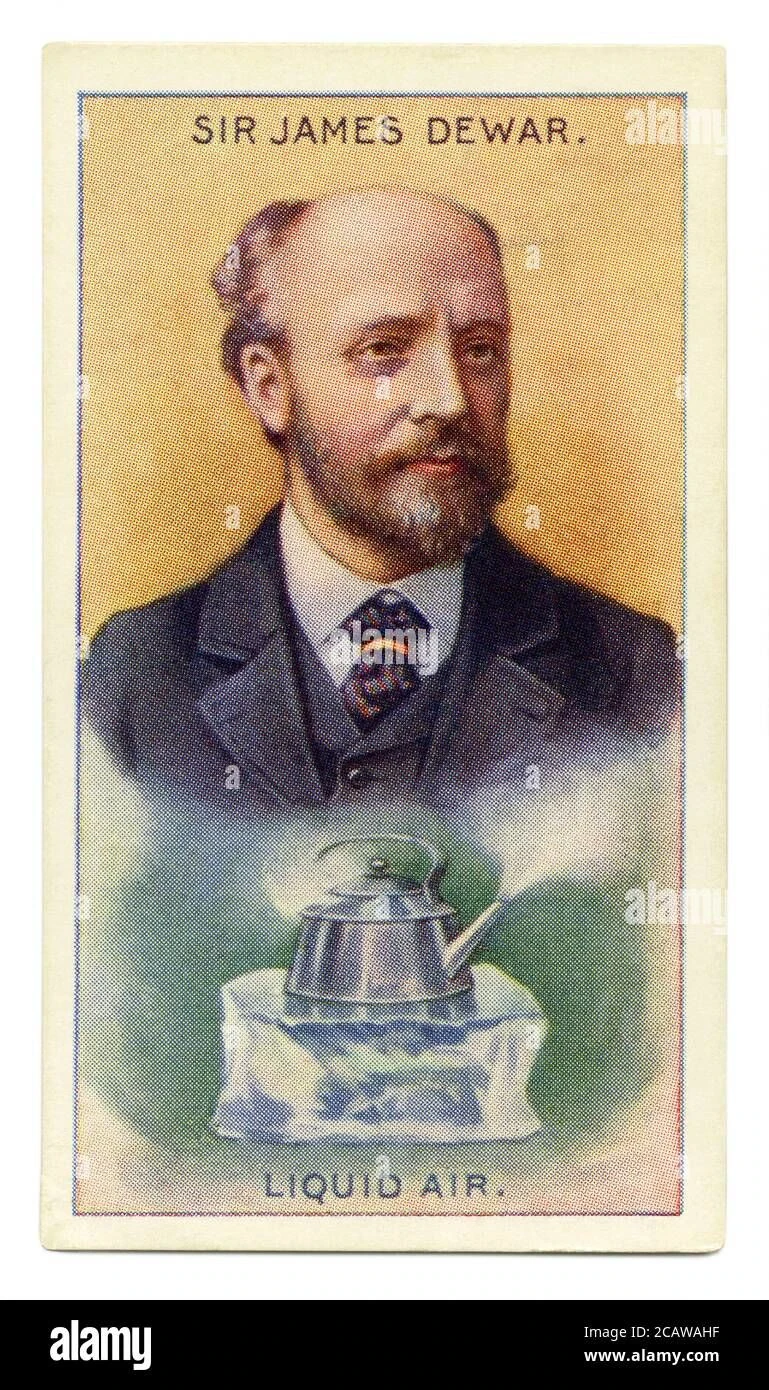
James Dewar’s best-known invention began as scientific equipment. Designed to store liquefied gases while limiting heat transfer, the vacuum-jacketed vessel became known as the Dewar flask and later found a place in everyday life as the vacuum flask. But the container was one part of a much wider career: Dewar worked across chemistry and physics, investigated matter at very low temperatures and helped develop cordite with Frederick Augustus Abel.
From Kincardine to Cambridge
Dewar was born in Kincardine, Scotland, on 20 September 1842, the youngest of six boys. His parents were Ann Dewar and Thomas Dewar, a vintner. He attended Kincardine Parish School and Dollar Academy. After both parents died when he was 15, he went on to study chemistry at the University of Edinburgh under Lyon Playfair, later becoming Playfair’s personal assistant. He also studied under August Kekulé at Ghent University.
In 1875, Dewar was elected Jacksonian professor of natural experimental philosophy at the University of Cambridge and became a member of Peterhouse. He joined the Royal Institution and, in 1877, succeeded John Hall Gladstone as its Fullerian professor of chemistry. His appointments connected university teaching with a research career that ranged across chemical and physical questions.
His work included studies of organic chemistry, hydrogen, spectrophotometry and the electric arc. With J. G. McKendrick of the University of Glasgow, he investigated the physiological effects of light and changes in the electrical condition of the retina. From 1878, he and his Cambridge colleague G. D. Liveing undertook a long series of spectroscopic observations, including work on gases separated from atmospheric air at very low temperatures. Dewar also worked with J. A. Fleming of University College London on the electrical behaviour of substances cooled to low temperatures.
Research at the limits of temperature
Dewar’s interest in liquefying gases extended back at least to 1874, when he discussed the latent heat of liquid gases before the British Association. At the Royal Institution in 1878, he lectured on recent work by Louis Paul Cailletet and Raoul Pictet and demonstrated the Cailletet apparatus in Britain. In 1884, he described research by Zygmunt Wróblewski and Karol Olszewski, and publicly illustrated the liquefaction of oxygen and air.
He went on to build machinery that allowed liquefied gas to be drawn off through a valve for use as a cooling agent. He obtained oxygen in solid form and, by 1891, had designed and built equipment at the Royal Institution capable of producing liquid oxygen in industrial quantities. He also showed that magnets strongly attract liquid oxygen and liquid ozone. These investigations formed the immediate scientific setting for the flask: researchers needed reliable ways to store and examine substances at extremely low temperatures.
Around 1892, Dewar devised a vessel with one container inside another and a vacuum between their walls. Removing the air in the intervening space reduced heat transfer, helping to keep the contents cold. In his research, the flask made it possible to preserve liquids for comparatively long periods without refrigeration and examine their optical properties. The same principle proved useful well beyond the laboratory, where a vacuum flask could keep drinks hot or cold.
The flask became associated with Dewar’s name, but its commercial history was not a straightforward reward for its inventor. He did not patent the design, and the Wikipedia account records that he later lost a court case against Thermos concerning the patent. Rather than claiming that he chose to forgo commercial gain or describing his personal response, it is enough to note the documented outcome: the familiar vessel spread widely, while Dewar could not prevent Thermos from using the design.
Hydrogen, cordite and a wide-ranging career
Dewar’s low-temperature work continued beyond the flask. Using a high-pressure hydrogen jet and the Joule–Thomson effect, he achieved low temperatures and built a large regenerative cooling machine at the Royal Institution. In 1898, he collected liquid hydrogen for the first time; solid hydrogen followed in 1899. He also attempted to liquefy helium, but Heike Kamerlingh Onnes produced liquid helium first, in 1908. Dewar’s repeated nominations for the Nobel Prize—eight in total, five in physics and three in chemistry—did not result in an award.
His contributions were not confined to cryogenics. While serving on the Committee on Explosives, he and Frederick Augustus Abel developed cordite, a smokeless gunpowder alternative. His other work ranged from investigations of spectroscopy to research on the properties of substances at low temperatures. The breadth matters: the Dewar flask was a practical instrument within a sustained programme of experimental science, not an isolated stroke of invention.
Dewar held several scientific leadership roles. He was president of the Society of Chemical Industry in 1887–88, the Chemical Society in 1897 and the British Association for the Advancement of Science in 1902. He also served on the Royal Commission examining London’s water supply from 1893 to 1894 and on the Committee on Explosives. His Royal Institution Christmas Lectures covered topics including soap bubbles, atoms, meteorites, photography, clouds and liquid air.
Honours and later years
The Royal Society elected Dewar a Fellow in 1877. It awarded him the Rumford Medal in 1894 for his work on the liquefaction of gases, followed by the Davy Medal in 1909 and the Copley Medal in 1916. Other honours included the Hodgkins gold medal in 1899, the Bakerian Lecture in 1901, the Lavoisier Medal in 1904, the Matteucci Medal in 1906 and the Albert Medal in 1908. He was knighted in 1904.
Dewar continued research into the properties of elements at low temperatures, including low-temperature calorimetry, until the First World War. The Royal Institution’s laboratories lost staff to wartime service, and the post-war shortages of scholars made it difficult to resume the earlier programme. His later investigations included the surface tension of soap bubbles and the detection of infrared radiation in the atmosphere.
He died at the Royal Institution in London on 27 March 1923, aged 80, and was cremated at Golders Green. He had married Helen Rose Banks in 1871; they had no children. His scientific reputation was not limited to Britain: he received awards from institutions in Europe and the United States, and a lunar crater was named in his honour.
Why James Dewar deserves a place in British Legacy
Dewar’s place in British Legacy rests first on the close connection between his scientific questions and a lasting practical design. The vacuum-jacketed flask emerged from research into the storage and study of liquefied gases. By reducing heat transfer, it helped Dewar preserve cold liquids long enough to examine their properties; the same principle made the vacuum flask useful in homes and on journeys. This is a specific, traceable legacy: an experimental instrument became an everyday object without losing its link to the laboratory problem it was built to solve.
His contribution also reaches beyond the flask. At the Royal Institution and Cambridge, Dewar pursued work across chemistry and physics, from spectroscopy to the production of liquid and solid hydrogen. His role in developing cordite with Frederick Augustus Abel adds another significant strand to his career, while his lectures and scientific leadership connected research with institutions and wider audiences. The honours he received, including the Royal Society’s Rumford, Davy and Copley medals, reflect the breadth and continuing recognition of that work. Remembering Dewar means recognising both an enduring piece of scientific design and a career that helped extend British experimental science into new conditions and questions.
Sources
James Dewar — Wikipedia revision 1373162038
Adapted in part from James Dewar by Wikipedia contributors, under CC BY-SA 4.0. Text has been edited and combined with the existing article; this adapted text is shared under the same licence. Contributor history.