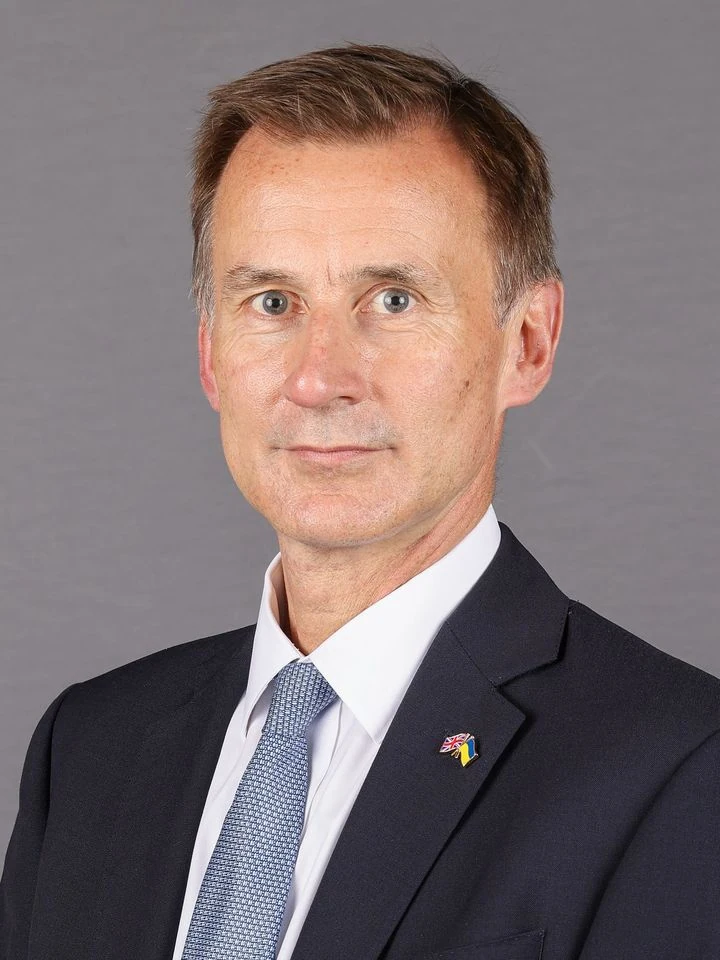
Jeremy Hunt’s political career has taken him from the Department for Culture, Media and Sport to the Treasury, with six years as health secretary and a year as foreign secretary between them. In each role, he faced disputes that made his approach a matter of public argument. His work on patient safety, the junior doctors’ contract and the 2012 London Olympics forms part of a record that is as much about contested decisions as ministerial longevity.
Education, business and Parliament
Hunt was born in Kennington, London, on 1 November 1966, and grew up in Shere, Surrey. He was educated at Charterhouse before studying philosophy, politics and economics at Magdalen College, Oxford. There he became president of the Oxford University Conservative Association. After graduating, he worked as a management consultant and taught English in Japan.
His early business ventures included Profile PR, a public-relations agency he co-founded with his childhood friend Mike Elms in 1991. The pair later turned to directory publishing and established Hotcourses, a company producing guides for people seeking courses and study opportunities. Hunt stepped down as a director in 2009, while retaining a shareholding; the business was sold to Australian education organisation IDP Education in 2017.
Hunt was elected Conservative MP for South West Surrey in 2005. He joined the shadow cabinet first as shadow minister for disabled people and later as shadow secretary of state for culture, media and sport. In the 2010 coalition government, he became secretary of state for culture, Olympics, media and sport. His work in that post included promoting local television and serving as the government minister responsible for the London 2012 Olympic and Paralympic Games. The Games received widespread acclaim for their organisation, although the shortage of contracted security staff meant soldiers had to be deployed.
Health secretary: safety and conflict
Hunt became secretary of state for health in September 2012 and held the post, later titled health and social care secretary, until July 2018. He became the longest-serving health secretary in British political history. Patient safety was a central theme of his tenure, which followed scrutiny of failings at Mid Staffordshire NHS Foundation Trust. His initiatives included work to strengthen openness when care went wrong and the NHS’s Learning from Deaths programme, intended to ensure that hospitals examined deaths and lessons arising from them.
That focus sat alongside policies and claims that drew strong criticism. Hunt pursued changes intended to improve weekend NHS services, arguing that staffing and access required attention. His use of evidence about weekend mortality was challenged by doctors and researchers, including over whether the figures showed that deaths were avoidable or caused by staffing levels. The dispute became part of a wider debate over the evidence, cost and workforce needed for a seven-day NHS.
The most prominent industrial conflict of his health secretary years was the dispute over a new contract for junior doctors in England. The British Medical Association opposed the terms, and doctors held strikes in 2016. After negotiations failed to produce an agreement accepted by doctors, Hunt announced that the contract would be imposed. A later offer was rejected in a BMA referendum, and the government proceeded with the new contract. The episode brought protests and lasting argument about pay, working hours and the relationship between ministers and NHS staff.
Hunt’s wider health record also included controversy over proposals to downgrade services at Lewisham Hospital. A court ruled that he had acted outside his powers in announcing changes to its casualty and maternity units. He also defended the NHS as a system of universal coverage. These episodes illustrate why his time in office cannot be reduced to a single account of reform: it combined safety initiatives with disputes over evidence, services and the terms of work.
Foreign affairs, leadership bids and the Treasury
In July 2018, Hunt succeeded Boris Johnson as foreign secretary, serving until July 2019. The job placed him in the middle of Brexit negotiations and wider diplomatic questions. He warned that leaving the European Union without a deal would be economically challenging and damaging to relations. He also spoke about human-rights abuses, including the plight of Rohingya Muslims, and sought the release of Nazanin Zaghari-Ratcliffe, the British-Iranian woman detained in Iran.
His foreign-policy positions were not without criticism. Hunt defended Britain’s relationship with Saudi Arabia, including arms sales, while acknowledging civilian deaths in Yemen. He condemned reports of mass internment camps for Uyghur Muslims in Xinjiang. In November 2018, after the United Arab Emirates sentenced British academic Matthew Hedges to life in prison on spying allegations, Hunt threatened serious diplomatic consequences; Hedges was released later that month. These cases show the varied demands of the office, from advocating for individuals to managing strategic relationships.
Hunt stood for the Conservative Party leadership in 2019 after Theresa May announced her resignation. He reached the final two candidates but lost to Boris Johnson. After returning to the back benches, he chaired the House of Commons Health and Social Care Select Committee from 2020 to 2022, a period in which the committee’s work took place against the background of the COVID-19 pandemic.
Hunt became chancellor of the exchequer in October 2022, first under Liz Truss and then under Rishi Sunak. He presented autumn statements in 2022 and 2023 and budgets in 2023 and 2024. His March 2023 budget included a fuel-duty freeze, an extension of the Energy Price Guarantee and childcare measures for working people in England. He also set out pension-industry reforms intended to encourage investment in British businesses. After the Conservatives lost the 2024 general election, Hunt served briefly as shadow chancellor before returning to the back benches.
Why Jeremy Hunt deserves a place in British Legacy
Hunt’s place in British political history rests partly on the length and range of his ministerial service. He was responsible for culture, media and sport during the London 2012 Games, led the health department for almost six years, represented the UK as foreign secretary during the Brexit period and later became chancellor. These roles connected domestic services, international relations and the management of the national economy. His career offers a record of how successive governments have tried to address questions of public safety, health provision, cultural life and Britain’s place abroad.
His most sustained contribution to public debate was his emphasis on patient safety and learning from harm. The importance of examining failures and being open about mistakes reaches beyond one minister or one government: it concerns how a public health service can identify problems and improve care. At the same time, the junior doctors’ dispute and arguments over weekend mortality show the consequences when policy meets contested evidence and the experience of the workforce. A balanced account of Hunt’s legacy must hold both sides in view. His record is significant not because every initiative was accepted, but because his decisions and the debates around them exposed difficult questions about accountability, resources and the people who deliver care.
Sources
Jeremy Hunt — Wikipedia revision 1378144108
Adapted in part from Jeremy Hunt by Wikipedia contributors, under CC BY-SA 4.0. Text has been edited and combined with the existing article; this adapted text is shared under the same licence. Contributor history.