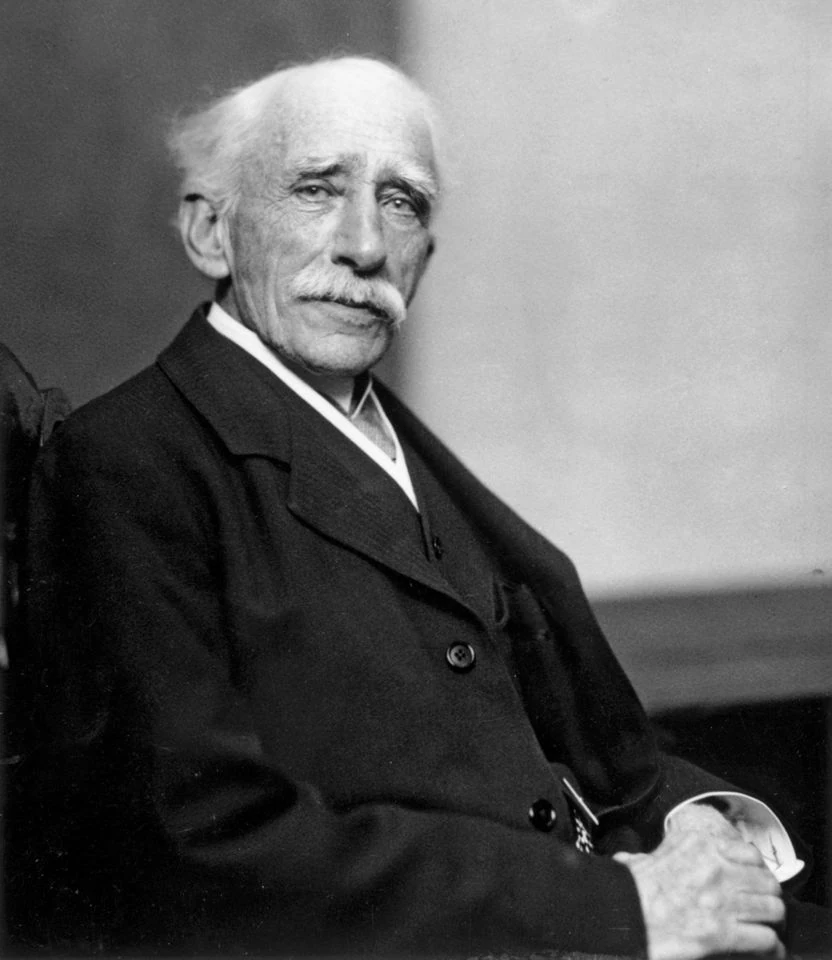
In 1904, while working to improve transatlantic radio reception, John Ambrose Fleming built a small device with consequences far beyond the wireless sets of his day. His two-electrode vacuum tube, known as the Fleming valve, could detect radio signals and became a building block of early electronics. It was one part of a career that also included designing the powerful transmitter used in the first radio transmission across the Atlantic, teaching electrical technology at University College London and writing extensively about electricity and wireless communication.
Education shaped by necessity
Fleming was born in Lancaster on 29 November 1849, the eldest of seven children of James Fleming, a Congregational minister, and Mary Ann White. The family moved to north London when he was young. He attended University College School and developed an interest in engineering, but his family could not afford an apprenticeship with a professional engineer. He therefore pursued science, combining study with paid work.
He enrolled at University College London in 1867, studying under teachers including Augustus De Morgan, Alexander Williamson and George Carey Foster. Financial difficulties interrupted his studies the following year. After a short spell in a shipbuilders’ drawing office in Dublin and work at a stockbroker’s office in the City, he continued studying part-time and graduated with a BSc in 1870.
Fleming taught science at Rossall School and Cheltenham College, then studied chemistry at the Royal College of Science. In 1877 he went to St John’s College, Cambridge, where he attended lectures by James Clerk Maxwell. He graduated with first-class honours in 1880 and became a Fellow of the college in 1883. The route was not a direct progression from student to inventor: teaching, interrupted study and employment all formed part of his preparation.
Building a department and a transmitter
After a year as a demonstrator of mechanical engineering at Cambridge, Fleming became the first Professor of Physics and Mathematics at University College Nottingham, though he left in less than a year. In 1882 he joined the Edison Electric Light Company as an electrician, advising on lighting and alternating-current systems. Three years later he became head of the newly established Department of Electrical Technology at UCL. He recalled that, at first, its equipment amounted to a blackboard and a piece of chalk. A £5,000 donation in 1897 helped establish the Pender Laboratory and the Pender Chair, which Fleming took up.
His work with the Marconi Company brought him into the engineering challenge of sending wireless signals over the Atlantic. In 1899, Guglielmo Marconi engaged Fleming to design a much more powerful transmitter than the equipment then in use. Fleming devised a spark transmitter at Poldhu, Cornwall, powered by a 25-kilowatt alternator driven by a combustion engine. It transmitted the first radio signal across the Atlantic on 12 December 1901.
The achievement became closely associated with Marconi. Fleming had agreed that, if the experiment succeeded, the principal credit would go to Marconi. Fleming kept to that agreement during Marconi’s lifetime, although he later described Marconi as ungenerous. The episode makes clear that a major technical achievement can depend on work that receives less public recognition than the headline result.
The Fleming valve and the growth of radio
In 1904, Fleming built the first vacuum-tube diode while working for the Marconi Company to improve radio reception. He called it the oscillation valve; it later became known as the Fleming valve. He patented it that year. The diode could detect radio signals, and receivers and radar systems used the technology for decades before solid-state electronics superseded it.
The valve was not, by itself, an amplifier. In 1906, the American inventor Lee de Forest added a control grid to develop an amplifying tube called the Audion. That development led to a long-running patent dispute between the two inventors, with both sides winning at different stages. Fleming’s diode is often regarded as a starting point for electronics, but the distinction between detecting a signal and amplifying it matters: later developments built on the valve rather than making Fleming’s original device perform every subsequent function.
Fleming also established the right-hand rule used in physics. His work and teaching extended beyond the devices most closely associated with his name. He wrote books and manuals on electric lighting, transformers, electric currents, wireless telegraphy and the thermionic valve, addressing both technical readers and the general public. In 1926 he retired from UCL, but remained active as an advocate of television and served as the second president of the Television Society.
Recognition, later life and remembrance
Fleming was elected a Fellow of the Royal Society in 1892. His honours included the Hughes Medal in 1910, the Albert Medal in 1921 and the Faraday Medal in 1928. He was knighted in 1929. His career also continued into the period when radio and electronics had become increasingly important to national life: his contributions to electronic communications and radar were described as vital to Britain’s efforts in the Second World War.
Born with congenital hearing loss, Fleming attended scientific meetings and debates with an assistant who took notes. He married Clara Ripley in 1887; she died in 1917. In 1928 he married Olive May Franks, a singer. Outside his scientific work, he was a photographer, painted watercolours and enjoyed climbing in the Alps. He retired to Sidmouth, where he died on 18 April 1945, aged 95.
His papers and library, including laboratory notebooks, lecture notes, patent specifications and correspondence, were donated to UCL by his widow after his death. The collection preserves evidence of the work behind the public milestones: not only inventions, but also the teaching, experiments and technical writing through which electrical engineering developed as a discipline.
Why John Ambrose Fleming deserves a place in British Legacy
Fleming’s place in British Legacy rests on a specific combination of engineering and education. His design for the Poldhu transmitter helped make the first transatlantic radio transmission possible, linking work carried out in Cornwall to a turning point in wireless communication. His Fleming valve addressed a different problem: detecting radio signals reliably. The diode became a component in radio receivers and radar for decades, and its development helped establish the practical foundations of electronics. Those contributions are substantial without claiming that one inventor created the whole electronic age.
His legacy also belongs to Britain’s institutions of teaching and technical research. At UCL, Fleming headed a new department, helped establish the Pender Laboratory and occupied its chair; his long career connected engineering practice with formal education. His books and manuals carried technical knowledge to students, engineers and readers interested in wireless technology. The surviving notebooks, correspondence and papers add a material record of that work. Remembering Fleming therefore means more than celebrating an invention: it means recognising how research, teaching, engineering and communication combined to advance technologies that shaped modern life.
Sources
John Ambrose Fleming — Wikipedia revision 1378515968
Adapted in part from John Ambrose Fleming by Wikipedia contributors, under CC BY-SA 4.0. Text has been edited and combined with the existing article; this adapted text is shared under the same licence. Contributor history.