
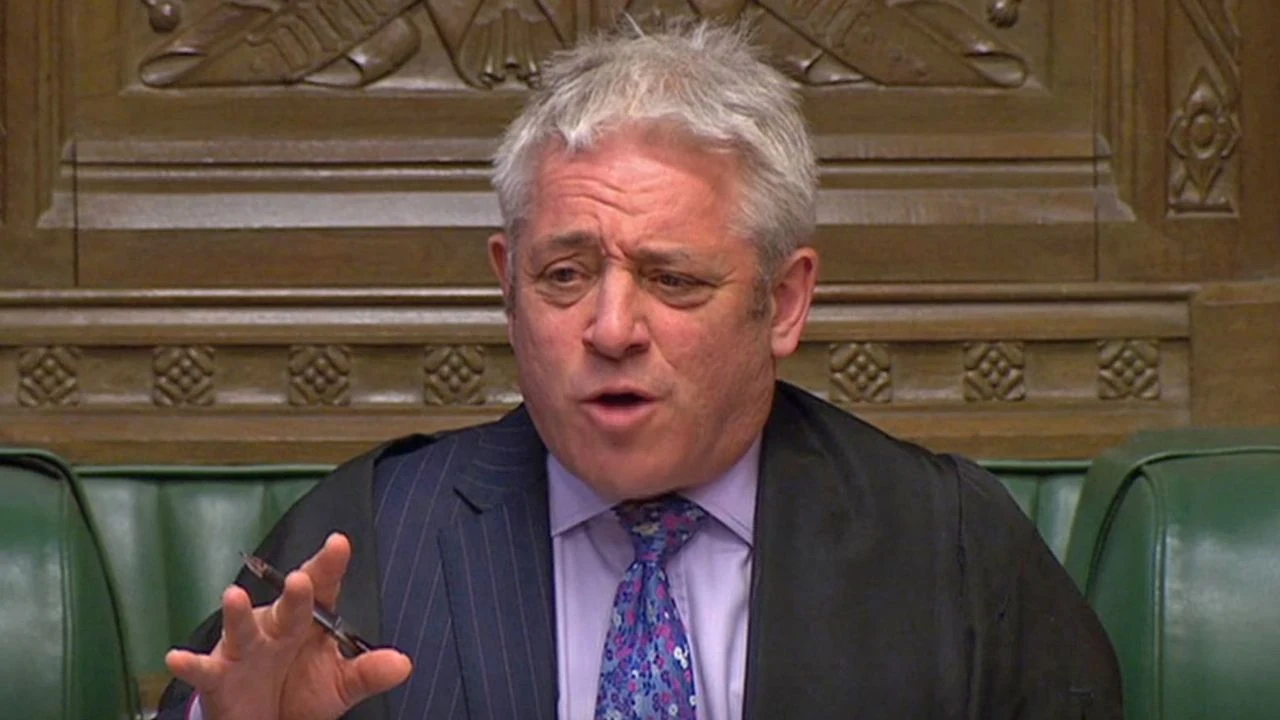
John Bercow’s decade as Speaker of the House of Commons placed him at the centre of arguments about who should control parliamentary business. Elected in 2009 after the expenses scandal, he said he wanted to strengthen the role of backbench MPs and Parliament’s ability to scrutinise government. During the Brexit debates, rulings on the Commons’ procedures made that ambition consequential—and controversial. His career also ran through several political identities: Conservative MP, independent Speaker, and, after leaving Parliament, Labour Party member.
From Lambeth councillor to Buckingham MP
John Simon Bercow was born in Edgware, Middlesex, on 19 January 1963. His father, Charles, was a taxi driver. Bercow attended Frith Manor Primary School and Finchley Manorhill School, and graduated from the University of Essex in 1985 with a first-class degree in Government. As a young Conservative, he was involved in the Monday Club, but left it at the age of 20, later describing his participation as “utter madness”.
Before entering Parliament, Bercow served as a Conservative councillor in the London Borough of Lambeth from 1986 to 1990. He unsuccessfully contested parliamentary seats in 1987 and 1992, then won selection for Buckingham and was elected as its MP at the 1997 general election. He held the seat until 2019. In opposition, he took front-bench roles under Iain Duncan Smith and Michael Howard, including Shadow Chief Secretary to the Treasury and Shadow Secretary of State for International Development.
His party position did not remain fixed. In 2002, he resigned from the Conservative front bench after defying a whip on the Adoption and Children Act, arguing that MPs should be allowed a free vote. He later returned to the front bench, but was dismissed in 2004 after clashing with Howard. In 2008, he was asked to review provision for children with speech, language and communication needs. The resulting Bercow review argued for early identification and consistent support; the government subsequently pledged £52 million to raise the profile of those needs in education.
Taking the Speaker’s chair
After Michael Martin resigned, Bercow stood for Speaker. MPs elected him on 22 June 2009, and he left the Conservative Party in accordance with the convention that the Speaker is politically independent. He was re-elected unopposed in 2010, 2015 and 2017. He was the first Speaker since the Second World War to be elected four times, and the first in that period to serve alongside four prime ministers.
At his election, Bercow said he wanted to give backbenchers more opportunity to influence parliamentary business and to prevent the Commons from becoming a “rubber-stamping operation”. In practice, the Speaker’s authority over proceedings can shape which questions and arguments receive time. Bercow made use of that authority to grant urgent questions and debates, increasing opportunities for MPs outside government and opposition front benches to put ministers under pressure. The role is procedural rather than executive: the Speaker does not set government policy, but can affect how effectively the Commons holds government to account.
His approach also brought changes in the way the office was presented. Bercow was the first Speaker not to wear traditional court robes while presiding. In October 2009, he chaired the first annual sitting of the UK Youth Parliament in the Commons chamber, and continued to chair its subsequent sittings until he left office. He also commissioned the Speaker’s Lectures, a series begun to mark the centenary of the Parliament Act 1911 and later extended to other subjects.
His tenure began amid criticism of MPs’ expenses. Bercow himself faced scrutiny after it emerged that he had changed the designation of his second home more than once, with consequences for capital gains tax on property sales. He denied wrongdoing and agreed to pay £6,508 plus VAT towards any tax that might have been due. In 2014, the destruction of evidence relating to claims before 2010 led to accusations of a further cover-up under his speakership. In 2015, he was criticised over a £172 claim for a chauffeur-driven journey of 0.7 miles. These episodes formed part of the difficult public context in which Parliament was expected to demonstrate accountability.
Brexit and the limits of neutrality
Bercow’s rulings attracted especially intense attention during the Brexit debates. In January 2019, he allowed an amendment to a government business motion that required Theresa May to bring forward alternative proposals within three days if her Brexit deal was rejected. In March, he ruled that the government could not put substantially the same motion to another vote after it had already been rejected, citing a parliamentary convention dating from 1604. The decisions showed how procedural authority could affect the options available to ministers and MPs, while also exposing the Speaker to accusations of political bias.
Bercow had supported continued EU membership in the 2016 referendum, but said he had been impartial while in the chair. He made his view of Brexit explicit after leaving office, calling it the biggest foreign-policy mistake of the post-war period. His rulings, and his public remarks, therefore became part of the dispute over whether a Speaker could exercise procedural judgement without appearing to take sides.
He also drew criticism in 2017 when he said he would oppose Donald Trump addressing Parliament during a planned state visit. Some welcomed his comments on racism and sexism; others argued that he had compromised the neutrality of his office. Bercow apologised to the Lord Speaker for not consulting him before making the remarks. The episode illustrated the tension between a Speaker’s public voice and the expectation that the office stand apart from party politics.
Leaving Parliament, and scrutiny of his conduct
Bercow announced in September 2019 that he would leave the Speaker’s chair on 31 October or at the next general election, whichever came first. He remained Speaker until 4 November, when he formally left Parliament. He had served for ten years, making him the longest-serving Speaker since Edward FitzRoy, who held the office from 1928 to 1943. Contrary to the customary expectation that former Speakers would enter the House of Lords, Bercow was not offered a peerage. His rulings during Brexit had been criticised by the government as biased, and the question of his impartiality remained contested.
After leaving Parliament, Bercow joined Labour in 2021, saying that his decision reflected support for equality, social justice and internationalism. He had also held university roles, including chancellorships at the universities of Bedfordshire and Essex. His post-parliamentary public life was, however, marked by findings about his treatment of staff. In 2022, an Independent Expert Panel upheld findings on 21 allegations of bullying and concluded that his evidence had been “widely unreliable and repeatedly dishonest”. The panel recommended that he should never receive a parliamentary pass. Bercow rejected its findings. He was suspended from the Labour Party in 2022.
Why John Bercow deserves a place in British Legacy
Bercow’s place in British political history rests above all on the use of the Speaker’s office during a period when the relationship between Parliament and government was under strain. He had entered the role promising to strengthen the position of backbenchers, and his use of urgent questions and debates gave MPs more opportunities to demand answers from ministers. His chairing of the UK Youth Parliament’s annual sitting also brought young representatives into the Commons chamber. These are specific parts of a public record concerned with access to parliamentary proceedings and the capacity of the legislature to scrutinise the executive.
That record cannot be separated from its disputes. His Brexit rulings affected parliamentary business and drew accusations that he had exceeded the limits of neutrality; his expenses attracted criticism; and formal findings of bullying and dishonesty, which he rejected, damaged his standing. Including those facts makes the legacy more useful than a simple celebration of reform. Bercow’s career shows both the power of procedural decisions in Britain’s parliamentary system and the responsibilities attached to the offices that make them. For British Legacy, he merits attention not as an uncontested model of public service, but as a consequential Speaker whose influence, controversies and formal findings remain part of the story of modern Commons politics.
Sources
John Bercow — Wikipedia revision 1372343406
Adapted in part from John Bercow by Wikipedia contributors, under CC BY-SA 4.0. Text has been edited and combined with the existing article; this adapted text is shared under the same licence. Contributor history.
_(cropped).jpg)