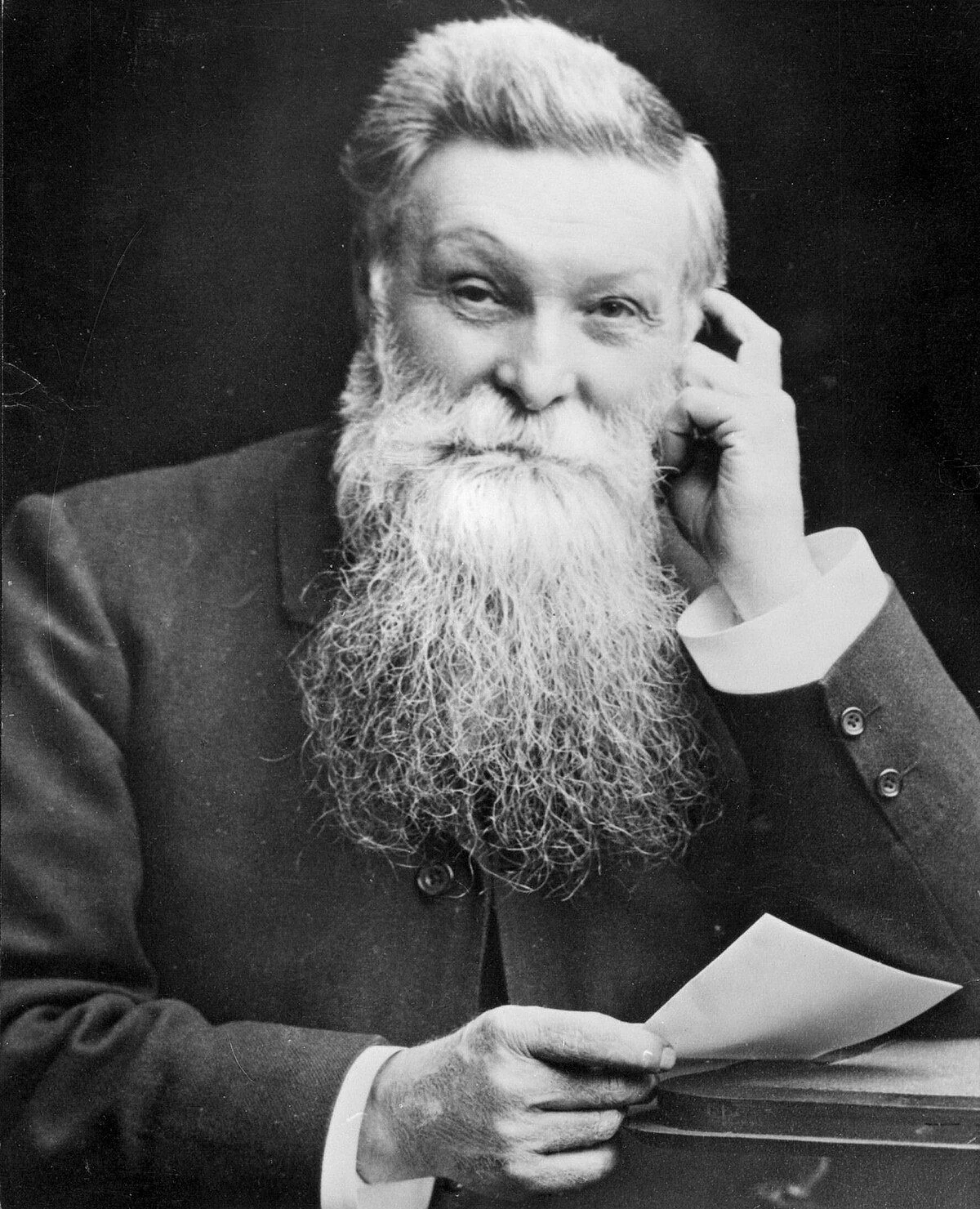
In October 1887, John Boyd Dunlop tested a home-made inflatable tyre by rolling it across the yard beside a metal wheel. The metal wheel stopped; the pneumatic one continued until it struck a gatepost and rebounded. The experiment, carried out in Belfast, was a practical answer to the jolting ride of his son’s tricycle. It would lead to a patent, cycle-racing victories and a tyre business, but Dunlop’s part in that business was shorter and less financially rewarding than the later global reach of his name might suggest.
A veterinary surgeon in Ireland
Dunlop was born on 5 February 1840 on a farm in Dreghorn, in what is now North Ayrshire, Scotland. He studied veterinary surgery at the University of Edinburgh and moved to Downpatrick, Ireland, in 1867. In 1871 he married Margaret Stevenson; they had a daughter and a son. With his brother James, he established a veterinary clinic in Downpatrick before moving to a practice in May Street, Belfast. By the mid-1880s, it was one of the largest veterinary practices in Ireland.
His professional life matters to the invention’s story. Dunlop was not a factory engineer who turned to bicycles: he was a practising veterinary surgeon, familiar with making rubber devices. When he developed the tyre, he drew on that practical knowledge and experimented at home. His immediate project was modest in scale—improving the ride of his child’s tricycle—not a plan to transform transport.
From tricycle experiment to patent
Dunlop first made an inflated tube from sheet rubber and fitted it to a wooden disc about 96 centimetres across. After comparing its movement with a metal wheel, he fitted pneumatic tyres to both rear wheels of his son’s tricycle. The improvement encouraged him to make larger tyres for a bicycle, which he tested at Cherryvale sports ground in south Belfast. The patent was granted on 7 December 1888.
The patent did not settle the question of priority. Another Scottish inventor, Robert William Thomson, had patented a pneumatic tyre in France in 1846 and in the United States in 1847. Dunlop was officially informed two years after receiving his patent that it was invalid. His importance lies in developing a practical tyre for cycle use and in bringing it into commercial production, rather than in being the first person to patent the broad idea of an inflatable tyre.
The bicycle was the first proving ground. In 1889, Belfast cyclist Willie Hume demonstrated the tyres in races, winning all four cycling events at the Queen’s College Sports in Belfast on 18 May and later winning all but one of the events in Liverpool. Hume had been the first member of the public to buy a bicycle fitted with the tyres. His results attracted Harvey du Cros, president of the Irish Cyclists’ Association, whose sons had competed against Hume. Du Cros recognised a commercial opportunity and formed a business with Dunlop.
A business that outgrew its inventor
Dunlop sold his rights to the pneumatic tyres to the new business in return for a small cash sum and a small shareholding. Together, he and du Cros faced difficulties, including the loss of the patent rights. In 1892 Dunlop retired from veterinary practice. He soon moved to Dublin, where du Cros, with his assistance, refloated Booth Bros as the Pneumatic Tyre and Booth’s Cycle Agency. Dunlop sold out in 1895 and took no further interest in the tyre or rubber trade. His remaining business interest was a local drapery.
The later corporate story should not be mistaken for Dunlop’s own career. In 1896 du Cros sold the bicycle-tyre business to financier Terah Hooley for £3 million; Hooley subsequently resold it to the public for £5 million. The business was renamed Dunlop Rubber early in the twentieth century, but the Dunlop Pneumatic Tyre Company was incorporated later and, despite its name, was du Cros’s creation. Dunlop did not make a great fortune from the invention.
Pneumatic tyres arrived at an important moment for road transport. Their first commercial production for cycles began in Belfast in late 1890. The tyre helped change the bicycle industry, already growing after the introduction of J. K. Starley’s safety bicycle in 1885. Car-tyre production did not begin until 1900, after Dunlop had withdrawn. The technology he had developed for cycles nevertheless became part of the subsequent development of motor transport.
Life after the tyre business
Dunlop died at his home in Dublin’s Ballsbridge on 23 October 1921, aged 81, and was buried at Deans Grange Cemetery. The business bearing his name would become internationally familiar through products in automotive, aerospace, industrial and sporting fields. That reach should be distinguished from the inventor’s own later involvement: he had sold out in 1895 and took no further interest in the tyre or rubber business.
His name also became part of public commemoration. From the 1980s, his image appeared on a Northern Irish £10 banknote issued by the Northern Bank as part of its Inventor Series; notes bearing his likeness were later issued by Danske Bank. He was inducted into the Automotive Hall of Fame in 2005, and the Ulster Historical Circle commemorated him with a blue plaque for inventing the first successful pneumatic tyre. In 2025 he was inducted into the Scottish Engineering Hall of Fame.
Why John Boyd Dunlop deserves a place in British Legacy
Dunlop’s place in British Legacy rests on a clearly traceable achievement: he developed a practical pneumatic tyre for a child’s tricycle, tested the idea through further experiments, and helped take it from a Belfast yard into cycle production. The tyre’s performance in races made its advantages visible. Willie Hume’s victories in Belfast and Liverpool helped turn a technical improvement into a commercial opportunity, connecting invention with demonstration and enterprise. The resulting change was not instantaneous, and Dunlop was not responsible for every later development, but his work arrived when bicycles were becoming an important form of transport and helped reshape the cycle industry.
His story also gives that achievement useful context. Dunlop was a Scottish veterinary surgeon whose working life unfolded largely in Ireland; his contribution belongs to a connected British and Irish history of practical invention and commerce. He did not retain control of the business or gain a great fortune, and the company later known as Dunlop Rubber was chiefly built through du Cros’s efforts. That distinction makes the legacy more accurate, not less significant. Dunlop’s tyre helped establish a practical route from bicycle innovation to wider use of pneumatic tyres, while the later prominence of his name shows how an invention can outlast its inventor’s involvement. Remembering both the achievement and the limits of his role gives a fuller account of the people and partnerships behind industrial change.
Sources
John Boyd Dunlop — Wikipedia revision 1379051139
Adapted in part from John Boyd Dunlop by Wikipedia contributors, under CC BY-SA 4.0. Text has been edited and combined with the existing article; this adapted text is shared under the same licence. Contributor history.