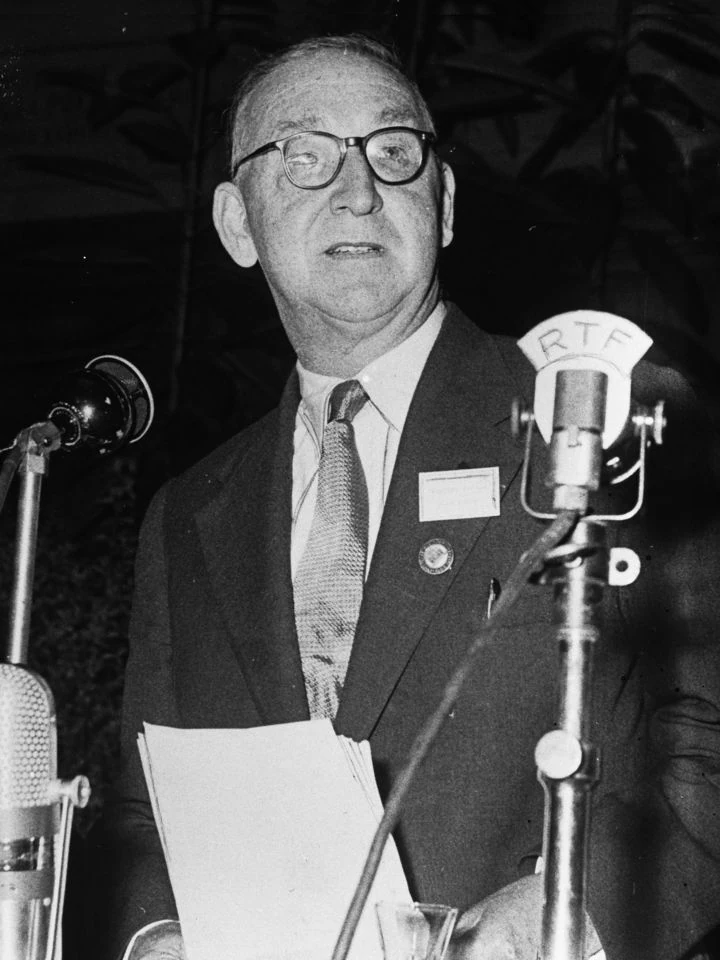
John Cockcroft’s name is tied to an experiment that made the atomic nucleus a subject of direct investigation. In 1932, working with Ernest Walton at Cambridge, he used an accelerator to bombard lithium with protons. The experiment produced alpha particles and demonstrated the first artificial disintegration of an atomic nucleus, popularly called splitting the atom. Cockcroft’s career did not stop at that laboratory achievement: it took him from wartime radar work to directing Britain’s Atomic Energy Research Establishment at Harwell, and later to helping establish Churchill College, Cambridge.
From Todmorden to the Cavendish Laboratory
Born in Todmorden on 27 May 1897, Cockcroft was the eldest son of mill owner John Arthur Cockcroft and Annie Maude Fielden. He attended local schools, including Todmorden Secondary School, where he played football and cricket. In 1914, he won a County Major Scholarship to study mathematics at the Victoria University of Manchester. His education was interrupted by the First World War: after enlisting in 1915, he served with the Royal Field Artillery on the Western Front and was commissioned as a lieutenant in October 1918.
After leaving the Army in January 1919, Cockcroft chose electrical engineering rather than returning to his earlier course. He studied at Manchester Municipal College of Technology, graduating in 1922, and completed an apprenticeship with Metropolitan Vickers. A scholarship then took him to St John’s College, Cambridge. He sat the Mathematical Tripos in 1924 and became a research student in the Cavendish Laboratory, where Ernest Rutherford supervised his doctorate. Awarded in 1928, Cockcroft’s thesis concerned the condensation of molecular streams on surfaces. He also assisted the physicist Peter Kapitza with low-temperature work, including the design and construction of helium liquefiers.
An accelerator and an artificial nuclear reaction
Rutherford wanted a way to produce particles with enough energy to probe atomic nuclei. Cockcroft and Walton worked on an accelerator to meet that challenge, with Mark Oliphant designing a proton source. Cockcroft’s calculations, informed by George Gamow’s work on quantum tunnelling, indicated that protons could penetrate a nucleus at lower energies than had first been expected. The University of Cambridge provided a grant for a transformer and other equipment, and Cockcroft and Walton began operating the accelerator in March 1932.
They bombarded lithium and beryllium with protons. After an initial search for gamma rays, they turned their attention to alpha particles. On 14 April 1932, Walton observed what appeared to be alpha particles coming from a lithium target. Cockcroft and Rutherford confirmed the result. Cockcroft and Walton announced the first artificial disintegration of an atomic nucleus in a letter to Nature. Their work became widely known as “splitting the atom”. They later used protons, deuterons and alpha particles to disintegrate other elements, and demonstrated the production of radioactive isotopes including carbon-11 and nitrogen-13.
The experiment brought recognition as well as a landmark in nuclear physics. Cockcroft and Walton received the Royal Society’s Hughes Medal in 1938 and shared the 1951 Nobel Prize in Physics for their work on the transmutation of atomic nuclei by artificially accelerated particles. Cockcroft was elected a Fellow of the Royal Society in 1936. His responsibilities at Cambridge also included directing research at the Mond Laboratory from 1935 and, from 1939, holding the Jacksonian Professorship of Natural Philosophy.
Radar, wartime science and Chalk River
When the Second World War began, Cockcroft moved into government scientific work as assistant director of scientific research at the Ministry of Supply, with radar among his responsibilities. He helped deploy scientists to bring the Chain Home early-warning radar system into operation. He also served on committees examining the scientific and technical implications of the Frisch–Peierls memorandum and the feasibility of an atomic bomb.
In 1940, Cockcroft travelled to the United States as part of the Tizard Mission, which shared British technology with an American ally not yet at war. The mission exchanged information on radar and other technologies. Later, as chief superintendent of the Air Defence Research Development Establishment at Christchurch, Hampshire, Cockcroft concentrated on radar for air defence. Trials on the Isle of Sheppey in 1943 showed the value of the American SCR-584 radar, and the equipment was requested for British use against the V-1 flying bomb. Cockcroft was made a Commander of the Order of the British Empire in 1944 for his services.
In May 1944, he became director of the Montreal Laboratory, which was working on nuclear reactors in Canada. He oversaw the development of the ZEEP and NRX reactors and the creation of Chalk River Laboratories. ZEEP became the first operating nuclear reactor outside the United States when it went critical in September 1945; the more powerful NRX followed in 1947. Cockcroft remained in Canada until 1946, while recruiting staff for the new British research establishment that he would lead.
Harwell, Windscale and Churchill College
Cockcroft became director of the Atomic Energy Research Establishment at Harwell after the war. The site’s GLEEP reactor began operating in August 1947, the first reactor to operate in Western Europe. BEPO, a larger research reactor, followed in 1948. Harwell also took part in work on reactors and chemical separation at Windscale and in post-war fusion research, including the ZETA programme. Cockcroft’s work placed him at the centre of Britain’s developing nuclear research system, a role that combined scientific direction with practical decisions about what facilities to build and which lines of research to pursue.
One of those decisions concerned filters for the chimney stacks of the Windscale reactors. Cockcroft insisted that they be installed, despite the cost and the criticism that earned them the nickname “Cockcroft’s Folly”. During the Windscale fire of 1957, the filters prevented a worse release of radioactive material. Their value became clear only after an accident, making this episode a particularly telling example of the consequences of technical judgement under uncertainty.
In 1959, Cockcroft became the first master of Churchill College, Cambridge. He nominated its first fellows and oversaw its early construction. The college admitted its first undergraduates in 1961 and was formally opened by Prince Philip, Duke of Edinburgh, in 1964. Cockcroft also served as chancellor of the Australian National University from 1961 to 1965, and held roles including president of the Institute of Physics and British delegate to the Council of CERN.
Honours and remembrance
Cockcroft received a range of honours for his scientific work. In addition to the Hughes Medal and Nobel Prize, these included the Royal Medal in 1954, the Faraday Medal in 1955 and the Atoms for Peace Award in 1961. He was appointed CBE in 1944, knighted in 1948 and appointed to the Order of Merit in 1957. These distinctions reflected a career that ranged from experimental physics to wartime research, nuclear science and institutional leadership.
He died at his home at Churchill College, Cambridge, on 18 September 1967, aged 70. He is buried at the Parish of the Ascension Burial Ground in Cambridge. Buildings bearing his name include the Cockcroft Institute at Daresbury Laboratory and buildings at Cambridge, Brighton and Salford. His papers, including laboratory notebooks, correspondence and photographs, are held at Churchill Archives Centre.
Why John Cockcroft deserves a place in British Legacy
Cockcroft’s place in British Legacy rests first on a specific scientific achievement: with Ernest Walton, he demonstrated that an atomic nucleus could be disintegrated using artificially accelerated particles. The result was not simply an abstract advance. It opened a new experimental route into nuclear physics, and its importance was recognised by the Hughes Medal and the Nobel Prize. Cockcroft’s story also shows the work behind a breakthrough: theoretical insight, equipment design, institutional support and careful experimental observation all contributed to the result.
His contribution to Britain extended well beyond the Cambridge laboratory. During the war, he worked on radar and scientific collaboration; after it, he led Harwell as it developed reactors and research programmes. His insistence on filters at Windscale, once mocked, helped limit the release of radioactive material during the 1957 fire. At Churchill College, he helped shape a new institution with a strong emphasis on science and technology. Together, these achievements connect discovery with public service and institution-building. They offer a grounded account of British scientific legacy: not a claim that one individual transformed every field, but a record of consequential work, leadership and decisions whose effects reached beyond the laboratory.
Sources
John Cockcroft — Wikipedia, revision 1378467944 · John Cockcroft — Wikipedia
Adapted in part from John Cockcroft by Wikipedia contributors, under CC BY-SA 4.0. Text has been edited and combined with the existing article; this adapted text is shared under the same licence. Contributor history.