John Constable’s landscapes began with close attention to places he knew: the River Stour, the mills and lanes of Suffolk, and the changing skies above them. His paintings did more than record rural scenery. By insisting that ordinary landscape could sustain large, serious pictures, he challenged the artistic fashions of his day. Works including The Hay Wain later became celebrated landmarks of British art, although recognition at home was slow and financial success remained elusive.
East Bergholt and the making of a painter
Constable was born on 11 June 1776 in East Bergholt, Suffolk, the second son of Golding and Ann Constable. His father was a wealthy corn merchant who owned Flatford Mill and later Dedham Mill. The family expected John to enter the business, and he worked in the corn trade after leaving school. His younger brother Abram eventually took over the running of the mills.
Meanwhile, Constable sketched the countryside around Suffolk and Essex. He later recalled that its sights and sounds had made him a painter. In 1799, he persuaded his father to let him pursue art and entered the Royal Academy Schools as a probationer. He studied from life, copied older artists and learned from the work of painters including Thomas Gainsborough, Claude Lorrain and Peter Paul Rubens. He exhibited at the Royal Academy from 1803.
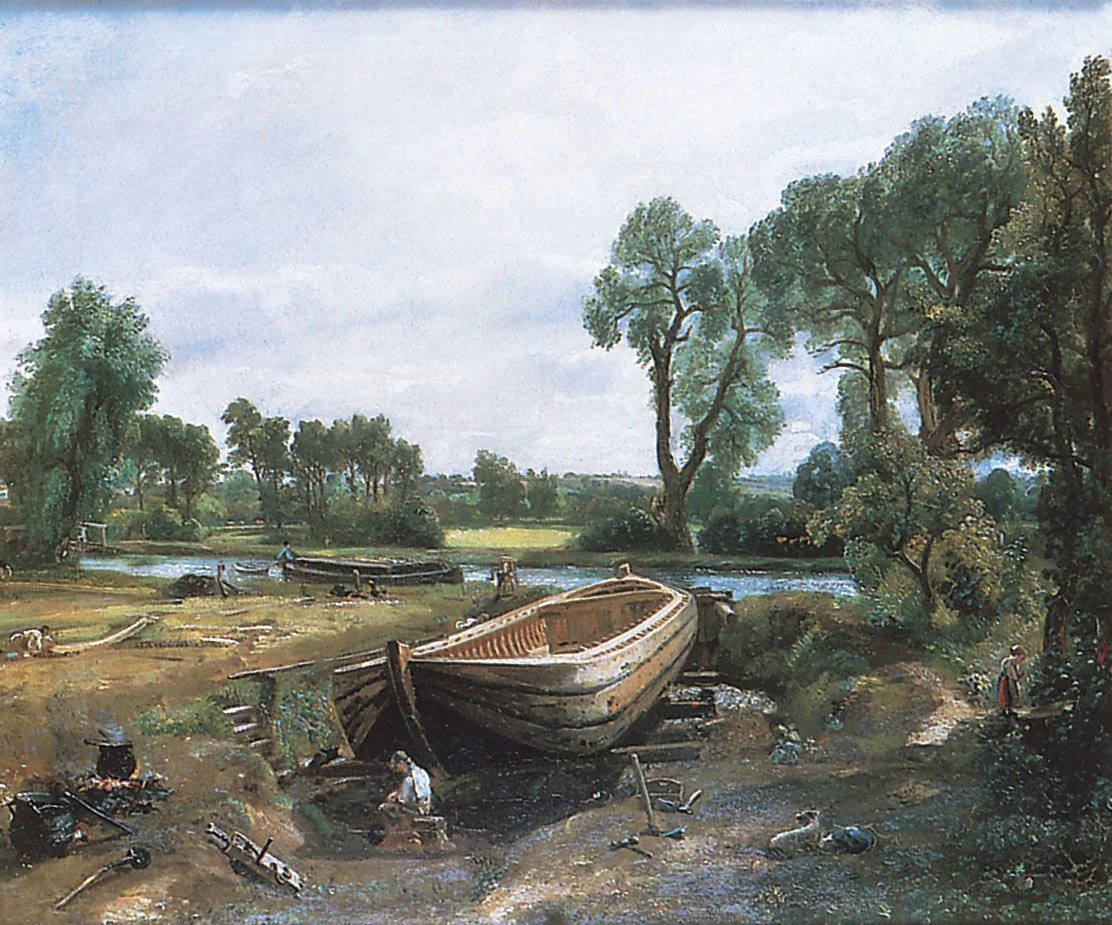
Constable resisted the idea that a landscape should be reshaped to imitate established pictures. He wanted to paint from nature, and wrote of his determination to avoid making his work look like that of other men. The scenes he chose—villages, mills, farmhouses and familiar stretches of river—were not the grand, dramatic landscapes then most likely to command attention. He nevertheless made the Stour valley the centre of an ambitious artistic career.
Ambition on the River Stour
For years, landscape painting offered Constable little financial security. He supplemented his income with portraiture and commissions to paint country houses. In 1816, the year he married Maria Bicknell, he painted Wivenhoe Park in Essex for Major-General Francis Slater Rebow. He continued to return to the Stour for subjects, and began to work on larger canvases intended to make an impression at the Royal Academy’s crowded exhibitions.
His first important sale came in 1819, when his friend John Fisher bought The White Horse. The painting’s success helped Constable develop a series of monumental Stour landscapes now known as the “six-footers”. They include Stratford Mill, The Hay Wain, The Lock and The Leaping Horse. Their scale helped make his approach harder to overlook, though success was uneven: The Leaping Horse did not sell during his lifetime.
The Hay Wain, painted in 1821, shows a horse-drawn hay wain beside the water near Flatford Mill. It was exhibited at the Royal Academy but did not find a buyer there. In 1824, the painting and View on the Stour near Dedham were sold to the dealer John Arrowsmith and exhibited at the Paris Salon. The paintings made a strong impression in France, and King Charles X awarded The Hay Wain a gold medal. The National Gallery later acquired it after its owner, Henry Vaughan, donated it in 1886.
Constable’s pictures found a receptive audience in France, where his work influenced artists including Eugène Delacroix and the Barbizon school. His reputation abroad did not erase the contrast with his home market: the biographical account records that he sold more than 20 paintings in France in a few years, while selling only 20 in England during his lifetime.
Looking closely at light, weather and place
Constable’s methods grew from repeated observation, not a single decision to paint outdoors. He made studies on location and developed full-scale preparatory sketches in oil, using loose, vigorous brushwork to test compositions before completing exhibition pictures. These sketches gave landscape painting a new force and scale. They also show how differently he could treat the same subject: in studies for The Hay Wain and The Leaping Horse, movement and brushwork can feel more immediate than in the finished canvases.
The sky was central to this way of working. Constable made studies of clouds and atmospheric effects, sometimes noting the weather, light and time of day on the back. He regarded the sky as a key to the scale and feeling of a landscape, and his interest in weather was informed by the meteorological work of Luke Howard. In paintings such as Chain Pier, Brighton and Salisbury Cathedral from the Meadows, changes in light and weather shape the whole composition.
His attachment to place did not mean that he painted only the Stour. He also worked in Salisbury and Brighton, and painted Hampstead Heath after moving to London. Yet the landscapes associated with Dedham Vale remain central to his reputation. “Painting is but another word for feeling,” he wrote to his friend John Fisher in 1821. The remark belongs to a larger commitment to making personal attachment and direct observation part of the work.
Family life, loss and recognition
Constable married Maria Bicknell in 1816. The couple had seven children. In the hope of improving Maria’s health, the family spent time in Brighton from 1824; she died in 1828, aged 41. Constable was left to care for their children. His later paintings include darker, more emphatic works such as Hadleigh Castle and Salisbury Cathedral from the Meadows.
In February 1829, at the age of 52, he was elected a full member of the Royal Academy. He later served as a visitor there and delivered public lectures on landscape painting. In 1836, he argued that painting was both scientific and poetic, and that imagination alone could not surpass reality. He died in London on 31 March 1837 and was buried with Maria at St John-at-Hampstead. His friend Charles Robert Leslie published a biography, Memoirs of the Life of John Constable, in 1843.
Why John Constable deserves a place in British Legacy
Constable’s place in British Legacy rests on the particular way he enlarged the possibilities of landscape painting. He treated the Suffolk and Essex countryside not as a lesser subject to be dressed up as history, but as a place worthy of sustained observation and ambitious scale. The Stour scenes in his “six-footers”, especially The Hay Wain, brought that conviction into the Royal Academy and then to a wider audience in France. The painting’s later place in the National Gallery gives its journey a public afterlife, but its importance begins with Constable’s determination to paint the landscape he knew.
His legacy also lies in the practice behind the finished pictures. Constable’s studies of fields, rivers and skies joined close looking with experimentation: he tested compositions in full-scale oil sketches, recorded atmospheric conditions and made changing light central to the structure of a painting. That approach helped reshape the possibilities of landscape art and influenced French artists, including the Barbizon school and, later, the Impressionists. His career was not an easy march from talent to acclaim: he struggled to sell work in England, and his largest pictures did not all find buyers. That tension makes his achievement more tangible. British Legacy can remember him as an artist who made a local landscape internationally consequential without ceasing to attend to its particular weather, water and working places.
Sources
John Constable — Wikipedia, revision 1378342042
Adapted in part from John Constable by Wikipedia contributors, under CC BY-SA 4.0. Text has been edited and combined with the existing article; this adapted text is shared under the same licence. Contributor history.