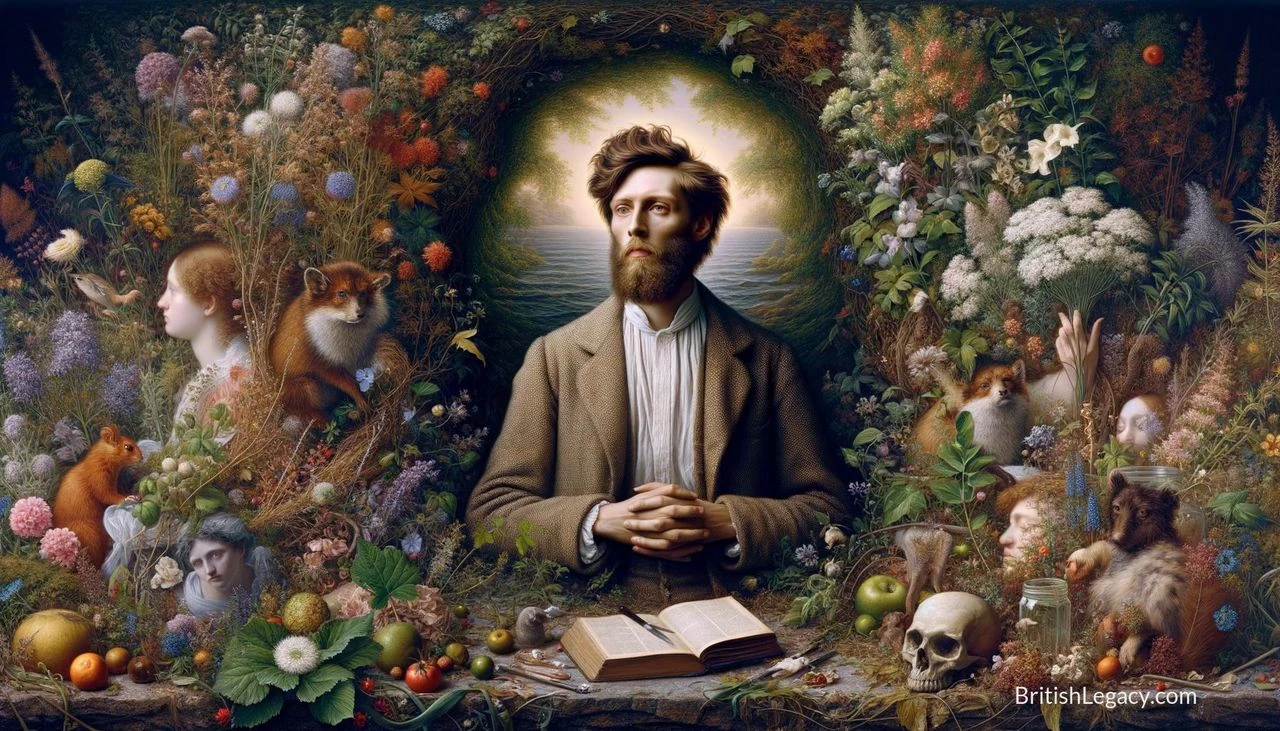
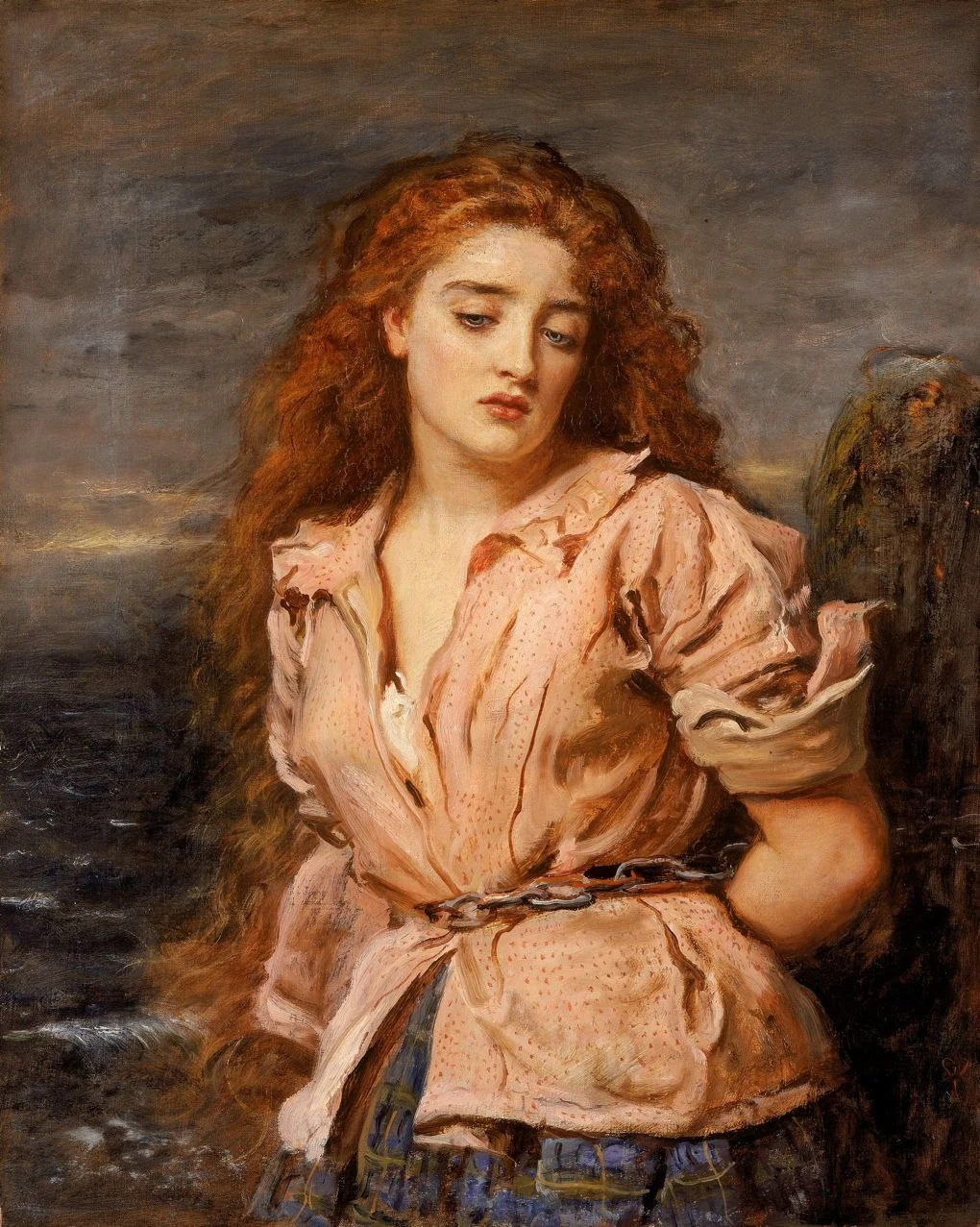
John Everett Millais moved from the exacting naturalism of the Pre-Raphaelite Brotherhood to a broad, commercially successful style that divided opinion. A child prodigy, he became the youngest student to enter the Royal Academy Schools at eleven. He helped found the Brotherhood in 1847, painted Ophelia and The Blind Girl, and later became President of the Royal Academy. His career tells a story not only of artistic change, but of changing ideas about what British painting could be.
A prodigy from Southampton
Millais was born in Southampton on 8 June 1829, into a family with roots in Jersey. He spent much of his early childhood there and retained a strong attachment to the island. His mother, Emily Mary Millais, encouraged his artistic ability and supported the family’s move to London so that he could pursue opportunities at the Royal Academy. In 1840, aged eleven, he entered the Royal Academy Schools, becoming their youngest student.
At the Academy, Millais met William Holman Hunt and Dante Gabriel Rossetti. The three artists formed the Pre-Raphaelite Brotherhood in September 1847 at the Millais family home in Gower Street, London. The name expressed their challenge to the artistic conventions they associated with Raphael and the academic tradition that followed him. Their early work favoured intense observation, intricate detail and close attention to the natural world.
Millais’s Christ in the House of His Parents, painted in 1849–50, brought the group’s approach into public controversy. Its realistic depiction of the Holy Family working in a carpenter’s shop challenged idealised religious imagery. He also found popular success with A Huguenot (1851–52), which presents a young couple facing separation because of religious conflict. The paintings established him as an artist able to combine close observation with emotionally charged subjects.
Ophelia and the Pre-Raphaelite vision
Ophelia, painted in 1851–52, is among Millais’s best-known works and a defining example of his early style. Drawing on Shakespeare’s Hamlet, it shows the drowned Ophelia surrounded by carefully observed vegetation. Rather than treating the landscape as a backdrop, Millais gave its plants and water a dense, vivid presence. The effect joins the natural detail central to Pre-Raphaelite painting with the tragedy of its subject.
His method depended on sustained observation. The complexity of the plants and the carefully constructed surface make the natural setting an essential part of the picture’s meaning and emotional force. In this way, Ophelia embodies the Brotherhood’s interest in detailed representation while remaining a work of narrative drama.
The Blind Girl (1856), also celebrated for its emotional depth, turns from Shakespearean tragedy to a scene of human vulnerability. It depicts two sisters in an English landscape after rain: one is blind, while the other is beside her. The contrast between the sisters and the weather-cleared setting gives the painting its layered character. Millais’s treatment of colour and detail makes the landscape more than a setting; it helps shape the viewer’s encounter with the figures.
A changing style and a wider practice
By the mid-1850s, Millais was moving away from the Brotherhood’s most exacting approach. After his marriage to Effie Gray in 1855, his painting grew broader and more confident. The change was criticised by former supporters, including John Ruskin, who had earlier defended the Pre-Raphaelites. William Morris and others accused Millais of compromising his earlier principles for popularity and wealth. Millais, by contrast, argued that greater confidence allowed him to paint with greater boldness.
His later pictures ranged widely. Historical subjects included The Boyhood of Raleigh (1871), The Northwest Passage (1874) and The Two Princes Edward and Richard in the Tower (1878). He also became widely known for paintings of children. Bubbles (1886) achieved a particularly durable public afterlife when it was used in an advertisement for Pears soap, an association that also drew criticism. His portraits, landscapes and illustrations for books by Anthony Trollope and poems by Alfred, Lord Tennyson show that his work extended well beyond the subjects and methods that first made his name.
From 1870, Millais regularly painted Scottish landscapes, often working in Perthshire during the late summer and autumn. These scenes tend towards bleak, damp terrain: moors, riversides and lochs rather than picturesque views. Chill October (1870) was his first large-scale landscape of this kind. The freer handling of these works differed from the close, blade-by-blade observation of his early outdoor painting, but retained a close engagement with landscape.
Public standing and final years
Millais’s growing reputation was recognised within the Royal Academy. He became an associate member in 1853 and a full member in 1863. In 1885, Queen Victoria made him a baronet, the first artist to receive a hereditary title. He was elected President of the Royal Academy after the death of Lord Leighton in 1896, but died later that year, on 13 August, from throat cancer. He was buried in the crypt of St Paul’s Cathedral.
His public commemoration continued after his death. A memorial committee chaired by the Prince of Wales commissioned a statue by Thomas Brock, installed outside the National Gallery of British Art, now Tate Britain, in 1905. The statue was later moved to a position beside the gallery entrance. Tate Britain’s 2007 retrospective drew 151,000 visitors; the exhibition then travelled to Amsterdam, Fukuoka and Tokyo, bringing Millais’s work to audiences beyond Britain.
His paintings have also continued to reach the public through later adaptations and popular culture. The story of Millais, Effie Gray and Ruskin has been retold in films, stage and radio works, an opera and television dramas. Such retellings reflect the continuing interest in both his artistic career and the personal relationships that intersected with it. His reputation, meanwhile, has not been fixed: the later pictures once dismissed by some critics have increasingly been reconsidered in the context of wider changes in nineteenth-century art.
Why John Everett Millais deserves a place in British Legacy
Millais deserves a place in British Legacy because his career captures a consequential change in British art. As a founder of the Pre-Raphaelite Brotherhood, he helped advance a style grounded in close observation, intricate detail and vivid colour. Works such as Ophelia made those principles memorable, while Christ in the House of His Parents shows how they could unsettle established expectations of religious painting. His work did not merely illustrate the Brotherhood’s ideas: it helped bring their challenge to public attention.
His later career matters just as much. Millais moved beyond the strictures of his early style into landscapes, portraits, historical pictures, children’s paintings and book illustration. That change brought exceptional success but also accusations of compromise, leaving a useful record of the tension between artistic conviction, public taste and commercial reward. His service as President of the Royal Academy and his baronetcy place him within the institutions and honours of British cultural life; the statue and the continuing exhibitions give his work a lasting public presence. Remembering both his innovations and the arguments around his later art offers a fuller account of how British painting developed during the Victorian period.
Sources
John Everett Millais — Wikipedia revision 1374168229 · John Everett Millais — Wikipedia
Adapted in part from John Everett Millais by Wikipedia contributors, under CC BY-SA 4.0. Text has been edited and combined with the existing article; this adapted text is shared under the same licence. Contributor history.