
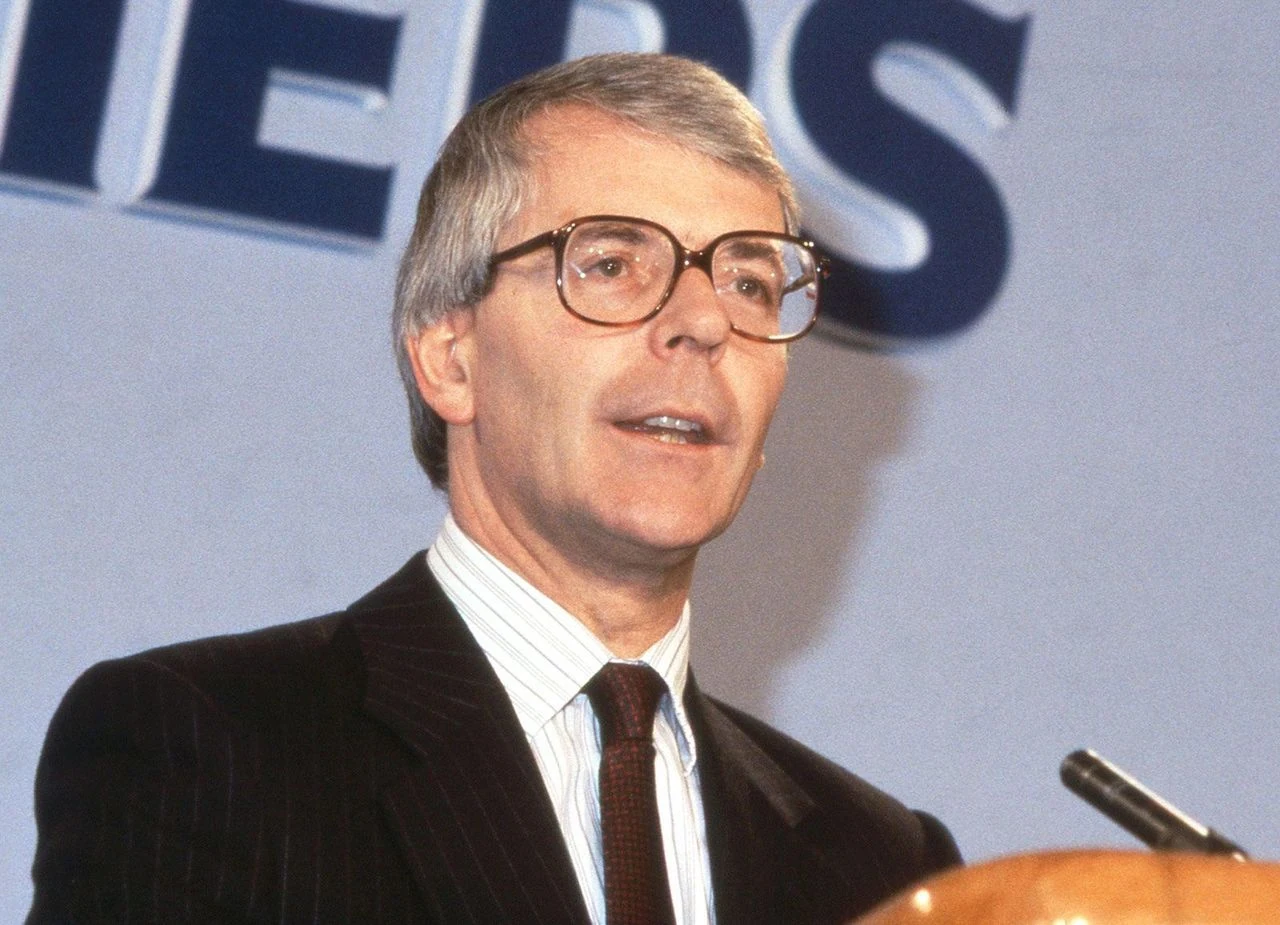
John Major’s route to Downing Street began far from Westminster’s familiar paths. He left school before 16, worked in clerical and banking jobs, and built a political career through the Young Conservatives and Lambeth council. By the time he became prime minister in November 1990, he had served in several senior Cabinet posts. His seven years in office brought a recession, Britain’s departure from the European Exchange Rate Mechanism, bitter arguments over European integration and important early steps towards peace in Northern Ireland.
From Brixton to the Commons
Major was born on 29 March 1943 at St Helier, Surrey, to Gwen Major and Tom Major-Ball, a former music-hall performer. The family’s circumstances became more difficult after his father’s health declined and the garden-ornament business ran into financial trouble. They moved from Worcester Park to a rented flat in Brixton. Major attended Rutlish School, leaving just before his 16th birthday with three O-levels. He later described school as a difficult experience; reading newspapers on his journeys across London helped sustain his interest in politics.
His first job was as a clerk at an insurance brokerage. After periods of unemployment and work with the family business, he joined the London Electricity Board and then moved into banking. He became active in the Young Conservatives, speaking at Brixton Market, and won a seat on Lambeth council in 1968. As chair of its housing committee, he oversaw the building of council estates and promoted public meetings with residents. He lost his council seat in 1971, but continued working towards a parliamentary career.
After two unsuccessful attempts to win St Pancras North, Major was selected for Huntingdonshire, a seat he won at the 1979 general election. In Parliament he joined committees and took on junior party roles before entering government. He became a minister in the Department of Health and Social Security in 1985, then joined the Cabinet as Chief Secretary to the Treasury after the 1987 election. In 1989 he served briefly as Foreign Secretary before becoming Chancellor of the Exchequer. These appointments brought him rapidly from junior ministerial work to two of the most senior offices of state.
Taking office in a divided party
Major entered the 1990 Conservative leadership contest after Margaret Thatcher announced she would resign. He presented himself as a candidate of moderation, including on Europe, and succeeded her as party leader and prime minister in November. His comparatively conciliatory manner differed from Thatcher’s, although much of his government’s policy programme continued the direction set under her administrations.
The economic conditions were severe. Britain was in recession, with high interest rates, falling house prices and rising unemployment. Major’s government replaced the poll tax with council tax, which took effect in 1993, and introduced the Citizen’s Charter in 1991. The Charter set out standards for public services, including performance measures and procedures for complaints and redress. These initiatives sat alongside a wider programme of market-oriented reform, including the privatisation of the railways and the core assets of British Coal.
Major called the 1992 general election and led the Conservatives to a fourth consecutive victory. The party received more than 14 million votes, still the highest total won by a British political party in a general election. The result gave his government a narrow majority. It was soon tested by the currency crisis known as Black Wednesday. On 16 September 1992, after heavy intervention to defend sterling and interest-rate increases, the government withdrew the pound from the European Exchange Rate Mechanism. The decision damaged the Conservatives’ reputation for economic management and intensified debate about Britain’s monetary and European policy.
Europe, recession and peace talks
Major led Britain’s negotiations over the Maastricht Treaty, which was signed in 1992. The treaty set a framework for deeper European integration and established the European Union; it did not itself establish the euro as an existing common currency. Major’s government secured parliamentary approval, but the process exposed deep Conservative divisions. The treaty’s ratification became a major test of his authority, as MPs opposed to further integration could use the government’s reduced majority to challenge it.
In Northern Ireland, Major and Irish taoiseach Albert Reynolds issued the Downing Street Declaration in December 1993. It made majority consent central to any change in the territory’s constitutional status and offered parties committed to peaceful methods a route into negotiations. The declaration helped establish the basis for the peace process. The IRA announced a ceasefire in August 1994, followed by loyalist paramilitaries in October. The Good Friday Agreement came later, in 1998, after Major had left office; his government’s contribution was an earlier stage in a longer process.
Major also oversaw the United Kingdom’s participation in the Gulf War. At home, his government launched the Back to Basics campaign in 1993, an appeal covering areas including education, public services, industry and law and order. Its association with traditional morality became politically damaging amid later Conservative scandals. In 1995, Major resigned as party leader and stood for re-election, defeating John Redwood. The leadership contest did not end the party’s divisions, while Labour under Tony Blair opened a commanding lead in opinion polls. The Conservatives lost their parliamentary majority in 1996 and were defeated by Labour in the 1997 general election.
After Downing Street
Major remained in the Commons after leaving office, serving briefly as Leader of the Opposition while the Conservatives chose his successor. He stood down as an MP at the 2001 general election and declined a peerage, saying he wanted a break from politics. He later wrote about his life and interests, publishing an autobiography in 1999, a history of cricket in 2007 and a book about music hall in 2012.
Cricket remained a substantial part of his public life. Major was president of Surrey County Cricket Club from 2000 to 2001 and later served as an honorary life vice-president. He joined the Marylebone Cricket Club committee in 2005 and left in 2011 over concerns about the planned redevelopment of Lord’s. His charitable roles included work with Asthma UK and other organisations. He also continued to comment on political questions, including the European Union and the peace settlement in Northern Ireland.
His public standing has remained contested. The departure from the ERM became a lasting liability for his government, and Conservative divisions over Europe contributed to its difficulties. Later assessments have also pointed to the Downing Street Declaration and the economic recovery that followed the early-1990s recession as significant parts of his record. The contrast between those achievements and the party’s prolonged internal conflict is central to understanding his premiership: Major held office through consequential change, but could not reconcile the divisions that weakened his government.
Why John Major deserves a place in British Legacy
John Major belongs in British Legacy not because his premiership was untroubled, but because its decisions had lasting consequences for Britain. His government’s handling of the early-1990s recession and the withdrawal of sterling from the Exchange Rate Mechanism show the risks of economic policy under pressure. Black Wednesday was a serious political failure for Major, but it also marked a change in Britain’s monetary course. The Citizen’s Charter, meanwhile, set out service standards and ways for the public to complain or seek redress, making accountability an explicit part of the government’s public-service programme.
His record in Northern Ireland merits particular attention. The 1993 Downing Street Declaration, agreed with Albert Reynolds, connected consent on constitutional change with a route into talks for parties committed to peaceful methods. It did not deliver the later Good Friday Agreement, but it helped establish the basis for the peace process that followed. Major’s premiership also placed Britain at the centre of difficult negotiations over the Maastricht Treaty, while the resulting divisions exposed the limits of his authority within his own party. Together, these episodes offer a specific British political legacy: a government confronting economic and constitutional pressures, making consequential choices and helping create conditions that later administrations and political leaders would build upon.
Sources
Adapted in part from John Major by Wikipedia contributors, under CC BY-SA 4.0. Text has been edited and combined with the existing article; this adapted text is shared under the same licence. Contributor history.

.jpg)