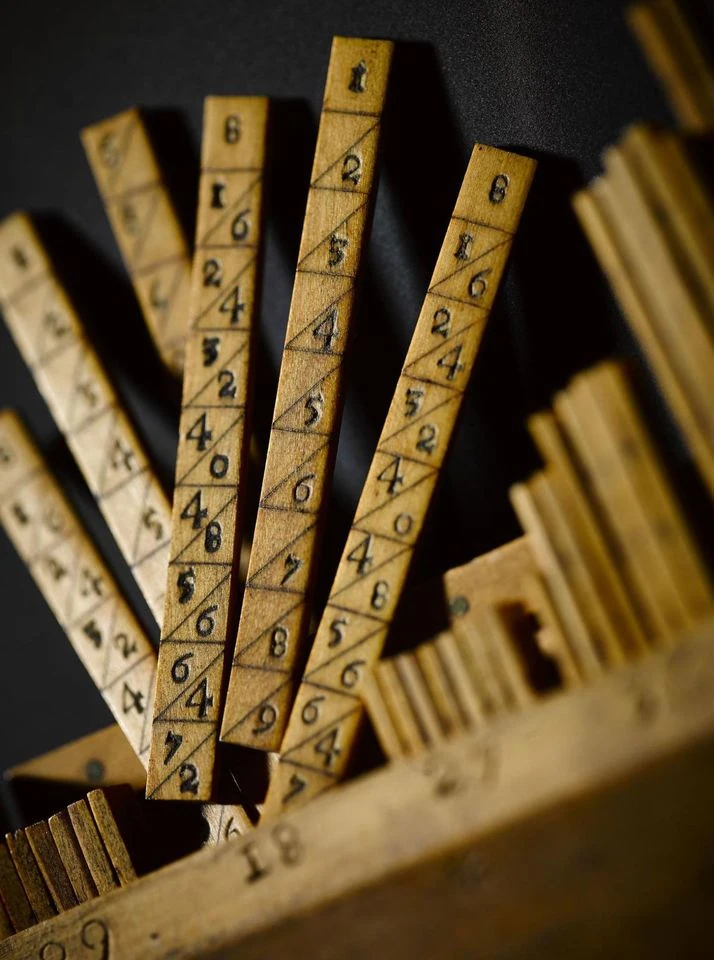
John Napier’s achievement was to make difficult calculation less laborious. His logarithms turned multiplication and division into addition and subtraction, offering a practical aid to people working with large numbers and trigonometry. Published in 1614, his tables helped open a new route through calculation. Napier also devised numbered rods for multiplication and improved the notation used for decimal fractions. A Scottish landowner working in an age of religious and scientific change, he brought mathematical ideas into forms that could be used by other practitioners.
Merchiston and an unfinished education
Napier was born in Edinburgh on 1 February 1550, the son of Sir Archibald Napier of Merchiston Castle and Janet Bothwell. He was enrolled at St Salvator’s College, St Andrews, at 13, but there is no record that he completed his education there. Accounts of his early learning are sparse. It is thought that he left Scotland to continue his studies in continental Europe, although no university attendance there is documented. He returned to Scotland in 1571.
Napier bought a castle at Gartness in 1574. After his father’s death in 1608, he and his family moved to Merchiston Castle in Edinburgh, where he lived for the rest of his life. He was a landowner as well as a mathematician, and his working life took place in a Scotland shaped by religious divisions and political pressures. His interests were not confined to mathematics: he wrote on theology and, in 1596, described proposed devices intended for the defence of the island.
Making calculation more manageable
Napier sought ways to reduce the effort involved in calculation. The mathematical methods he drew on included trigonometric techniques, decimal fractions and symbolic ways of expressing powers. He recognised that people facing particularly laborious calculations often worked in trigonometry, so he developed logarithms in a trigonometric context that could serve those practical needs.
In 1614 he published Mirifici Logarithmorum Canonis Descriptio, or A Description of the Wonderful Canon of Logarithms. The book contained explanatory text and tables of logarithms of trigonometric functions, as well as a discussion of spherical trigonometry later known as Napier’s Rules of Circular Parts. By changing multiplication into addition and division into subtraction, logarithms allowed calculations by hand to be carried out more quickly. The practical gain was important in fields such as astronomy and other areas of physics, where substantial calculations were needed.
The response was swift. The English mathematician Henry Briggs adopted Napier’s work and visited him in 1615. They discussed revising the logarithms into a more convenient form. Napier entrusted Briggs with calculating a revised table; Briggs went on to produce a base-ten table accurate to 14 decimal places. This development extended the usefulness of logarithmic calculation, while the initial invention and its tables remained Napier’s contribution.
Rods, decimals and spherical trigonometry
Logarithms were not Napier’s only aid to computation. His numbered rods, known as Napier’s bones, made lattice multiplication more convenient. The rods offered a physical method for organising multiplication, complementing the abstract method of logarithms. In 1617, the year of his death, his work on this and another calculating device, the Promptuary, was published posthumously as Rabdologiæ.
Napier also improved the notation for decimal fractions developed by Simon Stevin, introducing the full stop as a marker between the whole-number and fractional parts. In spherical trigonometry, he devised a mnemonic aid called Napier’s circle, or Napier’s pentagon, to help users remember relationships among the parts of a right spherical triangle. These achievements show the practical character of his mathematics: he worked not only on mathematical relationships, but on ways to make them easier to calculate and remember.
Faith, family and final years
Napier’s religious writing formed another substantial part of his work. His A Plaine Discovery of the Whole Revelation of St. John, published in 1593, interpreted the Book of Revelation through a strongly anti-papal Protestant reading. Written in English, it was intended to reach a broad readership. Napier used mathematical analysis in an attempt to identify the sequence and timing of events described in the text, while maintaining that people could not know the true date of the Apocalypse.
He married Elizabeth Stirling in 1572; they had two children. After her death in 1579, he married Agnes Chisholm, with whom he had ten children. Napier died at Merchiston Castle on 4 April 1617, aged 67. He was buried at St Giles in Edinburgh; after the kirkyard there was lost to the construction of Parliament House, his remains were transferred to a vault at St Cuthbert’s Parish Church, where a wall monument also commemorates him.
Why John Napier deserves a place in British Legacy
Napier’s place in British Legacy rests on a specific achievement with a clear practical benefit. His logarithms reduced the effort involved in large calculations, helping people work more quickly by hand. The method was taken up by Henry Briggs and extended through revised tables, while its usefulness reached astronomy, dynamics and other areas of physics. This was not simply an abstract advance: Napier addressed the labour of calculation and provided methods that other mathematicians and practitioners could use.
His contribution was broader than logarithms. Napier’s bones supplied a hands-on multiplication aid; his work on decimal notation made fractions easier to represent; and his rules for spherical trigonometry offered a way to organise and remember relationships. Together, these achievements show an interest in mathematics as both theory and working instrument. Napier’s influence is also reflected in Edinburgh Napier University’s name and in the unit called the neper. As a Scottish mathematician whose work helped shape the practice of calculation, he belongs in a British account of ideas that travelled beyond their place of origin and served generations of scientific work.
Sources
John Napier (revision 1372532281) · John Napier
Adapted in part from John Napier by Wikipedia contributors, under CC BY-SA 4.0. Text has been edited and combined with the existing article; this adapted text is shared under the same licence. Contributor history.