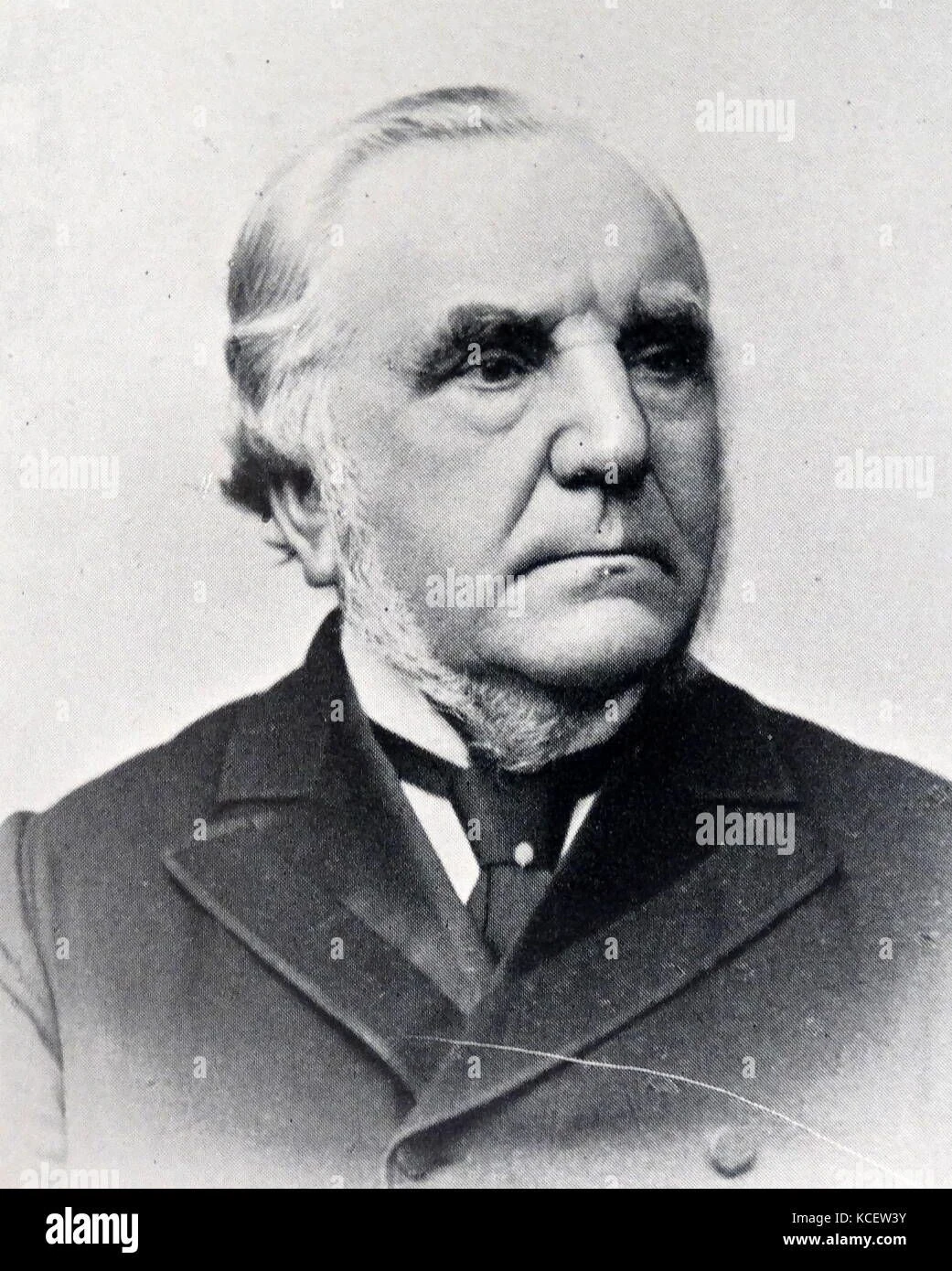
In 1866, a telegraph cable linking Valentia Island, off Ireland, with Heart’s Content in Newfoundland carried messages beneath the Atlantic. John Pender was not its solitary inventor: he was the leading financier and chairman among those who made the successful project possible. A textile merchant turned cable entrepreneur, he helped turn an uncertain engineering undertaking into a commercially viable connection—and went on to build companies that laid submarine telegraph cables across the world.
From the Vale of Leven to the textile trade
Pender was born on 10 September 1816 in the Vale of Leven, Scotland, the son of James Pender and Marion Mason. He attended Glasgow High School and made his career in textile fabrics, first as a merchant in Glasgow and later in Manchester. There, his warehouse stood in Peter Street, near the Great Northern Warehouse. The textile trade gave him a business career before telegraphy became his defining enterprise.
By the middle of the nineteenth century, the telegraph was transforming communication across land. Messages sent over the Atlantic, however, still depended on ships and could take weeks to arrive. Laying a working cable across the ocean promised a different speed of exchange, but the practical and financial risks were formidable. Earlier attempts had attracted mixed success, and the first transatlantic cable, laid in 1858, failed after an initial period of operation.
Financing a transatlantic connection
Pender became involved with the Atlantic Telegraph Company, established in 1856, alongside figures including the American entrepreneur Cyrus Field and the engineer Charles Tilston Bright. The failure of the 1858 cable did not end the effort. Pender later led the financing and direction of the companies involved in the successful 1866 undertaking. He was a chairman and financier in a collective enterprise, not the cable’s engineer working alone.
The 1866 cable ran from Valentia Island to Heart’s Content, Newfoundland and Labrador. Unlike the previous transatlantic attempts, it proved commercially viable. Its operation demonstrated that submarine telegraphy could provide a durable link across the ocean, bringing Europe and North America into much faster communication. The achievement depended on more than the moment the cable reached shore: investment, manufacture, laying and operation all had to be brought together.
The companies involved in the project joined the Anglo-American Telegraph Company, the Gutta Percha Company and Glass, Elliott of Greenwich in the Telegraph Construction and Maintenance Company, commonly known as Telcon. Telcon subsequently manufactured and laid cables for the Eastern Telegraph network and many other submarine telegraph routes. Pender’s part in the story was therefore not confined to financing one crossing; it connected the Atlantic project to the industrial capacity required for further cables.
A network of companies and routes
Pender founded 32 telegraph companies, including the Eastern Telegraph Company, the Eastern and South African Telegraph Company, the Western Telegraph Europe and Azores Telegraph Company, and the Australasia and China Telegraph Company. Other ventures included the London Platino-Brazilian Telegraph Company and the Pacific and European Telegraph Company. Together, these enterprises extended submarine telegraph links well beyond the North Atlantic.
The Eastern Telegraph Company was among the companies later brought together in Imperial and International Communications. In 1934, that organisation adopted the name Cable & Wireless, chosen to reflect its cable and radio services rather than its imperial associations. Pender did not live to see that change, but the scale of the cable businesses he established formed part of the network’s history.
His interests were not restricted to communications. In 1887, he joined the City financiers Leopold Salomons and Jabez Balfour in founding the Trustees, Executors and Securities Insurance Corporation. He also invested in railways, including the Isle of Man Steam Railway; one of its locomotives, No. 3, was named Pender in his honour. He served as a director of the Chicago, St Paul, Minneapolis and Omaha Railway in the United States and founded Yule Ranch in western North Dakota in 1883. The town of Pender, Nebraska, was also named after him.
Parliament, honours and private interests
Pender sat in Parliament as a Liberal member for Totnes from 1862 to 1866. The seat was disenfranchised under the Reform Act 1867. He later represented Wick Burghs from 1872 until his defeat in 1885, unsuccessfully contested that seat as a Liberal Unionist in 1886, and was an unsuccessful candidate at a Govan by-election in 1889. He returned to represent Wick Burghs from 1892 until his death.
He was made a Knight Commander of the Order of St Michael and St George in 1888 and promoted to Knight Grand Cross in 1892. Pender also collected paintings, including works by J. M. W. Turner, Landseer, Joshua Reynolds, John Everett Millais, Gainsborough and Canaletto. Parts of the collection were sold after his death. He lived at various times in Scotland and England, including at Foots Cray Place in Kent, where he died on 7 July 1896, aged 79.
Why John Pender deserves a place in British Legacy
Pender’s place in British Legacy rests on a specific achievement: he helped finance and direct the first successful, commercially viable telegraph cable across the Atlantic. The crossing linked Ireland and Newfoundland, turning a difficult engineering ambition into a working route for communication between Europe and North America. Recognising his role accurately matters. The cable was the work of companies, engineers and financiers; Pender’s contribution was to organise investment and leadership at a point when earlier attempts had failed.
He also helped extend submarine telegraphy beyond a single route. The companies he founded carried the business of cable communication into networks connecting regions across the world, while Telcon manufactured and laid cables for the Eastern Telegraph Company and many other routes. These businesses helped establish the infrastructure through which messages could travel far faster than by ship. Their later history, including the formation of Cable & Wireless from earlier organisations, shows how long-lived that infrastructure proved to be. Pender’s career joined British textile commerce, finance, engineering enterprise and overseas communications. Its legacy is not an uncomplicated tale of one man inventing global connection, but a record of the capital, companies and organisation that made a new scale of communication possible.
Sources
John Pender — Wikipedia, revision 1352991394
Adapted in part from John Pender by Wikipedia contributors, under CC BY-SA 4.0. Text has been edited and combined with the existing article; this adapted text is shared under the same licence. Contributor history.