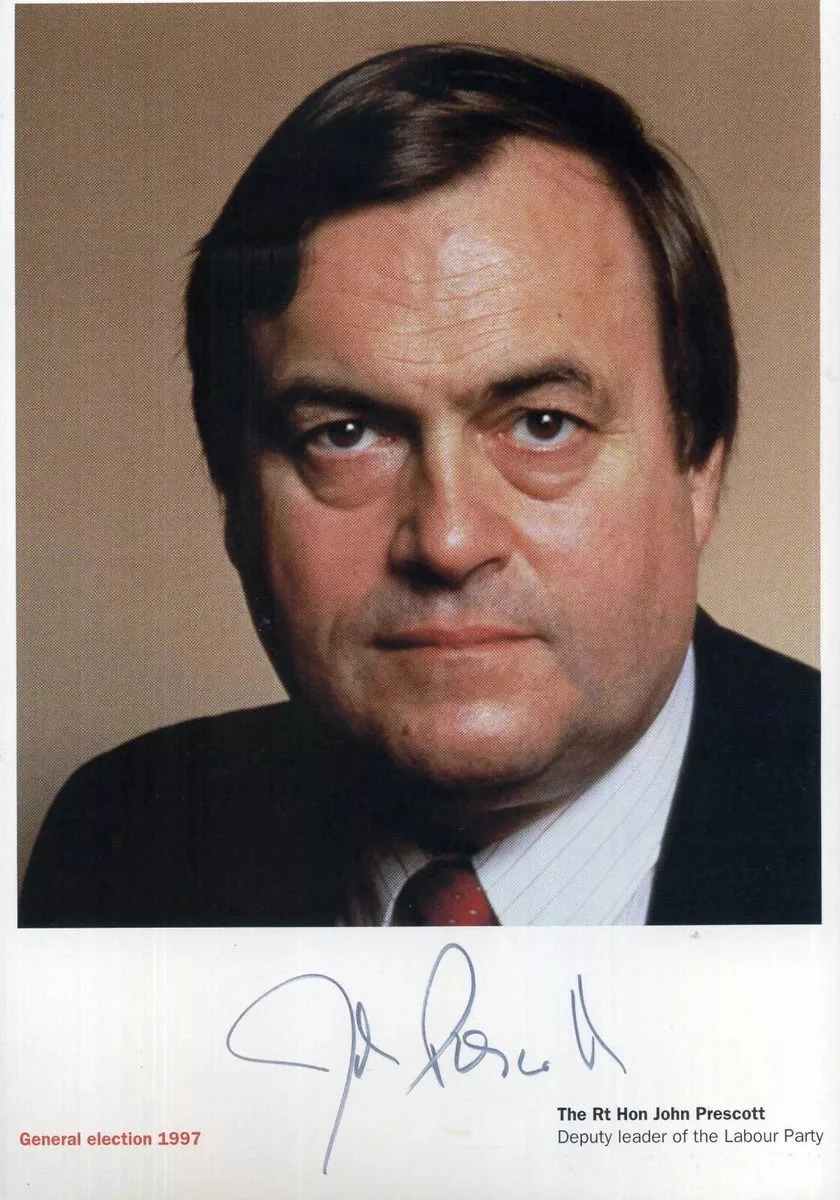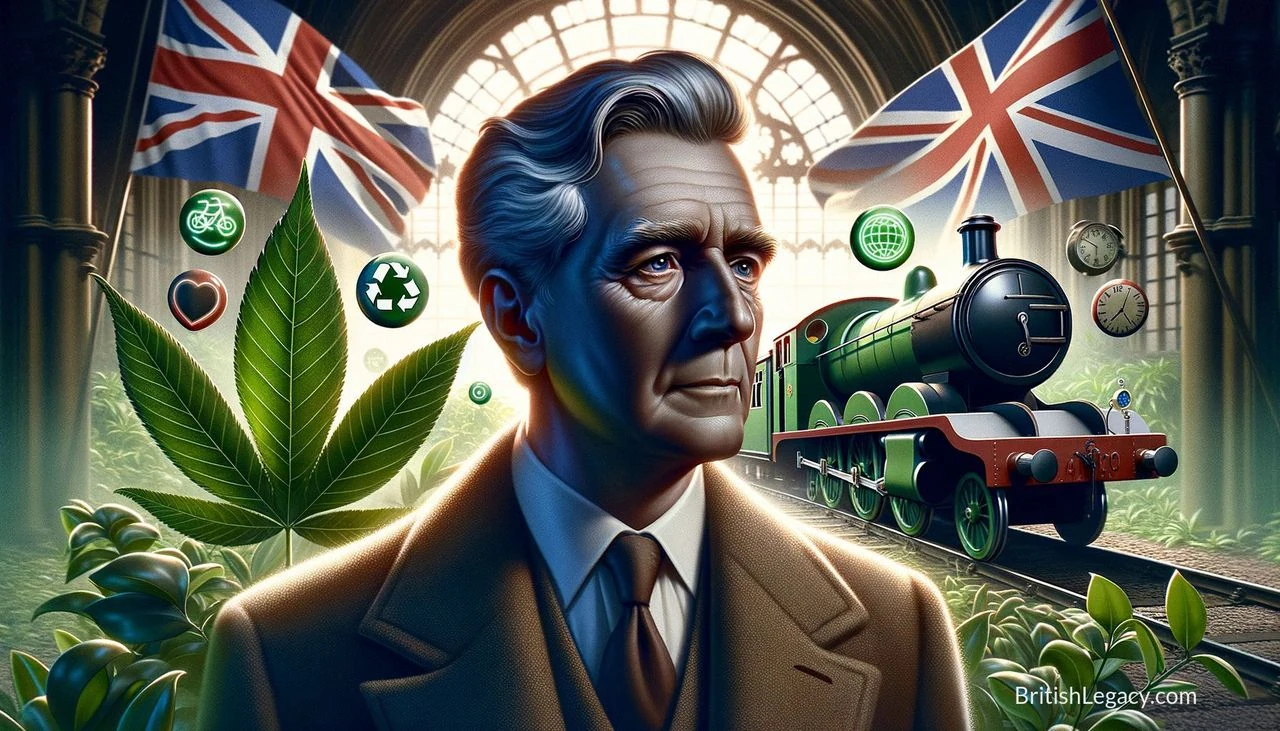
John Prescott’s career brought a former Merchant Navy steward and trade-union official into the centre of British government. As Deputy Prime Minister from 1997 to 2007, he became a prominent link between Tony Blair’s New Labour leadership and the party’s traditional working-class support. He also held senior responsibility for a broad policy brief, initially joining environment, transport and the regions in one department. His ambitions included fewer car journeys, stronger regulation of the railways and elected regional assemblies in England. Not all were realised: road traffic rose, and voters rejected the first referendum on regional assemblies. That record of both influence and limits is central to understanding his political legacy.
From Wales to the trade-union movement
Prescott was born in Prestatyn, Wales, on 31 May 1938. His father, John Herbert “Bert” Prescott, was a railway signalman, Labour councillor and justice of the peace. The family moved to Yorkshire when John was four, and later to the Ellesmere Port area. He failed the eleven-plus examination for grammar school and attended a secondary modern school. The experience became part of the public story of a politician who would later be seen as a representative of Labour’s traditional supporters, though Prescott himself described himself as “pretty middle class”.
He went to sea as a steward and waiter in the Merchant Navy, working for Cunard, and became active in the trade-union movement. After returning to the National Union of Seamen as a full-time official, he studied at Ruskin College, gaining a diploma in economics and politics in 1965. He completed a BSc in economics and economic history at the University of Hull in 1968. His route into politics combined work at sea, union organisation and further education.
In 1970, Prescott was elected Labour MP for Kingston upon Hull East, a seat he held for 40 years. He also served as a Member of the European Parliament from 1975 to 1979, when members were nominated by national parliaments. He held several shadow cabinet positions. At the 1993 Labour conference, his speech during the debate on “one member, one vote” helped swing support towards the reform of how parliamentary candidates were selected and reselected.
After John Smith’s death in 1994, Prescott stood for both the Labour leadership and deputy leadership. Tony Blair won the leadership contest; Prescott became deputy leader. He would become one of the most visible figures in Blair’s government, both because of his senior offices and because his background offered a contrast with the party’s increasingly modernising leadership.
Transport: ambition and the test of results
After Labour’s 1997 election victory, Blair appointed Prescott Deputy Prime Minister and Secretary of State for the newly created Department for the Environment, Transport and the Regions. The deputy premiership had no separate constitutional powers or salary; Prescott’s ministerial pay came from his departmental office. He was often a public link between Blair’s modernising leadership and Labour’s older traditions, and became an important conciliator in the sometimes difficult relationship between Blair and Gordon Brown.
Prescott pursued an integrated transport policy. In June 1997, he set himself a clear test: “I will have failed if in five years time there are not...far fewer journeys by car.” The 1998 transport White Paper set out the government’s approach to transport. By June 2002, however, car traffic had risen by 7 per cent. The gap between the stated goal and that outcome became a measure of the difficulty of changing travel patterns. Prescott nevertheless focused attention on the environmental consequences of car use and the need for effective public transport alternatives. The subsequent debate over road pricing developed in the context of that policy approach.
The railway presented another challenge. Prescott had opposed privatisation while Labour was in opposition, but accepted a policy of closer regulation rather than an immediate commitment to renationalise. In 1998 he called the privatised railway a “national disgrace”, prompting criticism from Transport Minister John Reid and from rail companies. Prescott promised a tougher approach and a “spring clean” of the industry. The transport White Paper that year argued that rail needed greater stability and certainty for effective planning. In 1999, he appointed Tom Winsor as Rail Regulator; Winsor shared Prescott’s view that the industry needed substantial institutional, operational, engineering and economic change to attract and retain private investment.
Transport policy also illustrated the friction between public commitments and political life. In 1999, Prescott and his wife travelled about 250 yards in an official chauffeur-driven car to the Labour conference, where he was due to speak about encouraging public transport. He defended the decision on security grounds and because his wife did not want her hair blown about. The episode became a pointed contrast with his public appeal for fewer car journeys.
Climate, housing and regional power
Prescott led the UK delegation during the successful negotiations on the Kyoto Protocol on climate change. In May 2006, Tony Blair asked him to work with the Foreign Secretary and Environment Secretary on developing the government’s post-Kyoto agenda. His environmental responsibilities also included a specific regulatory measure: in August 1999, he made regulations banning the use of chrysotile asbestos. From 24 November that year, products containing asbestos were banned in the United Kingdom.
As the minister responsible for local government, Prescott promoted regional government in England. He introduced regional assemblies made up of delegates from local authorities and other regional stakeholders to oversee the work of Regional Development Agencies. After Labour’s second election victory, he pressed for elected assemblies. The government held a referendum in the North-East in November 2004; 78 per cent voted against the proposal. Plans for elected regional assemblies were shelved. The result showed that a policy intended to distribute power could not proceed without public consent, and the first electoral test rejected it decisively.
Housing policy brought its own tensions. Rising household numbers, particularly in the South-East, increased pressure for new homes. Prescott proposed more housebuilding, primarily on brownfield sites but also on some undeveloped greenfield land, and was criticised for the effect on the Green Belt. In a radio interview in 1998, asked about development on the Green Belt, he replied: “It’s a Labour achievement, and we mean to build on it.” He had intended to convey that the government would extend Green Belt protection, and was distressed when the remark prompted laughter.
In northern England, Prescott approved the demolition of around 200,000 homes judged to be in “failing areas” under the Pathfinder regeneration scheme. Critics argued that renovation would have made better financial and community sense. The programme reflected the difficult choices within housing and regeneration policy: improving areas could involve decisions about existing homes and communities that remained contested.
Leaving government and public life
Prescott’s departmental responsibilities were transferred in May 2006, following revelations about his private life and a poor result for Labour in that year’s local elections. He remained Deputy Prime Minister and a Cabinet member, with other responsibilities, until 2007. At the 2006 Labour conference he apologised to the party for the bad press he had caused and confirmed that he would stand down as deputy leader when Blair left office. Prescott resigned as Deputy Prime Minister when Blair resigned as Prime Minister in June 2007; Harriet Harman succeeded him as Labour’s deputy leader.
After leaving the government, Prescott represented the UK in the Parliamentary Assembly of the Council of Europe, where he made opposition to slave labour a key issue. He retired as an MP at the 2010 general election and became a life peer as Baron Prescott of Kingston upon Hull. In 2012, he stood unsuccessfully to become Humberside’s first police and crime commissioner. In 2013, he resigned from the Privy Council in protest at delays to the introduction of press regulation. He briefly returned to political work in 2015 as an adviser to Labour leader Ed Miliband.
Prescott ceased to be a member of the House of Lords in July 2024 because of non-attendance in the preceding parliamentary session, while retaining his peerage. He died on 20 November 2024, aged 86. His family said that he had been living in a care home with Alzheimer’s disease. His funeral took place at Hull Minster on 30 January 2025.
Why John Prescott deserves a place in British Legacy
Prescott’s place in British political history rests on the combination of his experience and his responsibilities in government. A Merchant Navy steward, union official and MP for Kingston upon Hull East, he became Deputy Prime Minister and held a brief bringing transport, the environment and regional affairs together. He gave integrated transport policy a clear public test: fewer car journeys. Traffic rose instead, but the ambition made the relationship between travel, public transport and environmental impact a question by which ministers could be judged. His approach to rail regulation addressed the consequences of privatisation, while his role leading the UK delegation at Kyoto connected British policy-making with international climate negotiations. His asbestos regulations and housing programme further show the practical reach of his ministerial work.
His record should be remembered with its setbacks and controversies intact. The North-East referendum defeated his plan for elected regional assemblies; his housing policies drew criticism, and transport outcomes fell short of his stated goal. Those limits do not erase his influence. They show how difficult it is to translate a government’s aims into lasting changes in travel, housing or the distribution of power. Prescott also mattered within Labour: he helped secure a party-selection reform and represented a political tradition that Blair’s leadership needed to keep in view. For British Legacy, his story offers a specific account of how working life, trade-union experience and parliamentary politics met at the top of government—and how national policy is tested against everyday consequences.
Sources
Adapted in part from John Prescott by Wikipedia contributors, under CC BY-SA 4.0. Text has been edited and combined with the existing article; this adapted text is shared under the same licence. Contributor history.