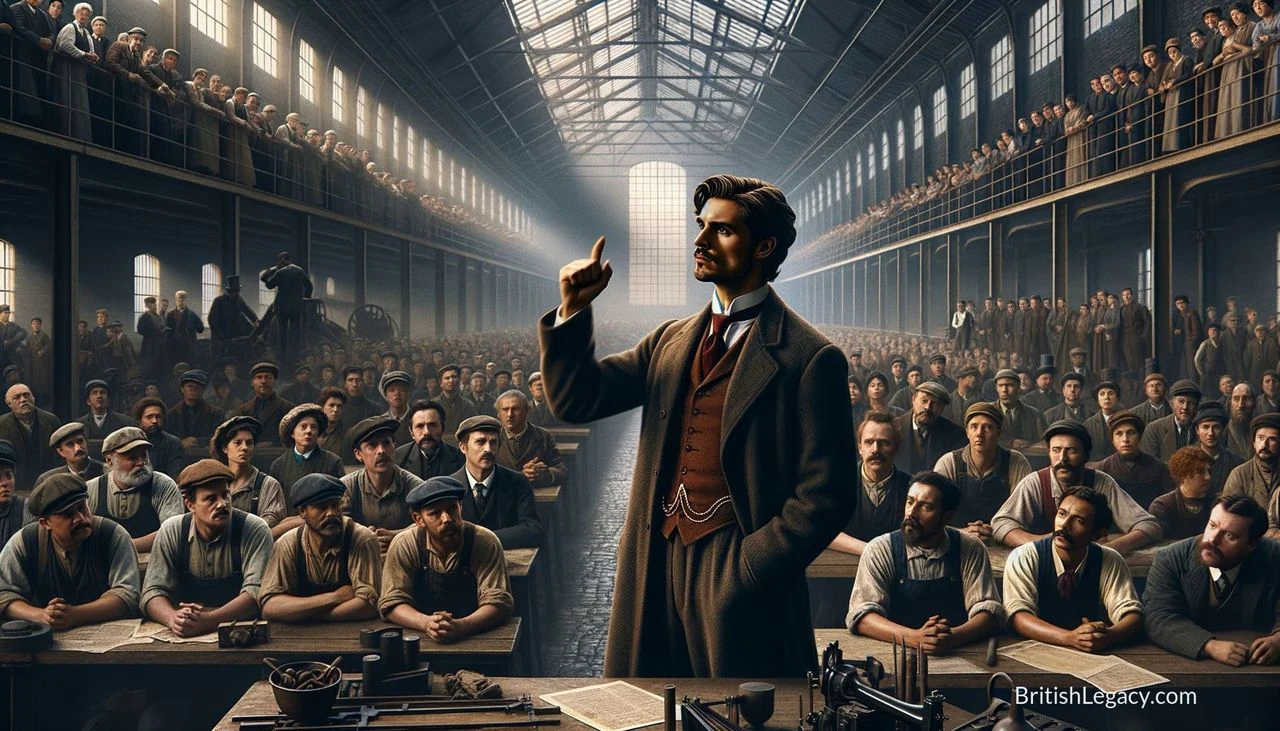
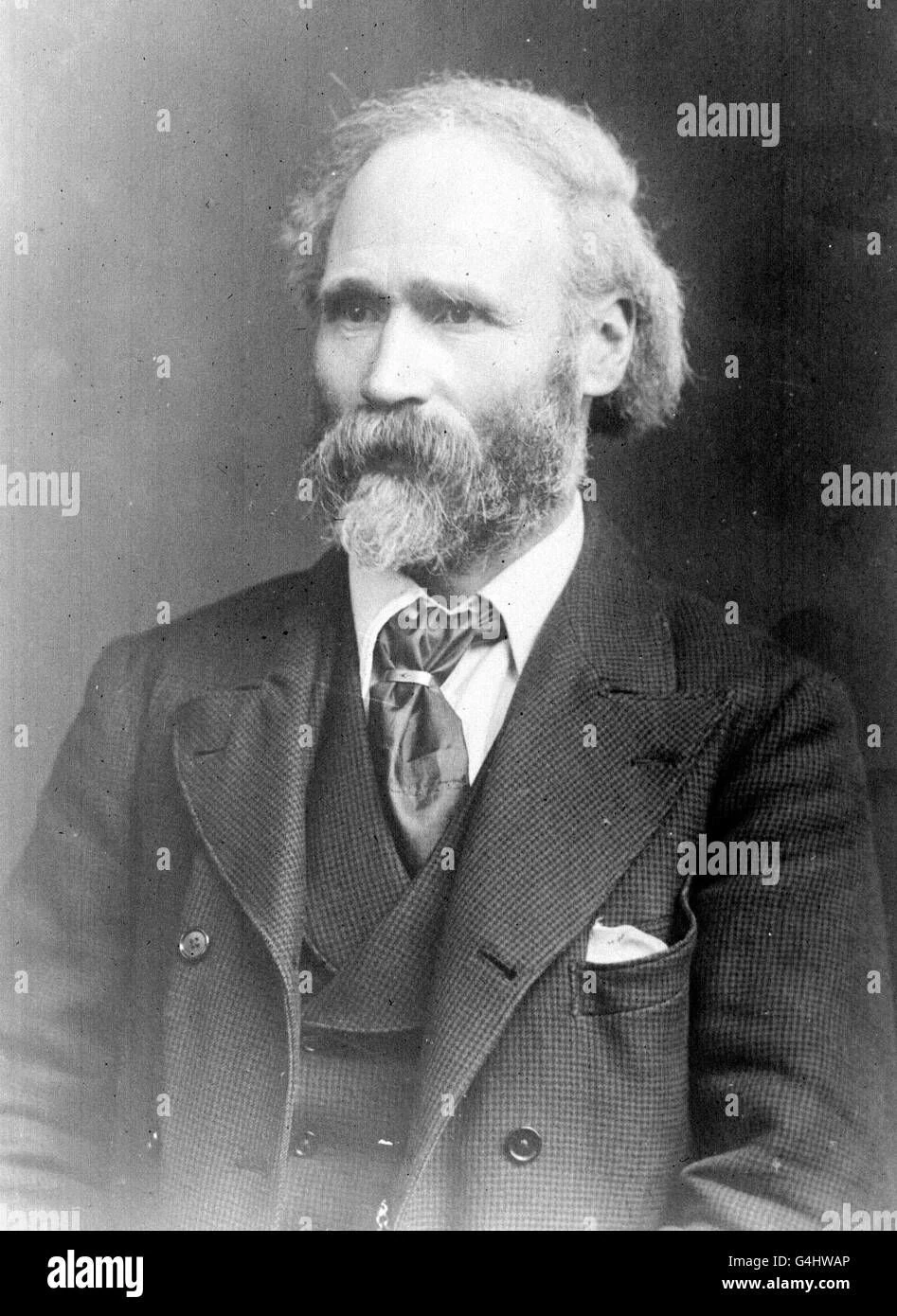
James Keir Hardie began work as a child in Lanarkshire and ended his life as one of the founders of the Labour Party. Between those points, he organised miners, addressed Parliament in a plain tweed suit and red tie, and argued that working people needed political representation independent of the Liberal Party. His route into politics was neither smooth nor inevitable: it ran through the coalfields, trade union organisation and successive attempts to build a party capable of turning labour grievances into parliamentary action.
A childhood shaped by work
Hardie was born on 15 August 1856 in Newhouse, Lanarkshire. His mother, Mary Keir, was a domestic servant; his stepfather, David Hardie, worked as a ship’s carpenter. The family later moved to Govan, where precarious employment and financial hardship shaped the household. Hardie’s first job, at seven, was as a message boy for the Anchor Line Steamship Company. Formal schooling became impossible, though his parents taught him to read and write at home.
A succession of low-paid jobs followed, including work in a brass-fitting shop, shipyards and a bakery. At ten, he went down the mines as a trapper, opening and closing a door to maintain the airflow for miners. He later worked as a pony driver and hewer, and spent time in quarries. He attended night school and taught himself shorthand. By his early twenties he was an experienced miner, but his growing involvement in workers’ meetings was taking him beyond the pit.
Preaching and temperance work helped him develop the public-speaking skills that became central to his union career. Miners chose him to represent their grievances, while mine owners came to regard him as an agitator. He and two younger brothers were blacklisted from local mining work. The experience gave his advocacy a practical focus: organisation was a way for workers to negotiate collectively when an individual miner had little leverage.
Organising miners and building a political alternative
In 1879, Hardie became a miners’ representative in southern Scotland and was appointed secretary at a national miners’ conference in Dunfermline. He organised during strikes in Lanarkshire and Ayrshire. Both stoppages ended without miners immediately winning their demands, and the fledgling union lacked strike funds. During the Lanarkshire dispute, Hardie and his wife, Lillie Wilson, ran a soup kitchen from their home. The work demonstrated the practical demands of organising as well as the limits faced by workers with little financial protection.
Hardie moved into full-time union work and, in 1886, became organising secretary of the Ayrshire Miners’ Union. He also wrote for local newspapers and launched The Miner in 1887. Initially a supporter of the Liberals, he grew convinced that the party would not deliver the radical reforms he thought workers needed. He stood as an independent candidate at a Mid Lanarkshire by-election in 1888, then helped form the Scottish Labour Party that year.
His first election to the House of Commons came in 1892, when he won West Ham South as an independent candidate. He was described at the time as a Labour or “Liberal and Labour” candidate, rather than as the first Labour MP. In Parliament he rejected the expected black frock coat and top hat, wearing a tweed suit and red tie instead. The choice attracted press attention, but his priorities were substantive: he advocated a graduated income tax, free schooling, pensions, the abolition of the House of Lords and votes for women.
Hardie helped establish the Independent Labour Party in 1893. He lost his West Ham South seat in 1895, following a period in which his criticism of the monarchy caused controversy. He continued organising and speaking at public meetings. In 1900, he helped bring trade unions and socialist groups together in the Labour Representation Committee, which later became the Labour Party. He was elected for Merthyr Tydfil that year, alongside Richard Bell, who won in Derby. The committee’s formation was a collective undertaking, not the creation of a finished party by Hardie alone.
Parliamentary leadership, women’s suffrage and war
After Labour’s gains in the 1906 general election, Hardie became the party’s first parliamentary leader, serving from 1906 to 1908. The party had by then adopted the name Labour. His leadership was short, and disagreements over how the parliamentary group should respond to party conference decisions exposed tensions within the new movement. At Labour’s first annual conference in 1907, Hardie opposed a proposed restriction on MPs’ freedom to support legislation extending the vote to women. He argued that women’s exclusion from citizenship was unjust. The dispute was resolved by allowing him to vote as he wished; he resigned the leadership the following year and Arthur Henderson succeeded him.
Hardie continued campaigning for women’s suffrage and developed a close relationship with Sylvia Pankhurst. He also supported self-rule for India and an end to racial segregation in South Africa. His positions and arguments could be complicated: support for equal rights did not always translate into consistent statements on race. The record deserves neither a simplified portrait nor an unqualified claim that he was a champion of every form of equality.
A pacifist, Hardie opposed the First World War and sought international action to stop it, including a general strike. His anti-war speeches met heckling and his position was unpopular, including among Labour colleagues. He supported conscientious objectors and continued addressing demonstrations. Yet his wartime statements were not simply a demand for an immediate end to the fighting: in a 1914 article, he wrote that stopping the war before German forces had been driven back would be “foolish in the extreme”. His opposition to the war therefore needs to be understood through his recorded arguments, not reduced to a single slogan.
After a series of strokes, Hardie died of pneumonia in a Glasgow hospital on 26 September 1915, aged 59. He had been attempting to organise a pacifist general strike. His death closed a life spent moving between mining communities, union organisation and parliamentary politics, but the institutions he helped build outlasted him.
What his political legacy can—and cannot—claim
The Labour Representation Committee formed in 1900 was renamed the Labour Party in 1906 and became one of the United Kingdom’s principal political parties. That development was not Hardie’s work alone: unions, socialist groups, parliamentary colleagues and later generations all shaped the party. His importance lies in helping make an independent labour political organisation possible and in serving as its first parliamentary leader. His campaigns for votes for women, workers’ representation and social reform formed part of that wider political history.
Hardie did not establish the National Health Service, the welfare state or later education reforms. Those institutions belong to subsequent political histories, and attributing them directly to him would overstate what the evidence establishes. A more grounded account of his influence follows the work he actually did: organising miners, helping to form the Independent Labour Party and the Labour Representation Committee, and arguing that Parliament should hear claims that established parties had neglected.
Why Keir Hardie deserves a place in British Legacy
Hardie’s place in British Legacy rests on a specific political achievement: he helped create durable routes from workplace organisation to representation in Parliament. He began as a child worker and miner, became an organiser chosen by other miners, and helped build organisations that could bring trade unions and socialist groups into electoral politics. The Labour Representation Committee’s creation in 1900, its development into the Labour Party, and Hardie’s subsequent role as its first parliamentary leader mark a significant change in British political life. Working people had an organised political vehicle of their own, rather than relying solely on established parties to speak for them.
His record also matters because it shows the demands and disagreements involved in that change. Hardie advocated votes for women, campaigned for miners and opposed the First World War, but his arguments and political judgements were not free of tension. Recognising those complexities makes his contribution more intelligible, not less valuable. The benefit of remembering him is not to assign him credit for reforms enacted long after his death, but to understand the groundwork: union organisation, parliamentary advocacy and the effort to make workers’ interests a sustained part of national politics. His legacy belongs to Scotland, to the British coalfields and to the broader history of democratic representation across the United Kingdom.
Sources
Keir Hardie — Wikipedia, revision 1372865524
Adapted in part from Keir Hardie by Wikipedia contributors, under CC BY-SA 4.0. Text has been edited and combined with the existing article; this adapted text is shared under the same licence. Contributor history.